
A Hermit of Carmel, and Other Poems
George Santayana
THE CLASSIC COLLECTION · 1923
Scepticism and Animal Faith (1923) is a later work by Spanish-born American philosopher George Santayana. He intended it to be "merely the introduction to a new system of philosophy," a work that would later be called The Realms of Being, which constitutes the bulk of his philosophy, along with The Life of Reason.
Scepticism is Santayana's major treatise on epistemology; after its publication, he wrote no more on the topic. His preface begins humbly, with Santayana saying:
Here is one more system of philosophy. If the reader is tempted to smile, I can assure him that I smile with him...I am merely trying to express for the reader the principles to which he appeals when he smiles.
Moreover, he does not claim philosophical supremacy: I do not ask anyone to think in my terms if he prefers others. Let him clean better, if he can, the windows of his soul, that the variety and beauty of the prospect may spread more brightly before him.
While Santayana acknowledges the importance of skepticism to philosophy, and begins by doubting almost everything; from here, he seeks to find some kind of epistemological truths. Idealism is correct, claims Santayana, but is of no consequence. He makes this pragmatic claim by asserting that men do not live by the principles of idealism, even if it is true. We have functioned for eons without adhering to such principles, and may continue, pragmatically, as such. He posits the necessity of the eponymous "Animal Faith", which is belief in that which our senses tell us; "Philosophy begins in medias res", he assures us at the beginning of his treatise. (This summary is from Wikipedia.)
Introduction adapted from the source catalogue; source summaries may be automatically generated.
Free to read · English · 97,423 words · No account needed
MAKE TIME FOR A GOOD BOOK
On by default. Untick to stop anonymous reading totals. Each page counts after 10 seconds in view. How this works.
Anonymous counting is on unless you have switched it off.
I have already accepted the belief in memory; indeed, without accepting it I could not have taken the first step forward from the most speechless scepticism. But since such acceptance is an act of faith, and asserts transitive or realistic knowledge, I will pause to consider somewhat more explicitly what the cognitive claims of memory are, on which all human beliefs are reared.
The paradox of knowing the absent is posited in the past tenses of the verb; it is the paradox of knowledge itself, since intuition of essence is not properly called knowledge; it is imagination, since the only object present is then non-existent and the description of it, being creative, is infallible. The claim to knowledge everybody understands perfectly when he makes it, which he does whenever he perceives, remembers, or believes anything; but if we wish to paraphrase this claim reflectively, we may perhaps say that in it attention professes to fall on an object explicitly at a distance, being framed by other nearer objects (though at some distance themselves) upon which attention falls only virtually. If this foreground or frame were absent altogether, I should live in the pictured past thinking it present; memory would overleap its memorial office and become a dream. It would cease to be liable to error, being no longer a report about anything else; but it would become an idle entertainment, which a moralist might call an illusion, on the ground that its images were irrelevant to the practice of rational life, and its emotions wasted. But it would not misrepresent anything, since in ceasing to be a memory it would have abandoned all cognitive claims.
A frame or foreground is accordingly indispensable to the projection which renders a present image a vision of some past fact: I must stand here to point there. Yet if my present station were explicitly perceived, if the whole immediate datum were focussed equally in thought, the picture would seem flat and the perspective merely painted upon it, as upon a cheap drop-curtain in a theatre. It would destroy the claim and, if you like, the illusion of memory to remember that I am remembering; for then I should be considering myself only, and only the present, whereas in living remembrance I am self-forgetful, and live in the present thinking only of the past, and observe the past without supposing that I am living in it. My recollections, my souvenirs, are only essences which I read as I should the characters on this page, not viewing them contemplatively in their own category as forms present in their entirety, but accepting them readily (as in all knowledge) as messengers, as signs for existences of which they furnish but an imperfect description, for which I am perhaps hopeful of substituting a better view. In lapsing into the past I seem to myself to be entering a realm of shadows; and a chief part of my wakefulness, which prevents me from actually dreaming that I am living in that other world, is precisely this eagerness of mine to see better, to remember all, to recover the past as it really was; and the elusive and treacherous character of such images as come to me troubles me seriously, as a mist distorting and shutting off the truth. My heart, as it were, is fixed on that removed reality, and I know that my eyes see it but imperfectly. Yet if my heart had intuition now of what that reality once was, recollection would be superfluous, since I should possess all it could bring me before it brought it; and on the other hand, if my heart did not know the reality, how could I reject, criticise, or approve the images that professed to restore its forgotten aspects? Obviously what I am calling the heart, which is the psyche, is blind in herself: imagination is her only light, her only language; but she is a prior principle of choice and judgement and action in the dark; so that when the light shines in that darkness, she comprehends it, and feels at once whether the ray falls on the object towards which she was groping, or on some irrelevant thing. The psyche, in the case of memory, contains all the seeds, all the involutions and latent habits, which the past left there in passing; any one of these may be released freely, or only irritated and summoned to activity without being sufficiently fed, or only to be at once thwarted and contradicted; and the sentiment of this prosperous or mutilated rendering of experience, when memory proffers its images, enables the psyche to judge these images to be true or false, adequate or inadequate, without possessing any other images with which to compare them.
Your reading position is saved on this browser. Take it to another device with a library code. Reading pages adapt to text, rather than matching a printed edition.
George Santayana

George Santayana
George Santayana
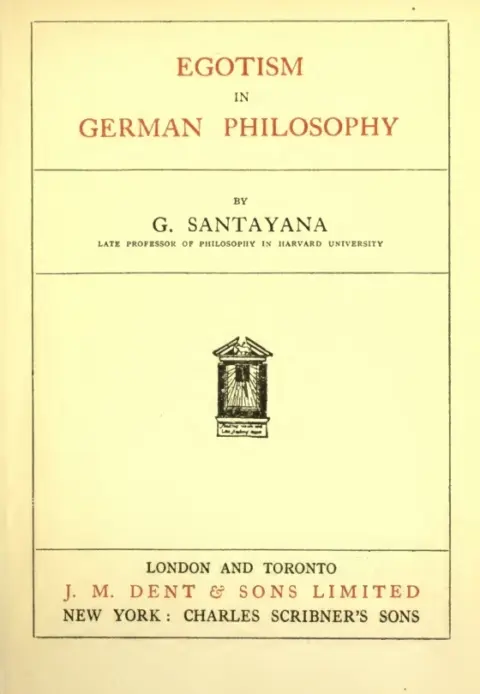
George Santayana
BEHIND THE BOOK
This eBook is for the use of anyone anywhere in the United States and most other parts of the world at no cost and with almost no restrictions whatsoever. You may copy it, give it away or re-use it under the terms of the Project Gutenberg License included with this eBook or online at www.gutenberg.org. If you are not located in the United States, you will have to check the laws of the country where you are located before using this eBook. Read the source licence.
The original source file, including credits and licence, is retained by this library. Request an original-format copy at no charge. Please include the book title and Project Gutenberg identifier #77155.
KEEP YOUR CURIOSITY GOING

Charles G. (Charles Griffith) Ross
Hannah Webster Foster

Emily Lawless
Edwin Hamlin Carr

Charles De Lano Hine
Andrew Ure