
A Hermit of Carmel, and Other Poems
George Santayana
THE CLASSIC COLLECTION · 1923
Scepticism and Animal Faith (1923) is a later work by Spanish-born American philosopher George Santayana. He intended it to be "merely the introduction to a new system of philosophy," a work that would later be called The Realms of Being, which constitutes the bulk of his philosophy, along with The Life of Reason.
Scepticism is Santayana's major treatise on epistemology; after its publication, he wrote no more on the topic. His preface begins humbly, with Santayana saying:
Here is one more system of philosophy. If the reader is tempted to smile, I can assure him that I smile with him...I am merely trying to express for the reader the principles to which he appeals when he smiles.
Moreover, he does not claim philosophical supremacy: I do not ask anyone to think in my terms if he prefers others. Let him clean better, if he can, the windows of his soul, that the variety and beauty of the prospect may spread more brightly before him.
While Santayana acknowledges the importance of skepticism to philosophy, and begins by doubting almost everything; from here, he seeks to find some kind of epistemological truths. Idealism is correct, claims Santayana, but is of no consequence. He makes this pragmatic claim by asserting that men do not live by the principles of idealism, even if it is true. We have functioned for eons without adhering to such principles, and may continue, pragmatically, as such. He posits the necessity of the eponymous "Animal Faith", which is belief in that which our senses tell us; "Philosophy begins in medias res", he assures us at the beginning of his treatise. (This summary is from Wikipedia.)
Introduction adapted from the source catalogue; source summaries may be automatically generated.
Free to read · English · 97,423 words · No account needed
MAKE TIME FOR A GOOD BOOK
On by default. Untick to stop anonymous reading totals. Each page counts after 10 seconds in view. How this works.
Anonymous counting is on unless you have switched it off.
Memory deploys all the items of its inventory at some distance, yet sees them directly, by a present glance. It makes no difference to the directness of this knowledge how great the distance of the object may be in the direction of the past. So also in foresight: I foresee my death as directly as I do my dinner, not necessarily more vaguely, and far more certainly. Memory and prophecy do in time what perception does in space; here too the given essence is projected upon an object remote from the living psyche which is the organ of the intuition and of the projection. The object is indeed not remote from the mind, if by mind I understand the intellectual energy of memory, prophecy, or perception reaching to that object, and positing it there in intent; but it is remote from the psyche, from the material agent, from me here and now. A little less or a little more interval of time or space—and there is always an interval—does not render less ocular and immediate the description of a removed event by the essences it brings before me. I see a peewit in the sky as directly as I see the watch in my hand, and I hear his note as easily as I do the ticking of the watch against my ear. So I remember the Scotch kilt I wore when a child as directly as the umbrella I carried this morning. The difficulty in extending the range of knowledge is physical only; I may be near-sighted; and the mechanism of memory may break down, or may be choked with parasitic fancies as it grows old.
In memory it is sometimes possible to reproduce almost exactly some earlier scene or experience. If the psyche happens to run through the same process twice—and being material she is compacted of habits—she will twice have exactly the same intuition; but this precise repetition of the past, far from constituting a perfect memory, excludes memory. The sentiment of pastness, the receding perspective in which memory places its data, will be wanting; and this perfect recovery of experience will not be remembrance. Nor is any fulness or precision in the image of the past necessary to the truth of memory. The nerve of recollection lies elsewhere, in the projection of the given essence—which may be vague or purely verbal—to a precise point or nucleus of relations in the natural past. Memory is genuine if the events it designates actually took place, and conformed to the description, however brief and abstract, which I give of them. Pictorial fulness and emotional reversion to the past are not important, and they are found most often at unimportant points. Healthy memory excludes them, and for two reasons. The bodily reaction to the old environment is now hardly possible, and certainly not appropriate; and therefore, even if the neurogram in the psyche could spring again into perfect life, it would bring a dream into being, an interruption to life in the present, rather than a sober memory filling the present appropriately with a long perspective. The second reason is that the neurogram is likely to have been modified by the accidents of nutrition and waste intervening, so that the old movement cannot really be repeated, and the essence called up will not really be the original one. That it may seem to be the original, in its very life, is nothing to the purpose. How, if vivid, should it not seem so, when no other memory exists to control it? But if I can control it by circumstantial evidence, I usually find that this specious recovery of past experience is a cheap illusion. If the reversion to the past seems complete, it is not because the facts are remembered accurately, but because some subtle influence fills me with a sentiment wholly foreign to my present circumstances, and redolent of a remote past; and that dramatic shift seems to lift all the details of the picture out of the perspective of memory into the foreground of the present. It is the fancy that comes forward, producing a waking dream, not the memory that sinks back into an old experience. The scent of a cedar chest in which old finery is kept may carry me back vividly to my earliest childhood; but the images that now seem to live again will be creatures of my present sophisticated and literary fancy; I shall see them romantically, not with the eyes of a child. I may truly recover knowledge of long-forgotten facts, but I shall not re-enact a long-past experience. And what need is there? A miraculous identity may be felt emotionally even when the two descriptions of the identical thing differ in every sensible term, as happens in metaphors, in myths, in myself as body and as mind, in idolatry, or in the doctrine—which expresses a mystical experience—of transubstantiation. In such cases the vital reaction, the deeper readjustment of the psyche, to the two appearances is the same; therefore I feel that the thing appearing in the two ways is identical, that the one is really the other, however diverse the two sets of symbols may be.
Your reading position is saved on this browser. Take it to another device with a library code. Reading pages adapt to text, rather than matching a printed edition.
George Santayana

George Santayana
George Santayana
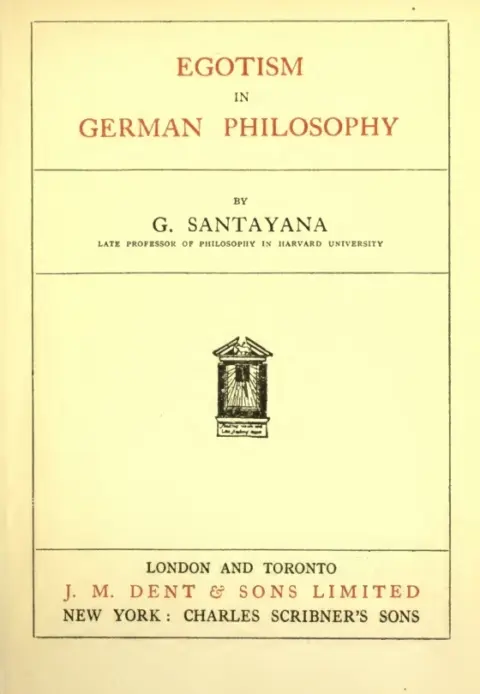
George Santayana
BEHIND THE BOOK
This eBook is for the use of anyone anywhere in the United States and most other parts of the world at no cost and with almost no restrictions whatsoever. You may copy it, give it away or re-use it under the terms of the Project Gutenberg License included with this eBook or online at www.gutenberg.org. If you are not located in the United States, you will have to check the laws of the country where you are located before using this eBook. Read the source licence.
The original source file, including credits and licence, is retained by this library. Request an original-format copy at no charge. Please include the book title and Project Gutenberg identifier #77155.
KEEP YOUR CURIOSITY GOING

Charles G. (Charles Griffith) Ross
Hannah Webster Foster

Emily Lawless
Edwin Hamlin Carr

Charles De Lano Hine
Andrew Ure