THE CLASSIC COLLECTION✦Picture playsCLASSIC FREE BOOKS
Picture plays
Marguerite Merington
THE CLASSIC COLLECTION · 1906
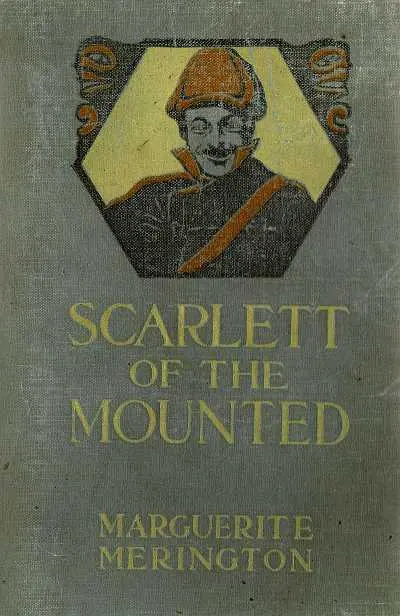
"Scarlett of the Mounted" by Marguerite Merington is a novel written in the early 20th century. The story is set in the rugged and tumultuous world of a mining camp, where lawlessness and moral complexities intermingle. The plot is centered around Sergeant Scarlett, a member of the Mounted Police, as he navigates the challenges of enforcing law and order among the rough miners and the enchanting women who arrive in the camp, especially Evelyn Durant, the daughter of a what appears to be a wealthy miner whose real circumstances may prove otherwise. At the start of the book, we meet Parson Maclane as he approaches the chaotic scene at Lost Shoe Creek, where he encounters a group of unruly miners. The tone is lively and raucous, with playful banter among the miners that gives way to darker undertones of vice and temptation. Scarlett is introduced amidst a confrontation with Bully Nick and a colorful cast of characters, including Evelyn's father, Matthew Durant, who is revealed to be chasing a false fortune. As the opening unfolds, the reader is drawn into a world where the characters are struggling with their moral compass in the face of desire, reputation, and the harsh realities of their environment, setting the stage for conflict and character development.
Introduction adapted from the source catalogue; source summaries may be automatically generated.
Free to read · English · 38,437 words · No account needed
MAKE TIME FOR A GOOD BOOK
On by default. Untick to stop anonymous reading totals. Each page counts after 10 seconds in view. How this works.
Anonymous counting is on unless you have switched it off.
Feeling that on her father's return she could requite the obligation a thousandfold, Evelyn consented to remain with her party as guests of Perdu's Grand Hotel while the shack at Lost Shoe Creek was being made ready for their tenancy.
Perdu, lying on a large lake of the same name, is port of entry, and base of supplies, to the goldfields beyond. Being at that time in the third year of its existence it had a highly developed social and commercial life. For in its initial season a camp is likely to be a bedlam of frenzied maniacs shrieking, Gold, gold, gold! The second season witnesses a slump proportioned to the inflated values of its predecessor. But if it weathers to a third, then some sort of poise is attained, as steady industries develop and existence seeks a normal plane. The fancy-women who flock wherever the nuggets are thickest, now segregate themselves in a secluded quarter of the township; married men send for their families, while the unblessed bachelor whistles "The Girl I Left Behind Me," or pays attention to the schoolteacher. On all sides one sees the effort, sometimes pitiful, always human and worthy, from the harsh matrix of the wilderness to wrest a home. And then follow the petty complexities of a miscalled civilization. To Evelyn's surprise, after the first warm tender of hospitality, she encountered the same restricted social conditions in Perdu that obtain in villages on the "outside," as the world beyond the mountains in northern latitudes is termed. Women left cards on her; heads of rival cliques warned her one against the other; the wife of the principal grocer planned a tea in her honor.
On a brilliant summer morning, without cloud or shadow, mountains and valleys alike lying exposed to a broadside of sun that had been warming to its work since four hours after midnight, Evelyn set out to return the visit of the town surveyor's wife. A short cut through the clustered willow bushes brought her to the back door of their cabin, where she came upon the hostess at her washtubs, while from the doorstep the town surveyor was cleaning his teeth publicly. Wholly unembarrassed, the good people greeted their visitor with cordiality, and conducted her into the living-room, where babies, cot beds and cooking commingled with such observances of decency and taste as a woman of refinement, no matter how overworked, seems somehow generally able to contrive. In point of cultivation, so Evelyn soon discovered, her new acquaintances were fully her equal. Delighted as they professed themselves to be that her stay would be of long duration, yet to the plans she outlined for her projected improvement of the district they showed an almost marked indifference. When she dropped hints about the free library she intended to establish, Mr. Grayson began quite inappositely to brag of having made more money the previous winter by lumbering than in the way of his profession, owing to the fact that "up here, thank God! no one, man or woman, loses caste by honest labor of any sort." When she alluded to the art furniture she thought of importing for her domicile, Mrs. Grayson cautioned her to be very careful of her lamp chimneys, the commonest kind costing fifty cents at local stores, because, so the storekeepers said, of the exorbitant freight rates that prevailed. Also she advised Evelyn to start right in and do her own washing, as the local laundries charged something over four dollars for a dozen simple pieces. When Miss Durant mentioned the theatre she was arranging to have built, the opera troupe with which she already was negotiating for a series of performances to beguile the long Klondike winter, the Graysons merely said, almost with sarcasm, "How nice!" adding that the camp contrived to get up some fair entertainments of its own in the hall over the truckman's stable. Coming to the conclusion that they were jealous lest her advent should undermine the social prestige which, so Hastie had informed her, they enjoyed, Evelyn rose to take her leave and, kindly wishful to put them at their ease, admired the babies, the bearskin rugs, the horns of mountain sheep and goat upon the wall, the view, the two geraniums in pots upon the window-sill; accepted an invitation to a wild-strawberry picnic, offered to teach them bridge, and departed in a glow of self-gratulation at her tact in dealing with the envious and small-minded.
Your reading position is saved on this browser. Take it to another device with a library code. Reading pages adapt to text, rather than matching a printed edition.
Marguerite Merington
Marguerite Merington
BEHIND THE BOOK
This eBook is for the use of anyone anywhere in the United States and most other parts of the world at no cost and with almost no restrictions whatsoever. You may copy it, give it away or re-use it under the terms of the Project Gutenberg License included with this eBook or online at www.gutenberg.org. If you are not located in the United States, you will have to check the laws of the country where you are located before using this eBook. Read the source licence.
The original source file, including credits and licence, is retained by this library. Request an original-format copy at no charge. Please include the book title and Project Gutenberg identifier #37949.
KEEP YOUR CURIOSITY GOING
Coulson Kernahan

Maurice Baring
Frances Wright
Cécile Tormay

Frederic Jesup Stimson

W. H. P. (William Henry Pope) Jarvis