THE CLASSIC COLLECTION✦An outlaw’s diary: the CommuneCLASSIC FREE BOOKS
An outlaw’s diary: the Commune
Cécile Tormay
THE CLASSIC COLLECTION · 1896
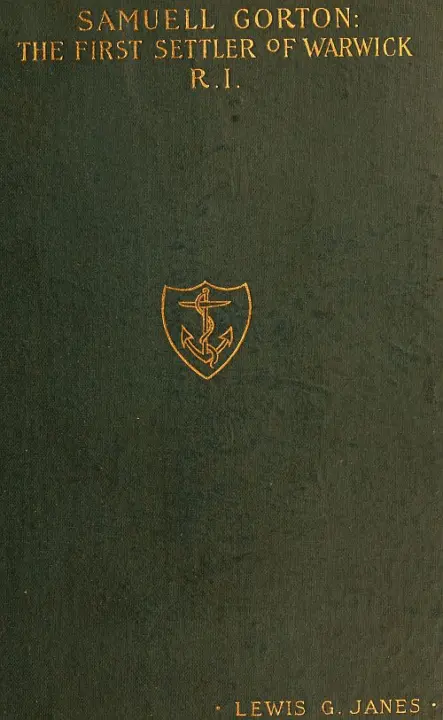
"Samuell Gorton: A Forgotten Founder of Our Liberties; First Settler of Warwick" by Lewis G. Janes is a historical account written in the late 19th century. The book delves into the life and contributions of Samuell Gorton, a significant yet overlooked figure in early American history, particularly regarding the establishment of civil liberties and religious freedom in Rhode Island. The narrative explores Gorton’s journey from England to New England and highlights his role as a founder of the town of Warwick and a champion of "soul liberty." The opening of this work introduces Gorton as a prominent figure in the early development of Rhode Island, emphasizing the challenges he faced and the injustices he endured while advocating for individual freedoms. Janes outlines Gorton's early life, his contentious interactions with colonial authorities, and his search for a place where he could live freely according to his beliefs. As the narrative begins, it hints at Gorton’s intellectual rigor, as he asserts his rights and defies the political constraints of his time, setting the stage for the critical examination of his impact on establishing foundational liberties in a fledgling America.
Introduction adapted from the source catalogue; source summaries may be automatically generated.
Free to read · English · 19,547 words · No account needed
MAKE TIME FOR A GOOD BOOK
On by default. Untick to stop anonymous reading totals. Each page counts after 10 seconds in view. How this works.
Anonymous counting is on unless you have switched it off.
This is substantially the conclusion of Judge Brayton. (Defence of
Samuel Gorton).
Footnote 67:
That Gorton believed in civil government also clearly appears in his correspondence relating to the Quakers, where he expressly dissents from their views about government.
Footnote 68:
Vide Nowell, Rawson, Winthrop, Winslow, Morton, et al.
Footnote 69:
“The Father was never knowne nor is he knowable but in Christ.” (Commentary on the Lord’s Prayer).
Footnote 70:
The quotations, unless otherwise indicated, are from Gorton’s unpublished Commentary on the Lord’s Prayer. (Commentary, p. 101).
Footnote 71:
“Though no church was formed in connection with his ministrations, he exercised a powerful influence upon the religious views of the Colony.” History of Warwick, p. 301. By Orris Payson Fuller, B. A.
Footnote 72:
He also differed with the Friends of his day in his views about
government.
Footnote 73:
This is strongly emphasized in his Commentary on the Lord’s Prayer.
Footnote 74:
Commentary Mss., p. 11. See, also, p. 14, et seq., as well as “Simplicities Defence,” (R. I. Hist. Soc. Ed.) page 183.
Footnote 75:
Commentary Mss., page 57.
Footnote 76:
Dr. Fiske is in error in classing him as a follower of Anne Hutchinson. His theology was original and peculiarly his own. (Commentary Mss., p. 58).
Footnote 77:
Commentary Mss., p. 90.
Footnote 78:
It is hardly necessary to say that neither Gorton or Parker held this doctrine in any materialistic sense. It was a lofty philosophical conception that the entire creative energy was expressed in the divine nature, to conceive which as purely masculine was inadequate, anthropomorphic and irrational.
Footnote 79:
The first charge against Roger Williams, on which he was banished from Massachusetts Bay, accused him of teaching “That wee have not our land by Pattent from the King, but that the natives are the true owners of it and that wee ought to repent of such receiving it by Pattent.” Gorton agreed with Williams as to the necessity of purchase from the Indians, but thought the charter also necessary.
Footnote 80:
John M. Mackie, in “Sparks’s American Biography.”
Samuel Eddy, Secretary of State of Rhode Island, circum 1820, says of Gorton: “From the first establishment of the government he was almost constantly in office, and during a long life there is no instance of record to my knowledge of any reproach or censure cast upon him, no complaint of him, although history furnishes abundance of evidence that there were no lack of enemies to his person, principles, or property. This can hardly be said of any other settler of the Colony of any standing.” Quoted in Judge Brayton’s “Defence of Samuel Gorton.”
Footnote 81:
Vide Winthrop’s Letters, the Portsmouth charges, etc.
Footnote 82:
Your reading position is saved on this browser. Take it to another device with a library code. Reading pages adapt to text, rather than matching a printed edition.
BEHIND THE BOOK
This eBook is for the use of anyone anywhere in the United States and most other parts of the world at no cost and with almost no restrictions whatsoever. You may copy it, give it away or re-use it under the terms of the Project Gutenberg License included with this eBook or online at www.gutenberg.org. If you are not located in the United States, you will have to check the laws of the country where you are located before using this eBook. Read the source licence.
The original source file, including credits and licence, is retained by this library. Request an original-format copy at no charge. Please include the book title and Project Gutenberg identifier #52573.
KEEP YOUR CURIOSITY GOING
Cécile Tormay

Moritz Busch
John L. Ransom
Frances Wright
Cécile Tormay

Mabel Potter Daggett