THE CLASSIC COLLECTION✦An outlaw’s diary: the CommuneCLASSIC FREE BOOKS
An outlaw’s diary: the Commune
Cécile Tormay
THE CLASSIC COLLECTION · 1896
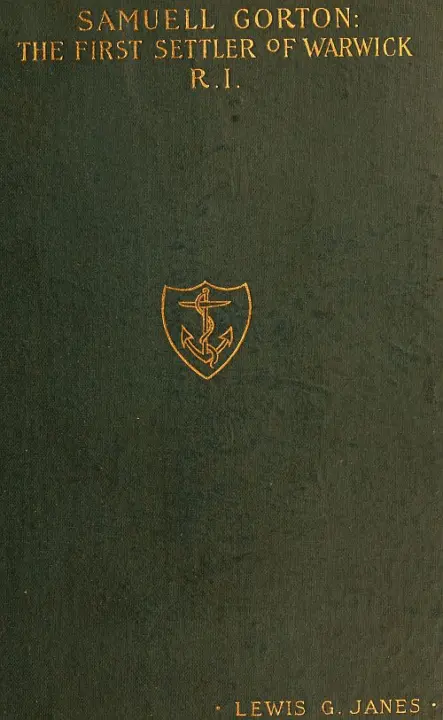
"Samuell Gorton: A Forgotten Founder of Our Liberties; First Settler of Warwick" by Lewis G. Janes is a historical account written in the late 19th century. The book delves into the life and contributions of Samuell Gorton, a significant yet overlooked figure in early American history, particularly regarding the establishment of civil liberties and religious freedom in Rhode Island. The narrative explores Gorton’s journey from England to New England and highlights his role as a founder of the town of Warwick and a champion of "soul liberty." The opening of this work introduces Gorton as a prominent figure in the early development of Rhode Island, emphasizing the challenges he faced and the injustices he endured while advocating for individual freedoms. Janes outlines Gorton's early life, his contentious interactions with colonial authorities, and his search for a place where he could live freely according to his beliefs. As the narrative begins, it hints at Gorton’s intellectual rigor, as he asserts his rights and defies the political constraints of his time, setting the stage for the critical examination of his impact on establishing foundational liberties in a fledgling America.
Introduction adapted from the source catalogue; source summaries may be automatically generated.
Free to read · English · 19,547 words · No account needed
MAKE TIME FOR A GOOD BOOK
On by default. Untick to stop anonymous reading totals. Each page counts after 10 seconds in view. How this works.
Anonymous counting is on unless you have switched it off.
The date ordinarily assigned to this patent, “Aug. 19, 1644,” must be erroneous. It was probably granted two years later, when Gorton was in England.
Footnote 45:
The manner in which the authorities of Massachusetts Bay recognized this safe-conduct was characteristic. Under date of “13th May, 1648,” the following entry appears in the Colonial Records: “Vppon the request of the Earle of Warwicke, the Court allowes Samuell Gorton, now a shipboard, one full weeke after the date hereof, for the transportatiō of himselfe & his goods through or iurisdictiō to the place of his dwelling, he demeaning himselfe inoffensively, accordinge to the contents of the Ŝd earle’s l’re, & that the marshals or some of them shall shew him a coppie of this order, or fix it to the maine mast of the shippe in which he is.”—Mass. Records, Vol. III, p. 127.
Footnote 46:
Warwick was not named in the Charter, as the town was not organized when it was granted; but it united with the other towns in 1647, in the first General Assembly of the entire Colony.
Footnote 47:
These were the names given the contesting parties of white men by the Indians. The latter, Roger Williams says, means “coat wearers,” which leads Dr. Fiske to query whether the Gortonists habitually went in their shirt sleeves!
Footnote 48:
Peage, or wampum, was legal tender in Rhode Island until 1662, and doubtless still passed current among the Indians. The bill of sale bears the name of Pomham’s son, but in its terms binds Pomham as well as his heirs.
Footnote 49:
The Charter of 1643-44 provided “that the laws, constitutions, punishments for the civil government of the said Plantation be conformable to the laws of England so far as the nature and constitution of that place would admit.”
Footnote 50:
Gorton’s legal acquirements were evidently superior to those of any other man in the Colony. He was one of the first Judges of the Colony.
Footnote 51:
Historical Records, Vol. I, p. 166.
Footnote 52:
William Arnold and the Pawtuxet malcontents.
Footnote 53:
Hazard’s State Papers, p. 555. Quoted in R. I. Colonial Records, Vol.
I, p. 235.
Footnote 54:
Colonial Records (May 19, 1652).
Footnote 55:
John M. Mackie.
Footnote 56:
Vide “Certain Letters which Passed between the Penman of this Treatise and certain men newly come out of Old England into New.” By Samuell Gorton.
Footnote 57:
Colonial Records, 1658.
Footnote 58:
Ibid, 1665.
Footnote 59:
Records of the Town of Warwick (unpublished).
Footnote 60:
Greene’s Short History of Rhode Island, p. 76.
Footnote 61:
Unpublished Town Records.
Footnote 62:
Vide Austin’s Genealogical Dictionary of Rhode Island. See, also, unpublished Town Records of Warwick.
Footnote 63:
Massachusetts Records, Vol. II, p. 51.
Footnote 64:
History of Rhode Island. By Samuel G. Arnold.
Footnote 65:
Ibid.
Footnote 66:
Your reading position is saved on this browser. Take it to another device with a library code. Reading pages adapt to text, rather than matching a printed edition.
BEHIND THE BOOK
This eBook is for the use of anyone anywhere in the United States and most other parts of the world at no cost and with almost no restrictions whatsoever. You may copy it, give it away or re-use it under the terms of the Project Gutenberg License included with this eBook or online at www.gutenberg.org. If you are not located in the United States, you will have to check the laws of the country where you are located before using this eBook. Read the source licence.
The original source file, including credits and licence, is retained by this library. Request an original-format copy at no charge. Please include the book title and Project Gutenberg identifier #52573.
KEEP YOUR CURIOSITY GOING
Cécile Tormay

Moritz Busch
John L. Ransom
Frances Wright
Cécile Tormay

Mabel Potter Daggett