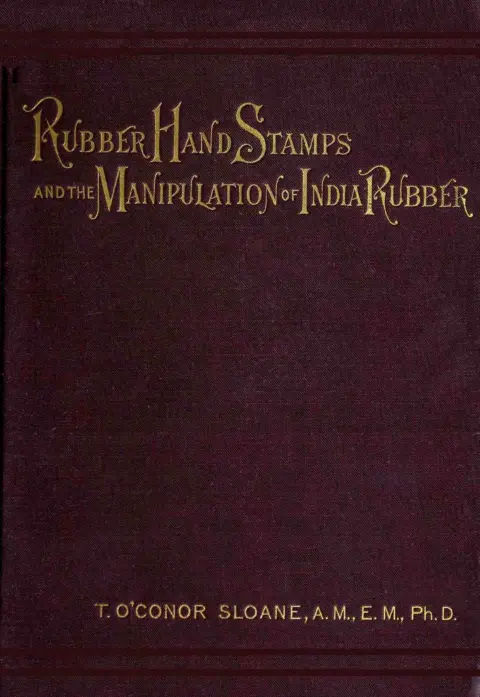
Rubber Hand Stamps and the Manipulation of Rubber A practical treatise on the manufacture of India rubber hand stamps, small articles of India rubber, the hektograph, special inks, cements, and allied subjects
Nitric acid as vulcanizer 100
Oil for composition stamp moulds 119–120
Oil for mould face 55
Oils fixed bad effect on solutions 105
Oxychloride of zinc cement for matrices 57
Papier maché matrices 80–82
Paraffin and rubber 105–106
Parkes’ process 100–102
Payen’s solvent 105
Pencil tips, moulds for 89–90
Phenyle sulphide as softener of vulcanized rubber 106
Plaster, dental for matrices 54
Press for moulding stamps, etc. 51–52
Press, gas-heated 52–53
Press, home-made 49
Press, matrix making 55–56
Products, general division of 35–36
Rods, stirring for laboratory 95
Rubber, origin of name 12
Rubber, see India Rubber
Salt bath for curing 98
Sap of india rubber tree, analysis of 27
Sheeting and washing 37–38
Sheet rubber, how made 40
Sheet rubber, its joining 94
Shellac for strengthening matrix 55
Shoes, blacking for 142
Shoes, india rubber, cement for 127
Siphonia, origin of name 11
Solution, different views of 31–32
Solution, difficulties of 103
Solvents for rubber 104–105
Spring chase for matrices 56
Springs for stamp moulds 51
Springs on moulding press 51
Sponge india rubber 137
Stamp making 47
Stamps, rubber, substitute for 138
Stamps, see India Rubber, Composition and general titles.
Strauss’ method of coagulating sap 22–23
Suction discs, regular mould for 88–89
Suction discs, simple mould for 87–88
Sulphides, alkaline as vulcanizers 100
Sulphur, absorption process 100
Sulphur bath for mixing and curing 98–100
Sulphur chloride process 100–102
Sulphur, how mixed with gum 43
Sulphur, its escape from vulcanized rubber 33–34
Sunlight excluded from washed sheet rubber 38
Syringes made by Indians 11
Test for curing with knife 48
Thread, rubber, cut 41
Thread, rubber, moulded 92
Tissues, coated, how made 45–46
Tubes, connecting glass 96
Tube, seamless 92
Turpentine, a solvent for vulcanized rubber 106
Turpentine compared with caoutchoucin 30
Turpentine, viscid nature of solution 104–105
Type, india rubber 73
Type moulding flask 74
Type and stamps from vulcanized rubber 77
Type, cutting apart 75
Type, points in moulding 75
Type, quads, and spaces for stamp models 71–72
Type, steel moulds for 76
United States composition stamps 113–120
Varnish shellac for india rubber 137–138
Vulcanite 108–111
Vulcanization, its two steps 42
Vulcanization, steps in process 47–48
Vulcanized rubber stamps and type 77
Vulcanizer 52–53
Vulcanizer, fish kettle as a 69–70
Vulcanizer, flower pot 68–70
Vulcanizer, chamber 63
Vulcanizing and moulding stamps 58–60
Washing and sheeting 37–38
Water absorbed by india rubber 31
Waterproof composition for shoes 142
Waterproofing for battery cells 127–128
Zinc, chloride 57
Transcriber’s Notes
Punctuation, hyphenation, and spelling were made consistent when a predominant preference was found in the original book; otherwise they were not changed.
Simple typographical errors were corrected; unbalanced quotation
marks were remedied when the change was obvious, and otherwise left
unbalanced.
Illustrations in this eBook have been positioned between paragraphs and outside quotations. In versions of this eBook that support hyperlinks, the page references in the List of Illustrations lead to the corresponding illustrations.
The index was not checked for proper alphabetization or correct page references. Three missing page references were added by the Transcriber.
Page 26: “The relegation of ice” was printed that way.
Page 40: “alkanine” may be a misprint for alkaline.