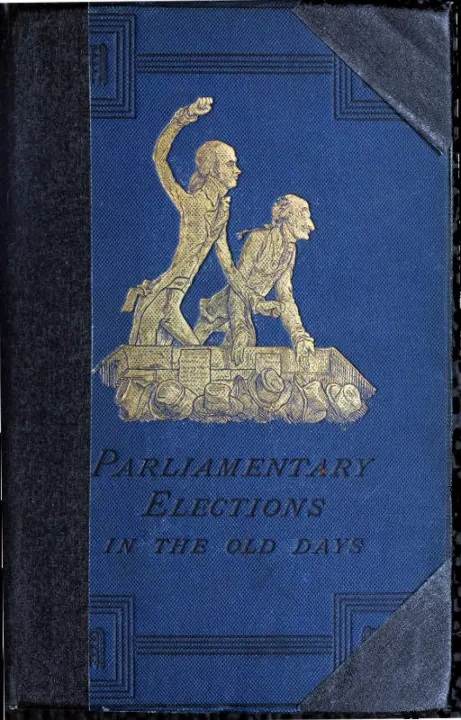
A History of Parliamentary Elections and Electioneering in the Old Days Showing the State of Political Parties and Party Warfare at the Hustings and in the House of Commons from the Stuarts to Queen Victoria
Joseph Grego
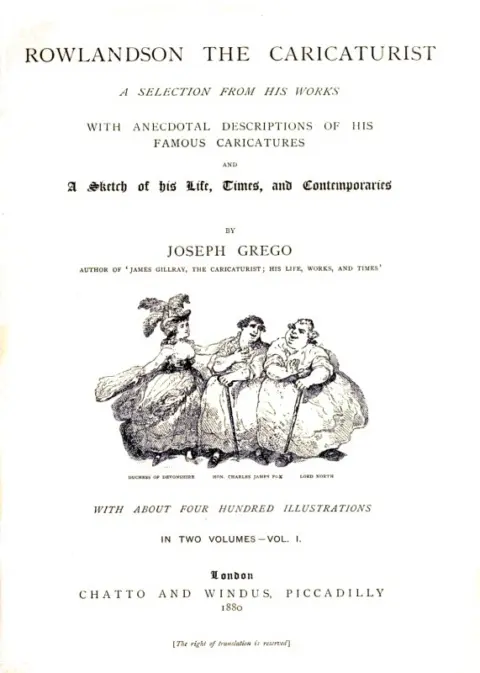
THE CLASSIC COLLECTION · 1880
"Rowlandson the Caricaturist; a Selection from His Works. Vol. 2" by Joseph Grego is a comprehensive collection of satirical illustrations and caricatures created by Thomas Rowlandson, written in the late 19th century. This volume includes a range of works that reflect social and political themes from 1800 to 1825, accompanied by anecdotal descriptions of Rowlandson's famous caricatures as well as insights into his life and contemporaries. The book serves as both an art historical account and a commentary on the cultural context of Rowlandson’s time through humor and wit. At the start of the book, readers are introduced to the format that combines the index of the current volume with references to the first volume. This initial section hints at the structure of the book, which contains a chronological summary of Rowlandson's works alongside illustrations that capture the essence of early 19th-century British life, societal norms, humor, and politics. The opening includes a variety of titles and descriptions of the caricatures, showcasing Rowlandson's ability to blend humor with critical societal commentary, as seen in his representations of characters and events from that era. The illustrations aim to provide a vivid window into the past, through both artistic expression and narrative, exemplifying Rowlandson's unique blend of artistry and satire.
Introduction adapted from the source catalogue; source summaries may be automatically generated.
Free to read · English · 166,732 words · No account needed
MAKE TIME FOR A GOOD BOOK
On by default. Untick to stop anonymous reading totals. Each page counts after 10 seconds in view. How this works.
Anonymous counting is on unless you have switched it off.
March 12, 1800. Humbugging, or Raising the Devil. Published by R. Ackermann, 101 Strand.--A credulous personage, who, judging from his costume, is in a fair position in life, has called to consult a necromancer. The enchanter has a venerable beard, and a divining rod; according to usage, he has made a circle of skulls, toads, and other inviting objects, in the centre of which, through a stage trap, he is raising the 'very deil,' and has conjured up a pantomimic demon, horned, winged, and grotesquely arranged, holding in one hand a gore-stained dagger, and a goblet of suppositious blood in the other. The knees of the befooled spectator are trembling beneath him; his back is turned to a curtain which conceals a fair enchantress, who is assisting the invocation, and giving a practical turn to the delusion by removing a well-filled pocket-book from the coat-tail of the simple victim. In the background is the traditional whiskered cat, and the folio of cabalistic signs; a stuffed crocodile is suspended from the roof.
March 12, 1800. Hocus Pocus, or Searching for the Philosopher's Stone. Rowlandson del. and sculp. Published by R. Ackermann, 101 Strand.--Companion plate to 'Humbugging, or raising the Devil.' The artist introduces us to the laboratory of a so-called alchemist. A roguish Jew and his familiar are busily engaged in the transmutation of metals; the servant, with a pair of long-nozzled bellows, is engaged in kindling the furnace, in which is a crucible; various retorts, alembics, and other paraphernalia of the 'black arts,' are scattered about, as well as a formula for 'changing lead into gold;' although the alchemists at best could only contrive to accomplish the reverse transmutation. Suggestive prints are hung on the walls of this chamber of mystery, such as the portrait of the notorious 'Count Cagliostro, discoverer of the Philosopher's Stone,' and the figure of the spurious 'Bottle Conjurer.'
A military officer, in the next apartment, is turning his opportunities to more practical advantage by embracing, with a certain display of ardour, a pretty maiden--who is nothing loth,--the daughter, it appears, of the philosophically minded investigator.
April 1, 1800. A Ghost in the Wine Cellar. Published by T. Rowlandson, 1 James's Street, Adelphi.
April, 1800. Caricature Medallions for Screens. Published by R.
Ackermann, Strand.
April 20, 1800. Hearts for the year 1800. Woodward inv., Rowlandson sculp. Published by R. Ackermann, Strand.
May 1, 1800. Cash. Published by R. Ackermann.
May 1, 1800. Bills of Exchange. Published by R. Ackermann.
May 12, 1800. Melopoyn haranguing the prisoners in the Fleet.
Hogarthian Novelist. Plate 5.
May 12, 1800. Captain Bowling introduced to Narcissa. Hogarthian
Novelist. Plate 6.
May 20, 1800. A Skipping Academy. G. M. Woodward inv., Rowlandson sculp. Published by R. Ackermann, Strand.
Your reading position is saved on this browser. Take it to another device with a library code. Reading pages adapt to text, rather than matching a printed edition.
Joseph Grego
Joseph Grego
BEHIND THE BOOK
This eBook is for the use of anyone anywhere in the United States and most other parts of the world at no cost and with almost no restrictions whatsoever. You may copy it, give it away or re-use it under the terms of the Project Gutenberg License included with this eBook or online at www.gutenberg.org. If you are not located in the United States, you will have to check the laws of the country where you are located before using this eBook. Read the source licence.
The original source file, including credits and licence, is retained by this library. Request an original-format copy at no charge. Please include the book title and Project Gutenberg identifier #45981.
KEEP YOUR CURIOSITY GOING
Cécile Tormay

Moritz Busch
John L. Ransom
Frances Wright
Cécile Tormay

Mabel Potter Daggett