A History of Parliamentary Elections and Electioneering in the Old Days Showing the State of Political Parties and Party Warfare at the Hustings and in the House of Commons from the Stuarts to Queen Victoria
Joseph Grego
THE CLASSIC COLLECTION · 1880
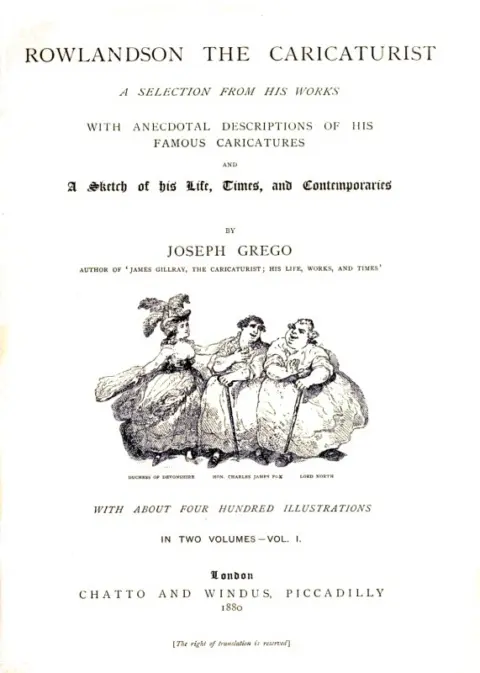
"Rowlandson the Caricaturist; a Selection from His Works. Vol. 2" by Joseph Grego is a comprehensive collection of satirical illustrations and caricatures created by Thomas Rowlandson, written in the late 19th century. This volume includes a range of works that reflect social and political themes from 1800 to 1825, accompanied by anecdotal descriptions of Rowlandson's famous caricatures as well as insights into his life and contemporaries. The book serves as both an art historical account and a commentary on the cultural context of Rowlandson’s time through humor and wit. At the start of the book, readers are introduced to the format that combines the index of the current volume with references to the first volume. This initial section hints at the structure of the book, which contains a chronological summary of Rowlandson's works alongside illustrations that capture the essence of early 19th-century British life, societal norms, humor, and politics. The opening includes a variety of titles and descriptions of the caricatures, showcasing Rowlandson's ability to blend humor with critical societal commentary, as seen in his representations of characters and events from that era. The illustrations aim to provide a vivid window into the past, through both artistic expression and narrative, exemplifying Rowlandson's unique blend of artistry and satire.
Introduction adapted from the source catalogue; source summaries may be automatically generated.
Free to read · English · 166,732 words · No account needed
MAKE TIME FOR A GOOD BOOK
On by default. Untick to stop anonymous reading totals. Each page counts after 10 seconds in view. How this works.
Anonymous counting is on unless you have switched it off.
September 27, 1809. This is the House that Jack Built. (Old Price Row at Drury Lane.) Published by T. Tegg.--This cartoon, in six compartments, is aimed at Kemble's new house, which, from certain arrangements of the boxes, and other innovations, became the cause of considerable turbulence--
These are the Boxes let to the great
That visit the House that Jack built.
The curtain of the theatre bears the advertisement: 'Grand theatrical Bagnio, fitted up in the Italian style;' 'Lodgings to let for the season, or a single night;' 'Roomy pit for parsons, poets, Presbyterians, Quakers, grumblers,' &c.; 'Boxes for the Cyprian corps, with snug lobby to ditto;' 'Private accommodations for the Members of both Houses of Parliament;' 'Boudoirs pour la Noblesse;' 'Rabbit hutches, seven shillings each;' 'Humbug gallery, two shillings;' and, chief cause of dissatisfaction, 'Pigeon-holes for the swinish multitude':--
These are the pigeon-holes over the Boxes, Let to the great that visit the House that Jack built. This is the Cat engaged to squall to the poor in the pidgeon-holes over the Boxes, let to the great that visit the House that Jack built.
Madame Catalini is endeavouring to sing; but the audience, armed with rattles, post-horns, and other noisy instruments, are raising a regular uproar:--
This is John Bull with a bugle-horn, That hissed the Cat engaged to squall to the poor, &c. This is the Thief-taker,[21] shaven and shorn, That took up John Bull, with his bugle-horn, &c.--
The rioters are having a regular stand-up fight outside the theatre, as well as within. The last verse--
This is the Manager, full of scorn, Who rais'd the price to the people forlorn, &c., And directed the Thief-taker, shaven and shorn, &c.--
introduces the great John Kemble at the foot-lights, haranguing his unruly audience; the house is represented much as it actually appeared; the rioters, provided with squirts, bellows, marrow-bones, cleavers, rattles, cow-horns, and all sorts of rough music, in short, every instrument of noise that ingenuity could suggest, with huge streamers, banners, and placards, held out on long poles, &c., containing such announcements as 'No theatrical taxation,' 'No intriguing shop,' 'No annual boxes,' 'No Italian singers,' 'None of your Jesuitical tricks, you black monk,' 'Be silent, Mr. Kemble's head aitches,' 'Kemble, remember the Dublin tin-man,' 'Dickons for ever, no Catalini.'
September 30, 1809. A Lump of Impertinence. Woodward del., Rowlandson sc. Published by T. Tegg.--'Who the devil do you stare at? Get along about your business.'
Your reading position is saved on this browser. Take it to another device with a library code. Reading pages adapt to text, rather than matching a printed edition.
Joseph Grego
Joseph Grego
BEHIND THE BOOK
This eBook is for the use of anyone anywhere in the United States and most other parts of the world at no cost and with almost no restrictions whatsoever. You may copy it, give it away or re-use it under the terms of the Project Gutenberg License included with this eBook or online at www.gutenberg.org. If you are not located in the United States, you will have to check the laws of the country where you are located before using this eBook. Read the source licence.
The original source file, including credits and licence, is retained by this library. Request an original-format copy at no charge. Please include the book title and Project Gutenberg identifier #45981.
KEEP YOUR CURIOSITY GOING
Cécile Tormay

Moritz Busch
John L. Ransom
Frances Wright
Cécile Tormay

Mabel Potter Daggett