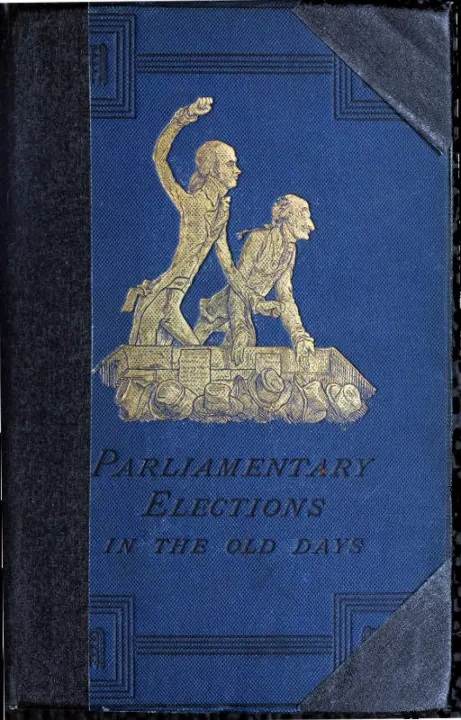
A History of Parliamentary Elections and Electioneering in the Old Days Showing the State of Political Parties and Party Warfare at the Hustings and in the House of Commons from the Stuarts to Queen Victoria
Joseph Grego
THE CLASSIC COLLECTION · 1880
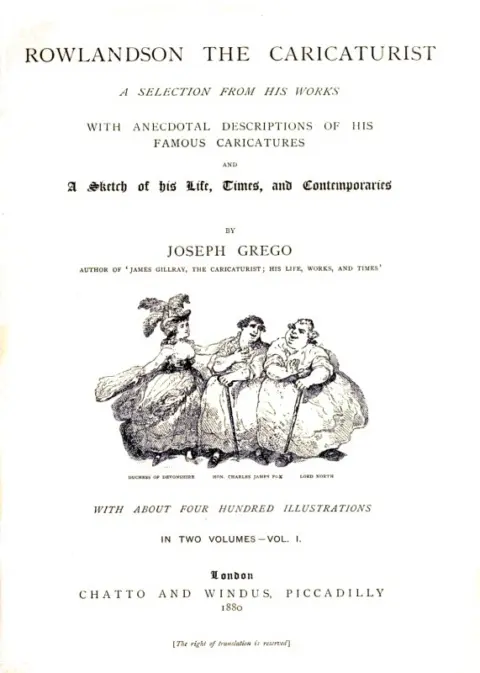
"Rowlandson the Caricaturist; a Selection from His Works. Vol. 2" by Joseph Grego is a comprehensive collection of satirical illustrations and caricatures created by Thomas Rowlandson, written in the late 19th century. This volume includes a range of works that reflect social and political themes from 1800 to 1825, accompanied by anecdotal descriptions of Rowlandson's famous caricatures as well as insights into his life and contemporaries. The book serves as both an art historical account and a commentary on the cultural context of Rowlandson’s time through humor and wit. At the start of the book, readers are introduced to the format that combines the index of the current volume with references to the first volume. This initial section hints at the structure of the book, which contains a chronological summary of Rowlandson's works alongside illustrations that capture the essence of early 19th-century British life, societal norms, humor, and politics. The opening includes a variety of titles and descriptions of the caricatures, showcasing Rowlandson's ability to blend humor with critical societal commentary, as seen in his representations of characters and events from that era. The illustrations aim to provide a vivid window into the past, through both artistic expression and narrative, exemplifying Rowlandson's unique blend of artistry and satire.
Introduction adapted from the source catalogue; source summaries may be automatically generated.
Free to read · English · 166,732 words · No account needed
MAKE TIME FOR A GOOD BOOK
On by default. Untick to stop anonymous reading totals. Each page counts after 10 seconds in view. How this works.
Anonymous counting is on unless you have switched it off.
Frontispiece.--The Vicar of Wakefield, a character eminently
calculated to inculcate benevolence, humanity, patience in
sufferings, and reliance on Providence.
2. The Social Evening.
3. The Departure for Wakefield.
4. Sophia Rescued from the Water.
5. The Welcome.
6. The Squire's Intrusion.
7. Mr. Burchell's First Visit.
8. The Dance.
9. Fortune-telling.
10. The Vicar's Family on their Road to Church.
11. Hunting the Slipper.
12. The Gross of Green Spectacles.
13. The Vicar Selling his Horse.
14. The Family Picture.
15. The Vicar in company with Strolling Players.
16. The Surprise.
17. The Stage. George Primrose as 'Horatio.'
18. Attendance on a Nobleman.
19. A Connoisseur Mellowing the Tone of a Picture.
20. The Scold, with News of Olivia.
21. The Fair Penitent.
22. Domestic Arrangements in Prison.
23. The Vicar Preaching to the Prisoners.
24. The Wedding.
The Family Picture.--'My wife and daughters, happening to return a visit to neighbour Flamborough's, found that family had lately got their pictures drawn by a limner who travelled the country and took likenesses for fifteen shillings a head. As this family and ours had long a sort of rivalry in point of taste, our spirit took the alarm at this stolen march upon us; and notwithstanding all I could say, and I said much, it was resolved that we should have our pictures done too. Having, therefore, engaged the limner--for what else could I do?--our next deliberation was to show the superiority of our taste in the attitudes. As for our neighbour's family, there were seven of them, and they were drawn with seven oranges, a thing quite out of taste--no variety in life, no composition in the world. We desired to have something in a brighter style; and after many debates at length came to a unanimous resolution of being drawn together in one large historical family piece. This would be cheaper, since one frame would serve for all, and it would be infinitely more genteel, for all families of any taste were now drawn in the same manner. As we did not immediately recollect an historical subject to hit us we were contented each with being drawn as independent historical figures. My wife desired to be represented as Venus, and the painter was desired not to be too frugal of his diamonds in her stomacher and hair. Her two little ones were to be as Cupids by her side; while I, in my gown and band, was to present her with my books on the Whistonian controversy. Olivia would be drawn as an Amazon, sitting on a bank of flowers, dressed in a green joseph, richly laced with gold, and a whip in her hand. Sophia was to be a shepherdess, with as many sheep as the painter could put in for nothing; and Moses was to be dressed out with a hat and white feather. Our taste so much pleased the Squire that he insisted on being put in as one of the family, in the character of Alexander the Great, at Olivia's feet. This was considered by us all as an indication of his desire to be introduced into the family; nor could we refuse his request. The painter was therefore set to work; and as he wrought with assiduity and expedition, in less than four days the whole was completed. The piece was large, and it must be owned he did not spare his colours, for which my wife gave him great encomiums. We were all perfectly satisfied with his performance; but an unfortunate circumstance had not occurred till the picture was finished, which now struck us with dismay. It was so very large that we had no place in the house to fix it. How we all came to disregard so material a point is inconceivable; but certain it is we had been all greatly remiss. The picture, therefore, instead of gratifying our vanity, as we hoped, leaned in a most mortifying manner against the kitchen wall, where the canvas was stretched and painted, much too large to be got through any of the doors, and the jest of all our neighbours. One compared it to Robinson Crusoe's longboat, too large to be removed; another thought it more resembled a reel in a bottle; some wondered how it could be got out, but still more were amazed how it got in.'
Your reading position is saved on this browser. Take it to another device with a library code. Reading pages adapt to text, rather than matching a printed edition.
Joseph Grego
Joseph Grego
BEHIND THE BOOK
This eBook is for the use of anyone anywhere in the United States and most other parts of the world at no cost and with almost no restrictions whatsoever. You may copy it, give it away or re-use it under the terms of the Project Gutenberg License included with this eBook or online at www.gutenberg.org. If you are not located in the United States, you will have to check the laws of the country where you are located before using this eBook. Read the source licence.
The original source file, including credits and licence, is retained by this library. Request an original-format copy at no charge. Please include the book title and Project Gutenberg identifier #45981.
KEEP YOUR CURIOSITY GOING
Cécile Tormay

Moritz Busch
John L. Ransom
Frances Wright
Cécile Tormay

Mabel Potter Daggett