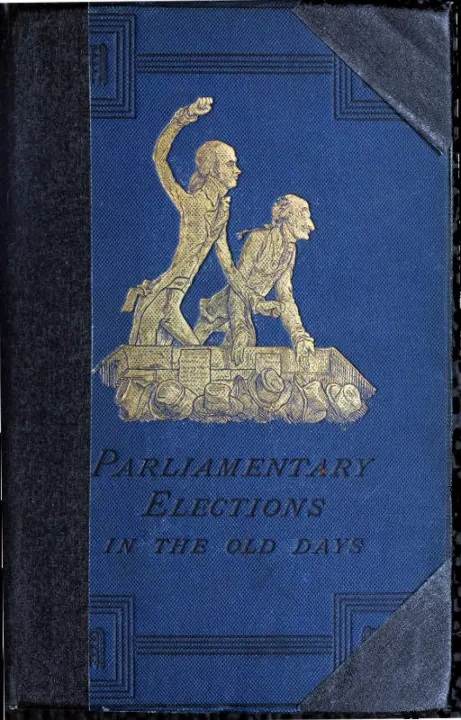
A History of Parliamentary Elections and Electioneering in the Old Days Showing the State of Political Parties and Party Warfare at the Hustings and in the House of Commons from the Stuarts to Queen Victoria
Joseph Grego
THE CLASSIC COLLECTION · 1880
"Rowlandson the Caricaturist; a Selection from His Works. Vol. 2" by Joseph Grego is a comprehensive collection of satirical illustrations and caricatures created by Thomas Rowlandson, written in the late 19th century. This volume includes a range of works that reflect social and political themes from 1800 to 1825, accompanied by anecdotal descriptions of Rowlandson's famous caricatures as well as insights into his life and contemporaries. The book serves as both an art historical account and a commentary on the cultural context of Rowlandson’s time through humor and wit. At the start of the book, readers are introduced to the format that combines the index of the current volume with references to the first volume. This initial section hints at the structure of the book, which contains a chronological summary of Rowlandson's works alongside illustrations that capture the essence of early 19th-century British life, societal norms, humor, and politics. The opening includes a variety of titles and descriptions of the caricatures, showcasing Rowlandson's ability to blend humor with critical societal commentary, as seen in his representations of characters and events from that era. The illustrations aim to provide a vivid window into the past, through both artistic expression and narrative, exemplifying Rowlandson's unique blend of artistry and satire.
Introduction adapted from the source catalogue; source summaries may be automatically generated.
Free to read · English · 166,732 words · No account needed
MAKE TIME FOR A GOOD BOOK
On by default. Untick to stop anonymous reading totals. Each page counts after 10 seconds in view. How this works.
Anonymous counting is on unless you have switched it off.
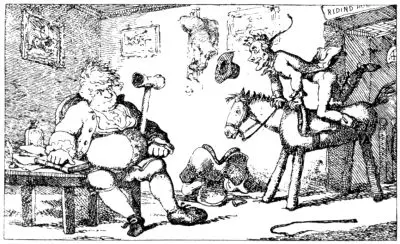
On August 15, 1800, Mr. Ackermann issued at his Repository of Arts, 101 Strand, a series of six plates designed and etched in Rowlandson's boldest and most spirited style; and finished and coloured in almost exact imitation of the original drawings. Each plate contains three large distinct heads, festooned with attributes peculiar to the respective designs. It is not very clear whether these symbolical groupings, which are superior in execution to the average of Rowlandson's published works, were devised to be cut up for scrap-books, screens, or wall borderings; but they have become remarkably scarce since the date of publication, and sets of these typical heads (eighteen in all) are rarely met with at the present date.
Philosophorum.--The head of the philosopher closely resembles the conventional portrait accorded to Father Time, horn spectacles, forelock, grey beard and all. The globe, a sextant, mariner's compass, chart, telescope, dividers, bells, squares, thermometers, &c., make up the symbolical garland which depends from the ears of this emblem of knowledge.
Fancynina.--This figure is borne out by one of the artist's favourite types of female beauty, a well-featured, handsomely made and languishing-looking young lady, wearing a modish hat, all feathered, beaded, and flowered. The portrait of Fancynina is festooned with such emblems of feminine frivolity as French rouge, Court sticking-plaister (for patches), ottar of roses, watches and trinkets, miniatures of admirers, an opera glass, a black domino or half-mask, a huge muff, parasol, fan, &c.
Epicurum.--An old gourmand in a red nightcap, whose flushed and blossoming countenance appears through a goodly string of sausages; a gridiron, a basting ladle, a cucumber, and other indications of creature comforts complete the emblems of this figure.
Penserosa.--The head of a tragic performer, modelled on that of one of the Gorgones is used to illustrate this figure. The Medusa head is entwined with serpents, and wreathed below with a festoon of bays, beneath which hang the dagger and bowl, and the manuscript of Penserosa's tragic part.
Tally ho! rum!--The head of a Nimrod, backed with a huntsman's cap, is the sign-piece of this figure; a corne de chasse is hung round the sportsman's neck, and on it are spurs, horseshoes, whips, a gun, powder-flask, and game bag; a fox's head completes the group of emblems distinctive of Tally ho! rum!
Allegoria.--The head of a rubicund, but young and well-featured, Bacchus does duty for Allegoria; heavy clusters of vine-leaves, and bunches of purple grapes and tendrils crown and surround the bucolic divinity; below is a Silenus mask; bacchanalian flutes, and pipes of Pan, complete the insignia.
Your reading position is saved on this browser. Take it to another device with a library code. Reading pages adapt to text, rather than matching a printed edition.
Joseph Grego
Joseph Grego
BEHIND THE BOOK
This eBook is for the use of anyone anywhere in the United States and most other parts of the world at no cost and with almost no restrictions whatsoever. You may copy it, give it away or re-use it under the terms of the Project Gutenberg License included with this eBook or online at www.gutenberg.org. If you are not located in the United States, you will have to check the laws of the country where you are located before using this eBook. Read the source licence.
The original source file, including credits and licence, is retained by this library. Request an original-format copy at no charge. Please include the book title and Project Gutenberg identifier #45981.
KEEP YOUR CURIOSITY GOING
Cécile Tormay

Moritz Busch
John L. Ransom
Frances Wright
Cécile Tormay

Mabel Potter Daggett