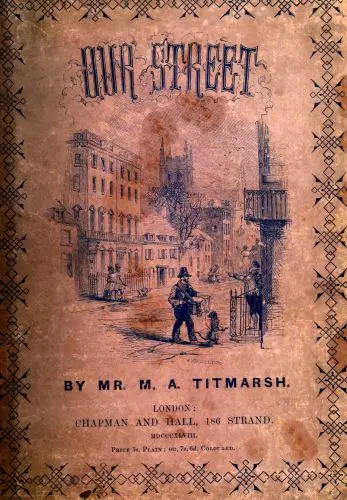
“Our Street”
William Makepeace Thackeray
THE CLASSIC COLLECTION · 1867
"Roundabout Papers" by William Makepeace Thackeray is a collection of essays and reflections written during the mid-19th century. The work captures Thackeray's keen observations on society, personal experiences, and literature through a variety of vignettes and humorous anecdotes, showcasing his characteristic blend of wit and critical insight. At the start of "Roundabout Papers," Thackeray describes a serene autumn in the quaint town of Chur, Switzerland, where he reflects on the history of the area and the peculiar figure of St. Lucius. The author observes the pastoral life around him, contrasting it with the hustle of modern progress. He introduces a lazy boy absorbed in reading novels and muses on the impact of literature on youth, celebrating the thrill and adventure found in storytelling while cautioning against excess. This opening establishes a contemplative yet humorous tone, inviting readers to engage with Thackeray’s thoughts on reading, youth, and the peculiarities of human nature.
Introduction adapted from the source catalogue; source summaries may be automatically generated.
Free to read · English · 121,024 words · No account needed
MAKE TIME FOR A GOOD BOOK
On by default. Untick to stop anonymous reading totals. Each page counts after 10 seconds in view. How this works.
Anonymous counting is on unless you have switched it off.
Among the sins of commission which novel-writers not seldom perpetrate, is the sin of grandiloquence, or tall-talking, against which, for my part, I will offer up a special libera me. This is the sin of schoolmasters, governesses, critics, sermoners, and instructors of young or old people. Nay (for I am making a clean breast, and liberating my soul), perhaps of all the novel-spinners now extant, the present speaker is the most addicted to preaching. Does he not stop perpetually in his story and begin to preach to you? When he ought to be engaged with business, is he not for ever taking the Muse by the sleeve, and plaguing her with some of his cynical sermons? I cry peccavi loudly and heartily. I tell you I would like to be able to write a story which should show no egotism whatever--in which there should be no reflections, no cynicism, no vulgarity (and so forth), but an incident in every other page, a villain, a battle, a mystery in every chapter. I should like to be able to feed a reader so spicily as to leave him hungering and thirsting for more at the end of every monthly meal.
Alexandre Dumas describes himself, when inventing the plan of a work, as lying silent on his back for two whole days on the deck of a yacht in a Mediterranean port. At the end of the two days he arose and called for dinner. In those two days he had built his plot. He had moulded a mighty clay, to be cast presently in perennial brass. The chapters, the characters, the incidents, the combinations were all arranged in the artist's brain ere he set a pen to paper. My Pegasus won't fly, so as to let me survey the field below me. He has no wings, he is blind of one eye certainly, he is restive, stubborn, slow; crops a hedge when he ought to be galloping, or gallops when he ought to be quiet. He never will show off when I want him. Sometimes he goes at a pace which surprises me. Sometimes, when I most wish him to make the running, the brute turns restive, and I am obliged to let him take his own time. I wonder do other novel-writers experience this fatalism? They MUST go a certain way, in spite of themselves. I have been surprised at the observations made by some of my characters. It seems as if an occult Power was moving the pen. The personage does or says something, and I ask, how the dickens did he come to think of that? Every man has remarked in dreams, the vast dramatic power which is sometimes evinced; I won't say the surprising power, for nothing does surprise you in dreams. But those strange characters you meet make instant observations of which you never can have thought previously. In like manner, the imagination foretells things. We spake anon of the inflated style of some writers. What also if there is an AFFLATED style,--when a writer is like a Pythoness on her oracle tripod, and mighty words, words which he cannot help, come blowing, and bellowing, and whistling, and moaning through the speaking pipes of his bodily organ? I have told you it was a very queer shock to me the other day when, with a letter of introduction in his hand, the artist's (not my) Philip Firmin walked into this room, and sat down in the chair opposite. In the novel of “Pendennis,” written ten years ago, there is an account of a certain Costigan, whom I had invented (as I suppose authors invent their personages out of scraps, heel-taps, odds and ends of characters). I was smoking in a tavern parlor one night--and this Costigan came into the room alive--the very man:--the most remarkable resemblance of the printed sketches of the man, of the rude drawings in which I had depicted him. He had the same little coat, the same battered hat, cocked on one eye, the same twinkle in that eye. “Sir,” said I, knowing him to be an old friend whom I had met in unknown regions, “sir,” I said, “may I offer you a glass of brandy-and-water?” “Bedad, ye may,” says he, “and I'll sing ye a song tu.” Of course he spoke with an Irish brogue. Of course he had been in the army. In ten minutes he pulled out an Army Agent's account, whereon his name was written. A few months after we read of him in a police court. How had I come to know him, to divine him? Nothing shall convince me that I have not seen that man in the world of spirits. In the world of spirits and water I know I did: but that is a mere quibble of words. I was not surprised when he spoke in an Irish brogue. I had had cognizance of him before somehow. Who has not felt that little shock which arises when a person, a place, some words in a book (there is always a collocation) present themselves to you, and you know that you have before met the same person, words, scene, and so forth?
Your reading position is saved on this browser. Take it to another device with a library code. Reading pages adapt to text, rather than matching a printed edition.
William Makepeace Thackeray
William Makepeace Thackeray
Charles Dickens & William Makepeace Thackeray
William Makepeace Thackeray
BEHIND THE BOOK
This eBook is for the use of anyone anywhere in the United States and most other parts of the world at no cost and with almost no restrictions whatsoever. You may copy it, give it away or re-use it under the terms of the Project Gutenberg License included with this eBook or online at www.gutenberg.org. If you are not located in the United States, you will have to check the laws of the country where you are located before using this eBook. Read the source licence.
The original source file, including credits and licence, is retained by this library. Request an original-format copy at no charge. Please include the book title and Project Gutenberg identifier #2608.
KEEP YOUR CURIOSITY GOING
Wilfrid Scawen Blunt
Wilfrid Scawen Blunt
E. W. (Edgar Watson) Howe

David Patterson (Spirit) Hatch

David Patterson (Spirit) Hatch

David Patterson (Spirit) Hatch