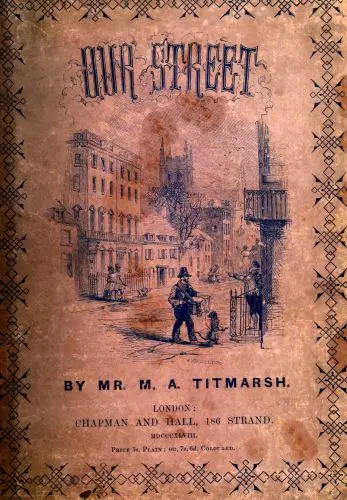
“Our Street”
William Makepeace Thackeray
THE CLASSIC COLLECTION · 1867
"Roundabout Papers" by William Makepeace Thackeray is a collection of essays and reflections written during the mid-19th century. The work captures Thackeray's keen observations on society, personal experiences, and literature through a variety of vignettes and humorous anecdotes, showcasing his characteristic blend of wit and critical insight. At the start of "Roundabout Papers," Thackeray describes a serene autumn in the quaint town of Chur, Switzerland, where he reflects on the history of the area and the peculiar figure of St. Lucius. The author observes the pastoral life around him, contrasting it with the hustle of modern progress. He introduces a lazy boy absorbed in reading novels and muses on the impact of literature on youth, celebrating the thrill and adventure found in storytelling while cautioning against excess. This opening establishes a contemplative yet humorous tone, inviting readers to engage with Thackeray’s thoughts on reading, youth, and the peculiarities of human nature.
Introduction adapted from the source catalogue; source summaries may be automatically generated.
Free to read · English · 121,024 words · No account needed
MAKE TIME FOR A GOOD BOOK
On by default. Untick to stop anonymous reading totals. Each page counts after 10 seconds in view. How this works.
Anonymous counting is on unless you have switched it off.
Another Finis written. Another mile-stone passed on this journey from birth to the next world! Sure it is a subject for solemn cogitation. Shall we continue this story-telling business and be voluble to the end of our age? Will it not be presently time, O prattler, to hold your tongue, and let younger people speak? I have a friend, a painter, who, like other persons who shall be nameless, is growing old. He has never painted with such laborious finish as his works now show. This master is still the most humble and diligent of scholars. Of Art, his mistress, he is always an eager, reverent pupil. In his calling, in yours, in mine, industry and humility will help and comfort us. A word with you. In a pretty large experience I have not found the men who write books superior in wit or learning to those who don't write at all. In regard of mere information, non-writers must often be superior to writers. You don't expect a lawyer in full practice to be conversant with all kinds of literature; he is too busy with his law; and so a writer is commonly too busy with his own books to be able to bestow attention on the works of other people. After a day's work (in which I have been depicting, let us say, the agonies of Louisa on parting with the Captain, or the atrocious behavior of the wicked Marquis to Lady Emily) I march to the Club, proposing to improve my mind and keep myself “posted up,” as the Americans phrase it, with the literature of the day. And what happens? Given, a walk after luncheon, a pleasing book, and a most comfortable armchair by the fire, and you know the rest. A doze ensues. Pleasing book drops suddenly, is picked up once with an air of some confusion, is laid presently softly in lap: head falls on comfortable arm-chair cushion: eyes close: soft nasal music is heard. Am I telling Club secrets? Of afternoons, after lunch, I say, scores of sensible fogies have a doze. Perhaps I have fallen asleep over that very book to which “Finis” has just been written. “And if the writer sleeps, what happens to the readers?” says Jones, coming down upon me with his lightning wit. What? You DID sleep over it? And a very good thing too. These eyes have more than once seen a friend dozing over pages which this hand has written. There is a vignette somewhere in one of my books of a friend so caught napping with “Pendennis,” or the “Newcomes,” in his lap and if a writer can give you a sweet soothing, harmless sleep, has he not done you a kindness? So is the author who excites and interests you worthy of your thanks and benedictions. I am troubled with fever and ague, that seizes me at odd intervals and prostrates me for a day. There is cold fit, for which, I am thankful to say, hot brandy-and-water is prescribed, and this induces hot fit, and so on. In one or two of these fits I have read novels with the most fearful contentment of mind. Once, on the Mississippi, it was my dearly beloved “Jacob Faithful:” once at Frankfort O. M., the delightful “Vingt Ans Apres” of Monsieur Dumas: once at Tunbridge wells, the thrilling “Woman in White:” and these books gave me amusement from morning till sunset. I remember those ague fits with a great deal of pleasure and gratitude. Think of a whole day in bed, and a good novel for a companion! No cares: no remorse about idleness: no visitors: and the Woman in White or the Chevalier d'Artagnan to tell me stories from dawn to night! “Please, ma'am, my master's compliments, and can he have the third volume?” (This message was sent to an astonished friend and neighbor who lent me, volume by volume, the W. in W.) How do you like your novels? I like mine strong, “hot with,” and no mistake: no love-making: no observations about society: little dialogue, except where the characters are bullying each other: plenty of fighting: and a villain in the cupboard, who is to suffer tortures just before Finis. I don't like your melancholy Finis. I never read the history of a consumptive heroine twice. If I might give a short hint to an impartial writer (as the Examiner used to say in old days), it would be to act, NOT a la mode le pays de Pole (I think that was the phraseology), but ALWAYS to give quarter. In the story of Philip, just come to an end, I have the permission of the author to state, that he was going to drown the two villains of the piece--a certain Doctor F---- and a certain Mr. T. H---- on board the “President,” or some other tragic ship--but you see I relented. I pictured to myself Firmin's ghastly face amid the crowd of shuddering people on that reeling deck in the lonely ocean, and thought, “Thou ghastly lying wretch, thou shalt not be drowned: thou shalt have a fever only; a knowledge of thy danger; and a chance--ever so small a chance--of repentance.” I wonder whether he DID repent when he found himself in the yellow-fever, in Virginia? The probability is, he fancied that his son had injured him very much, and forgave him on his death-bed. Do you imagine there is a great deal of genuine right-down remorse in the world? Don't people rather find excuses which make their minds easy; endeavor to prove to themselves that they have been lamentably belied and misunderstood; and try and forgive the persecutors who WILL present that bill when it is due; and not bear malice against the cruel ruffian who takes them to the police-office for stealing the spoons? Years ago I had a quarrel with a certain well-known person (I believed a statement regarding him which his friends imparted to me, and which turned out to be quite incorrect). To his dying day that quarrel was never quite made up. I said to his brother, “Why is your brother's soul still dark against me? It is I who ought to be angry and unforgiving: for I was in the wrong.” In the region which they now inhabit (for Finis has been set to the volumes of the lives of both here below), if they take any cognizance of our squabbles, and tittle-tattles, and gossips on earth here, I hope they admit that my little error was not of a nature unpardonable. If you have never committed a worse, my good sir, surely the score against you will not be heavy. Ha, dilectissimi fratres! It is in regard of sins NOT found out that we may say or sing (in an undertone, in a most penitent and lugubrious minor key), Miserere nobis miseris peccatoribus.
Your reading position is saved on this browser. Take it to another device with a library code. Reading pages adapt to text, rather than matching a printed edition.
William Makepeace Thackeray
William Makepeace Thackeray
Charles Dickens & William Makepeace Thackeray
William Makepeace Thackeray
BEHIND THE BOOK
This eBook is for the use of anyone anywhere in the United States and most other parts of the world at no cost and with almost no restrictions whatsoever. You may copy it, give it away or re-use it under the terms of the Project Gutenberg License included with this eBook or online at www.gutenberg.org. If you are not located in the United States, you will have to check the laws of the country where you are located before using this eBook. Read the source licence.
The original source file, including credits and licence, is retained by this library. Request an original-format copy at no charge. Please include the book title and Project Gutenberg identifier #2608.
KEEP YOUR CURIOSITY GOING
Wilfrid Scawen Blunt
Wilfrid Scawen Blunt

E. W. (Edgar Watson) Howe

David Patterson (Spirit) Hatch

David Patterson (Spirit) Hatch

David Patterson (Spirit) Hatch