THE CLASSIC COLLECTION✦An outlaw’s diary: the CommuneCLASSIC FREE BOOKS
An outlaw’s diary: the Commune
Cécile Tormay
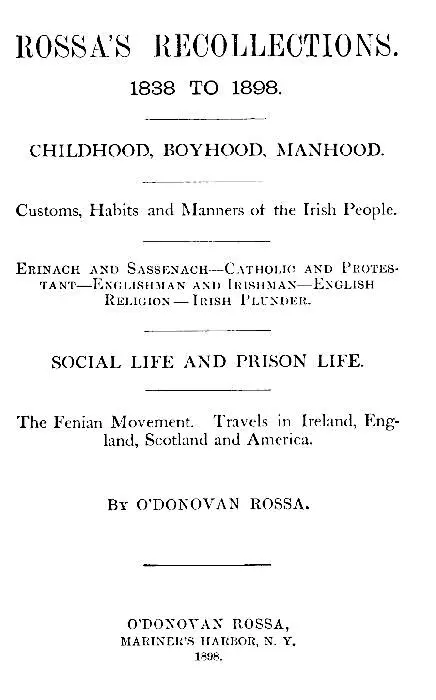
THE CLASSIC COLLECTION · 1898
"Rossa's Recollections, 1838 to 1898" by Jeremiah O'Donovan Rossa is a historical account written in the late 19th century. The memoir details the author’s life experiences, focusing on his childhood, family ties, and the social and political backdrop of Irish life during times of struggle and change, including the impact of English rule and the Fenian movement. The narrative offers strong insights into the customs, habits, and shared history of the Irish people through the lens of Rossa's personal journey. The opening of the memoir introduces the reader to Rossa’s early life in Ross Carbery, County Cork. He recalls poignant memories from childhood, including his baptism, and the scattering of his family due to emigration and political strife. As he reminisces about life with his grandparents and the warmth of familial bonds, he contrasts this with the emotional weight of separation and loss faced by many Irish families. Rossa provides vivid descriptions of his upbringing, the language and stories that shaped his identity, and the overarching influences of English oppression, setting the stage for the deeper political commentary that emerges in later chapters.
Introduction adapted from the source catalogue; source summaries may be automatically generated.
Free to read · English · 107,176 words · No account needed
MAKE TIME FOR A GOOD BOOK
On by default. Untick to stop anonymous reading totals. Each page counts after 10 seconds in view. How this works.
Anonymous counting is on unless you have switched it off.
Most of the grown people of my day remembered the battle. At the time of its occurrence the towns of Cork were famed for their societies of Orangemen,--men who were born in Ireland, but who were sworn to uphold the foreign rule of England in their native land. They were schooled, and the like of them are to-day schooled, into believing that only for the protecting power of England, the Catholics of Ireland would kill the Protestants of Ireland. These Orangemen societies grew strong in many places, and became so aggressive and so fostered and patronized by the English governors, that they acted as if their mission was the English mission of rooting the old Irish race out of Ireland altogether. The spirit that harmonized with their education was the spirit expressed by those words painted on the gates of the town of Bandon:
“Turk, Jew or Atheist may enter here, but not a papist.”
Of that it is said that some one wrote under it these words:
“Whoever wrote that wrote it well,
For the same is written on the gates of hell.”
But about this battle of Ross that is celebrated in song by John Collins, I may as well let the poet tell the story of it in those words of his that are sung to the air of “The Boyne Water.”
July the twelfth in ancient Ross
There was a furious battle.
Where many an Amazonian lass
Made Irish bullets rattle.
Sir Parker pitched his Flavian band
Beyond the Rowry water,
Reviewed his forces on the strand
And marshaled them for slaughter.
They ate and drank from scrip and can
And drew their polished bayonets;
They swore destruction to each man
Dissenting from their tenets.
Replete with wrath and vengeance, too,
They drank “Annihilation
To that insidious, hated crew--
The Papists of the nation!”
Their chief advanced along the shore
And every rank incited;
“Brave boys,” said he, “mind what you swore”--
And what they swore recited.
“This night let’s stand as William stood:
Set yonder town on fire;
Wade through a flood of Papist blood
Or in the flames expire.”
The listening multitude approved,
With shouts of approbation,
Of what their generous leader moved
In his sweet peroration.
Each swore that he would never flee,
Or quit the field of action,
Unless assailed by more than three
Of any other faction.
They crossed the purling Rowry Glen,
Intent on spoil and plunder;
Their firelocks raised a dreadful din,
Like peals of distant thunder.
The Garde-de-Corps first led across;
The rest in martial order,
And in full gallop entered Ross
In fourteen minutes after.
The warlike women of the town,
Apprized of the invasion,
Like Amazons of high renown,
Soon formed into a legion.
With courage scarcely ever known,
Led on by brave Maria,
Each stood, like David with a stone,
To face the great Goliah.
The Flavian corps commenced the fray,
And fired a sudden volley;
The women, strangers to dismay,
Made a most vigorous sally.
The fight grew hot along the van,
Both stones and bullets rattle.
And many a brave young Orangeman
Lay on the field of battle.
Now here, now there, Maria flies,
Nothing can stop her courses.
All instruments of death she plies
Against the Orange forces.
Such is her speed upon the plain,
No mortal can outpace her,
And such her valor--’tis in vain
For any man to face her,
Great Major Hewitt, for tactics famed,
Renewed the fierce alarms,
Celestial rays of lightning gleamed
From his refulgent arms.
His father was of earthly race,
His mother--once the fairest
Of rural nymphs--the stolen embrace
Of Jove upon a “Papist.”
He rushed into the virgin throng
And put them in commotion,
But brave Maria quickly ran
And stopped his rapid motion.
With his own pistol, on his head,
She gave him such a wherrit
As laid him with the vulgar dead,
Devoid of sense and spirit.
Barclay, the second in command,
Renowned for killing number
Was by Margretta’s daring band,
Knocked into deadly slumbers;
With a sharp saw upon his crown
She cut so deep a chasm,
He fell, and bit the bloody ground,
In a most frightful spasm.
The Orange banner was displayed
By youthful Ensign Legoe,
Who was by war’s sad chance soon laid
Low as the other hero:
In this predicament he found
Himself in no small hazard,
When a rude bullet of ten pound
Rebounded from his mazzard
He fell upon his brawny back
To the cold marble pavement;
The victors beat him like a sack,
By way of entertainment.
She said, “Go, vagrant, to the shades,
And tell Sir John the story,
How a small band of Carbery maids
Pulled down the Orange glory.”
Sir Parker, seeing his banner fall,
His warlike troops defeated,
Under the cover of a wall
To a small fort retreated,
Where he and all his Garde de Corps
Lay for some time securely,
And braved the clamor and uproar
Of th’ Amazonian fury.
But while the hero from within
Fired on a brave virago,
Who then pursued four of his men
With vengeance and bravado,
A rocky fragment from without
Made a most grievous rattle
Upon his cheek, his eye knocked out--
Which finished all the battle.
Some of his men in ditches lay
To shun their near extinction;
Some from their helmets tore away
The badges of distinction;
Some in the public streets declared
Against the name and Order.
And thus our Orange heroes fared
The day they crossed the border.
Your reading position is saved on this browser. Take it to another device with a library code. Reading pages adapt to text, rather than matching a printed edition.
BEHIND THE BOOK
This eBook is for the use of anyone anywhere in the United States and most other parts of the world at no cost and with almost no restrictions whatsoever. You may copy it, give it away or re-use it under the terms of the Project Gutenberg License included with this eBook or online at www.gutenberg.org. If you are not located in the United States, you will have to check the laws of the country where you are located before using this eBook. Read the source licence.
The original source file, including credits and licence, is retained by this library. Request an original-format copy at no charge. Please include the book title and Project Gutenberg identifier #49978.
KEEP YOUR CURIOSITY GOING
Cécile Tormay

Moritz Busch
John L. Ransom
Frances Wright
Cécile Tormay

Mabel Potter Daggett