THE CLASSIC COLLECTION✦Personal rightsCLASSIC FREE BOOKS
Personal rights
Mona Caird
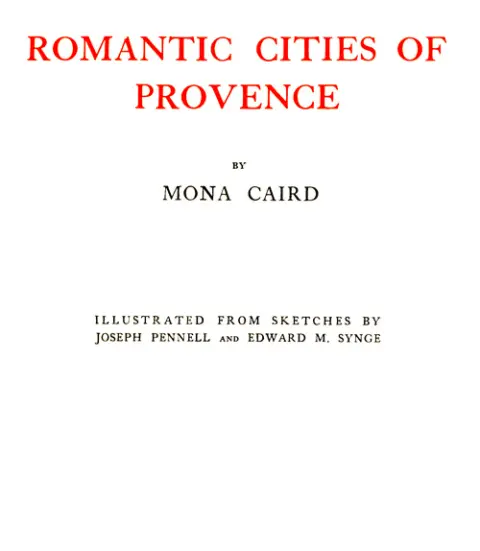
THE CLASSIC COLLECTION · 1906
"Romantic Cities of Provence" by Mona Caird is a travel narrative that was likely written in the late 19th century. This work reflects on the author's experiences during a journey through the picturesque and historically rich region of Provence in southern France. Caird captures the enchanting atmosphere of ancient cities, exploring their history, culture, and the profound impressions they leave on visitors. The opening of the narrative sets the stage for the author's exploration of Provence, particularly their encounter with the powerful wind known as the mistral, which shapes the landscape and influences the character of its inhabitants. Caird conveys a sense of deep wonder and emotional connection to the region, revealing how the raw natural forces and historical legacy intertwine to create a unique sense of place. Throughout this introductory portion, the author hints at the complex history of Provence and its impact on the people and culture, setting the tone for a journey that promises to blend personal reflection with historical insight.
Introduction adapted from the source catalogue; source summaries may be automatically generated.
Free to read · English · 82,770 words · No account needed
MAKE TIME FOR A GOOD BOOK
On by default. Untick to stop anonymous reading totals. Each page counts after 10 seconds in view. How this works.
Anonymous counting is on unless you have switched it off.
Vaccares, the, Lake of, 390
Vacqueiras, 52, 328
" Raimbaut de, 52, 134, 324-334
Valmasque, 274
Vandals, the, 103
Varigoule, 274
Vaucluse, 52, 74
Vaudois, the, 356, 365, 366
Ventadour, 105, 134
" Eblos III., Count of, 105, 371
Ventoux, Mont, 22, 34, 77, 192, 271
Vidal, Pierre, 120, 255-258
Vidourle, River, 84
Villeneuve-les-Avignon, 37, 39, 41, 42
" St. André, Castle of, 42, 44, 46, 47
" Tower of Philip le Bel, 41
St. Virgilius, 166, 167
Visigoths, the, 89, 103, 235, 316
" Ataulphe, King of, 103
" Euric, King of, 103, 316
" Theoderick II., King of, 103
" Womba, King of, 266
Volscians, the, 88
[1] Pronounce as in the English word crow.
[2] Translation by Duncan Craig, author of Miejour.
[3] It is difficult to find any but contradictory evidence about the frescoes of the Papal Palace, but most writers ascribe them to Giotto or Giottino, or their school.
[4] "Memoires pour l'histoire naturelle de la province de
Languedoc."--ASTUC.
[5] Some of these originally Celtic names appear to have been Romanised. My chief authorities for these details are Lenthérie and Paul Mariéton.
[6] In this author I have found the clearest short account of this period, and have taken the main facts in the following few paragraphs from his much-quoted volume.
[7] It is a curious fact, and somewhat difficult for the Western mind to realise, that just at this darkest moment of European history--or at any rate during the three later centuries of the period--the woman of Japan "held a higher social and intellectual rank than she then did in any other part of the world."
In an interesting work on "Feudal and Modern Japan," by Arthur May Knapp, occur the following arresting passages:--
"Aston also, in speaking of the fact that the author of this classic" (the "Jôsa Nikki") "professes to write as a woman, calls attention to the extraordinarily preponderant influence of woman in the field of ancient Japanese literature. It has long been recognised that woman occupies a much higher place in Japan than in any other Oriental country, but it is none the less surprising, especially in view of the supposed lack of intelligence among the sex in Japan to-day, to be told that by far the larger number of works of the best age of Japanese literature were of feminine authorship."
The writer quotes from the transactions of the Asiatic Society of Japan to the same effect: "that a very large proportion of the best writings of the best age of Japanese literature was the work of women."
This golden age in Japan was from the eighth to the eleventh century. During that time the men were chiefly engaged in pedantic studies in Chinese, while the women were developing a native and living literature. And during that time and for centuries before, the women of the West had not so much as arrived at the possession of human rights worthy the name!
Your reading position is saved on this browser. Take it to another device with a library code. Reading pages adapt to text, rather than matching a printed edition.
BEHIND THE BOOK
This eBook is for the use of anyone anywhere in the United States and most other parts of the world at no cost and with almost no restrictions whatsoever. You may copy it, give it away or re-use it under the terms of the Project Gutenberg License included with this eBook or online at www.gutenberg.org. If you are not located in the United States, you will have to check the laws of the country where you are located before using this eBook. Read the source licence.
The original source file, including credits and licence, is retained by this library. Request an original-format copy at no charge. Please include the book title and Project Gutenberg identifier #56442.
KEEP YOUR CURIOSITY GOING
Wilfrid Scawen Blunt
Wilfrid Scawen Blunt

E. W. (Edgar Watson) Howe
Francis Greenleaf Allinson & Anne C. E. (Anne Crosby Emery) Allinson
Cyrenus Cole

John Martineau