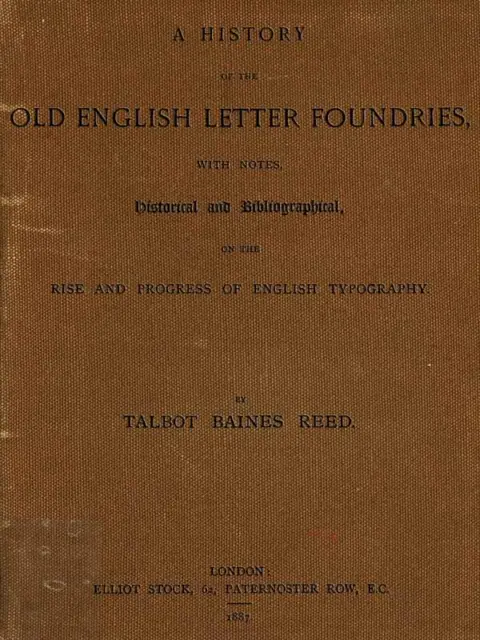
A History of the Old English Letter Foundries with Notes, Historical and Bibliographical, on the Rise and Progress of English Typography.
Talbot Baines Reed
THE CLASSIC COLLECTION · 1896
"Roger Ingleton, Minor" by Talbot Baines Reed is a novel written in the late 19th century. The story revolves around young Roger Ingleton as he navigates a life filled with familial secrets and responsibilities after his father, the old squire, passes away. With the discovery of a sealed letter from his father suggesting the possible existence of an estranged older brother, the narrative hints at themes of identity, family, and the search for belonging. The opening of the novel introduces us to a snowy setting at Maxfield Manor, where the elder Roger Ingleton is revealed to have just died. The remaining family now includes two other Roger Ingletons: the old man's estranged son, once thought dead, whose fate remains uncertain, and the titular character, a young man eager to uncover the truth. The opening also establishes the character of Frank Armstrong, a tutor concerned for his pupil's well-being as he begins to realize the challenges lying ahead for young Roger amidst the grief and potential revelations about his family. The narrative unfolds in a realistic manner, combining elements of mystery and emotional depth as it sets the stage for the protagonist's journey.
Introduction adapted from the source catalogue; source summaries may be automatically generated.
Free to read · English · 89,510 words · No account needed
MAKE TIME FOR A GOOD BOOK
On by default. Untick to stop anonymous reading totals. Each page counts after 10 seconds in view. How this works.
Anonymous counting is on unless you have switched it off.
"You'll have to do more, if you're to get rid of me. How about money?"
This abrupt question fairly staggered the captain, who broke out--
"Money! Didn't you drain me of every penny I had in London?"
The fellow laughed coarsely.
"What did you drain the regimental mess of, I should like to know? You needn't think you're out of that wood. Now, I shall want L200 for my month in town. I mean to enjoy myself."
The captain laughed dismally. "Where are you going to get it from?"
"You. Look sharp!"
"I tell you, Ratman, I haven't any money. You can't get blood out of a
stone."
"Then you must give me a bill--at a month."
"No, no! I won't begin that," said the captain, who had fibre enough left in him to know that a bill was the first plunge into an unknown region of financial difficulty. "If you're bent on ruining me in any case, for heaven's sake do it at once and have done with it. Remember, you bring down more than me. Whatever I may be, they don't deserve it."
"For their sake, then, give me the bill. Bless you, any one can put his hand to paper. Consider yourself lucky I don't insist on taking it out in hard cash."
It was no use arguing or protesting with a man like this. The captain flung himself miserably into a chair and scrawled out the ill-omened document.
Ratman snatched it up with a grunt of triumph.
"That's more like," said he. "What's the use of all that fuss? Plenty of things can happen in a month. Order the dogcart in half an hour."
The abrupt departure of Captain Oliphant's guest might have excited more remark than it did, had not another departure from Maxfield that same day thrown it somewhat into the shade.
True to her promise, or rather threat, Miss Rosalind had packed up her things and had them transported to the Vicarage.
It was not without a pang that she uprooted herself from her surroundings in Maxfield, or bore the protests of Roger, the tears of Jill, and the chaff of Tom for her desertion.
"It's not that you're not all awfully kind," said she to the first that afternoon, when the party was assembled in his room. "You are too kind--that's why I'm going."
"If a little of the opposite treatment would induce you to stay," said Roger, "I'd gladly try it. Don't you think it's a little unkind of her to go when we all want her to stay--eh, Armstrong?"
"That depends," said Mr Armstrong diplomatically. "I should be
inclined to say no, myself."
Your reading position is saved on this browser. Take it to another device with a library code. Reading pages adapt to text, rather than matching a printed edition.
Talbot Baines Reed
Talbot Baines Reed
Talbot Baines Reed
Talbot Baines Reed
BEHIND THE BOOK
This eBook is for the use of anyone anywhere in the United States and most other parts of the world at no cost and with almost no restrictions whatsoever. You may copy it, give it away or re-use it under the terms of the Project Gutenberg License included with this eBook or online at www.gutenberg.org. If you are not located in the United States, you will have to check the laws of the country where you are located before using this eBook. Read the source licence.
The original source file, including credits and licence, is retained by this library. Request an original-format copy at no charge. Please include the book title and Project Gutenberg identifier #21042.
KEEP YOUR CURIOSITY GOING
Coulson Kernahan

Maurice Baring
Frances Wright
Cécile Tormay

Frederic Jesup Stimson

W. H. P. (William Henry Pope) Jarvis