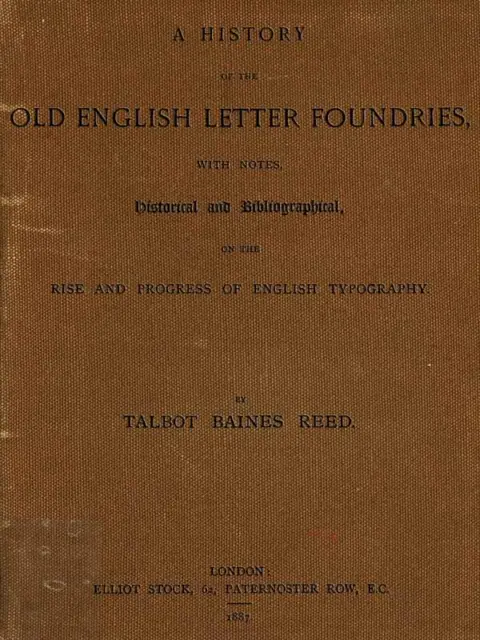
A History of the Old English Letter Foundries with Notes, Historical and Bibliographical, on the Rise and Progress of English Typography.
Talbot Baines Reed
THE CLASSIC COLLECTION · 1896
"Roger Ingleton, Minor" by Talbot Baines Reed is a novel written in the late 19th century. The story revolves around young Roger Ingleton as he navigates a life filled with familial secrets and responsibilities after his father, the old squire, passes away. With the discovery of a sealed letter from his father suggesting the possible existence of an estranged older brother, the narrative hints at themes of identity, family, and the search for belonging. The opening of the novel introduces us to a snowy setting at Maxfield Manor, where the elder Roger Ingleton is revealed to have just died. The remaining family now includes two other Roger Ingletons: the old man's estranged son, once thought dead, whose fate remains uncertain, and the titular character, a young man eager to uncover the truth. The opening also establishes the character of Frank Armstrong, a tutor concerned for his pupil's well-being as he begins to realize the challenges lying ahead for young Roger amidst the grief and potential revelations about his family. The narrative unfolds in a realistic manner, combining elements of mystery and emotional depth as it sets the stage for the protagonist's journey.
Introduction adapted from the source catalogue; source summaries may be automatically generated.
Free to read · English · 89,510 words · No account needed
MAKE TIME FOR A GOOD BOOK
On by default. Untick to stop anonymous reading totals. Each page counts after 10 seconds in view. How this works.
Anonymous counting is on unless you have switched it off.
Mr Armstrong, as unconcerned as if he had just returned from a half- hour's stroll, had little idea of the flutter which his return caused to the Maxfield family. He could hardly know that Raffles was parading the lower regions rubbing his hands, and informing his acquaintance down there that the season for "larks" was coming on; nor, as he was out of earshot, could he be supposed to know the particularly forcible expressions which Captain Oliphant rehearsed to himself in celebration of the occasion. As for the young people, it did afford him a passing gratification to feel his pupil's arm linked once more in his own, and to encounter the expected boisterous welcome from Tom and Jill. Miss Rosalind was busy, forsooth! and if Mr Armstrong flattered himself she took the slightest interest in his return, he might find out his mistake.
"I'll join you in a minute, Roger," said he to his ward, "but I must go and pay my respects to your mother."
"Oh, she'll keep," said Roger; "I want to hear what you've been up to."
"In five minutes," said the tutor, going to the drawing-room.
Mrs Ingleton was there, looking pale and fragile, pouring out afternoon tea for Captain Oliphant.
"Why, Mr Armstrong," said she, "we had given you up for lost; Roger was getting quite melancholy without you."
"I understood," began the captain, "when you asked leave--"
"Mrs Ingleton, I must ask you to excuse my long absence. I went to see a dying friend, and was unable to return earlier."
"You might have written," said the captain, returning to the charge.
Mr Armstrong screwed his eye-glass round and stared at the speaker.
"I beg your pardon," said he.
"I say, sir, you might have written. Let me tell you, Mr Armstrong, that, as my dear relative's co-trustee and guardian--"
"I am sorry," observed the tutor, addressing Mrs Ingleton, "that Roger's cough is still troubling him. He is waiting for me upstairs, by the bye, but I was anxious to offer you my apologies without delay for my long absence."
"Mr Armstrong," said the captain, stepping between the tutor and the door, "this will not do, sir. When I speak to you, I expect you to listen."
Mr Armstrong bowed politely.
"I repeat, sir, your conduct satisfies neither me nor your mistress. You forget, sir, that you are here on sufferance, and I desire to caution you that it may become necessary to dispense with your services, unless-- I am speaking to you, Mr Armstrong."
Mr Armstrong was examining with some curiosity a china group on the mantelpiece. He turned round gravely.
"You were saying--?" said he.
The captain gave it up.
Your reading position is saved on this browser. Take it to another device with a library code. Reading pages adapt to text, rather than matching a printed edition.
Talbot Baines Reed
Talbot Baines Reed
Talbot Baines Reed
Talbot Baines Reed
BEHIND THE BOOK
This eBook is for the use of anyone anywhere in the United States and most other parts of the world at no cost and with almost no restrictions whatsoever. You may copy it, give it away or re-use it under the terms of the Project Gutenberg License included with this eBook or online at www.gutenberg.org. If you are not located in the United States, you will have to check the laws of the country where you are located before using this eBook. Read the source licence.
The original source file, including credits and licence, is retained by this library. Request an original-format copy at no charge. Please include the book title and Project Gutenberg identifier #21042.
KEEP YOUR CURIOSITY GOING
Coulson Kernahan

Maurice Baring
Frances Wright
Cécile Tormay

Frederic Jesup Stimson

W. H. P. (William Henry Pope) Jarvis