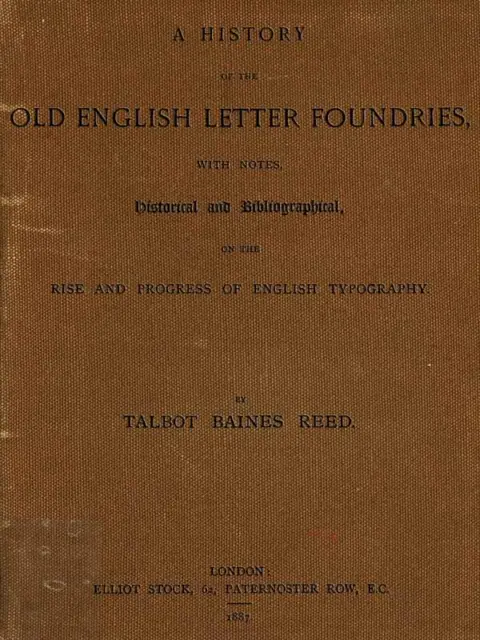
A History of the Old English Letter Foundries with Notes, Historical and Bibliographical, on the Rise and Progress of English Typography.
Talbot Baines Reed
THE CLASSIC COLLECTION · 1896
"Roger Ingleton, Minor" by Talbot Baines Reed is a novel written in the late 19th century. The story revolves around young Roger Ingleton as he navigates a life filled with familial secrets and responsibilities after his father, the old squire, passes away. With the discovery of a sealed letter from his father suggesting the possible existence of an estranged older brother, the narrative hints at themes of identity, family, and the search for belonging. The opening of the novel introduces us to a snowy setting at Maxfield Manor, where the elder Roger Ingleton is revealed to have just died. The remaining family now includes two other Roger Ingletons: the old man's estranged son, once thought dead, whose fate remains uncertain, and the titular character, a young man eager to uncover the truth. The opening also establishes the character of Frank Armstrong, a tutor concerned for his pupil's well-being as he begins to realize the challenges lying ahead for young Roger amidst the grief and potential revelations about his family. The narrative unfolds in a realistic manner, combining elements of mystery and emotional depth as it sets the stage for the protagonist's journey.
Introduction adapted from the source catalogue; source summaries may be automatically generated.
Free to read · English · 89,510 words · No account needed
MAKE TIME FOR A GOOD BOOK
On by default. Untick to stop anonymous reading totals. Each page counts after 10 seconds in view. How this works.
Anonymous counting is on unless you have switched it off.
"I am not at all like father," said she quietly, scanning him as she spoke in a way which made even him uncomfortable, and then putting her hand on her father's arm.
Thus repulsed, the visitor cheerfully offered his arm to Mrs Ingleton, congratulating her as he did so on the recovery of her son.
During the meal he was aware that the young lady's eyes were completing their scrutiny, and although, being a bashful man, he did not venture too often to meet them with his own, he was conscious that the result was not altogether satisfactory to himself. His few attempts to talk to her fell flat, and in spite of the captain's almost nervous attempts to improve the festivity of the occasion, the meal was an uncomfortable one.
"Where's old Armstrong?" demanded Tom.
"With Roger," replied Rosalind.
"Have you seen Armstrong?" inquired the boy of the visitor; "he's a stunner, I can tell you. He can bend a poker double across his knee. You'll like him awfully; and he plays the piano like one o'clock. He's our tutor, you know--no end of a chap."
Mr Ratman was fain to express a longing desire to make the acquaintance of so redoubtable a hero.
"Does he lick you?" he inquired.
"Sometimes, when it's wanted; but, bless you, he could take the lot of us left-handed; couldn't he, Jill?"
"Oh, yes," said Jill enthusiastically; "and he saved Roger's life, and prevented Hodder being turned out, and won such a lot of prizes at Oxford."
"He must be a fine fellow," said Ratman, with a disagreeable laugh. "You admire him too, of course, Miss Oliphant?"
"Yes, he's honest," said she.
"Teddy, my boy," said the visitor, when he and his friend had been left alone at the table, "that girl of yours is a treasure. She don't fancy me, but she'll get over that. I like her, Teddy; I like her."
That evening, on his way to say good night to his dear ward, Captain Oliphant stopped at his daughter's door.
She was hard at work over a picture.
"Rosalind," said he, "you have disappointed me. But if your mind is made up, I know it is no use my setting up my authority against your self-will. Therefore, to relieve you of the sin of disobedience to your father's wishes, I withdraw my refusal to your proposal. You may do as you like. Good night!"
Your reading position is saved on this browser. Take it to another device with a library code. Reading pages adapt to text, rather than matching a printed edition.
Talbot Baines Reed
Talbot Baines Reed
Talbot Baines Reed
Talbot Baines Reed
BEHIND THE BOOK
This eBook is for the use of anyone anywhere in the United States and most other parts of the world at no cost and with almost no restrictions whatsoever. You may copy it, give it away or re-use it under the terms of the Project Gutenberg License included with this eBook or online at www.gutenberg.org. If you are not located in the United States, you will have to check the laws of the country where you are located before using this eBook. Read the source licence.
The original source file, including credits and licence, is retained by this library. Request an original-format copy at no charge. Please include the book title and Project Gutenberg identifier #21042.
KEEP YOUR CURIOSITY GOING
Coulson Kernahan

Maurice Baring
Frances Wright
Cécile Tormay

Frederic Jesup Stimson

W. H. P. (William Henry Pope) Jarvis