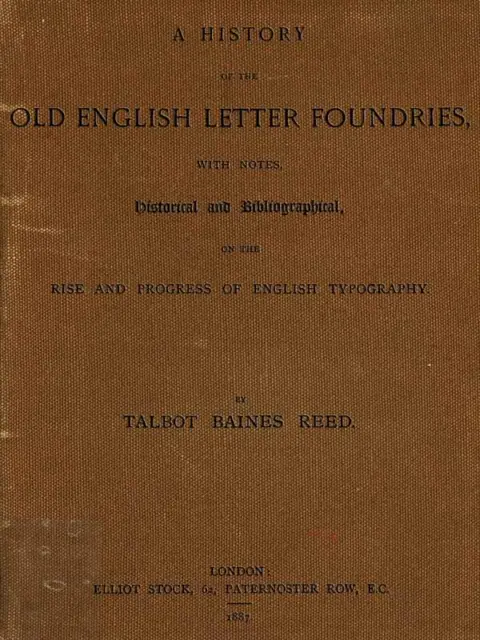
A History of the Old English Letter Foundries with Notes, Historical and Bibliographical, on the Rise and Progress of English Typography.
Talbot Baines Reed
THE CLASSIC COLLECTION · 1896
"Roger Ingleton, Minor" by Talbot Baines Reed is a novel written in the late 19th century. The story revolves around young Roger Ingleton as he navigates a life filled with familial secrets and responsibilities after his father, the old squire, passes away. With the discovery of a sealed letter from his father suggesting the possible existence of an estranged older brother, the narrative hints at themes of identity, family, and the search for belonging. The opening of the novel introduces us to a snowy setting at Maxfield Manor, where the elder Roger Ingleton is revealed to have just died. The remaining family now includes two other Roger Ingletons: the old man's estranged son, once thought dead, whose fate remains uncertain, and the titular character, a young man eager to uncover the truth. The opening also establishes the character of Frank Armstrong, a tutor concerned for his pupil's well-being as he begins to realize the challenges lying ahead for young Roger amidst the grief and potential revelations about his family. The narrative unfolds in a realistic manner, combining elements of mystery and emotional depth as it sets the stage for the protagonist's journey.
Introduction adapted from the source catalogue; source summaries may be automatically generated.
Free to read · English · 89,510 words · No account needed
MAKE TIME FOR A GOOD BOOK
On by default. Untick to stop anonymous reading totals. Each page counts after 10 seconds in view. How this works.
Anonymous counting is on unless you have switched it off.
"Ah, Hodder," said he, after saluting the young lady, "what's all this about turning you out of your cottage! What a notion to get into your head!"
"You may call it a notion, Mr Armstrong," said the old man, "but what about this here piece of paper?" And he produced a blue legal document.
Mr Armstrong put up his eye-glass and read it, with a face which, as Rosalind furtively glanced upwards, seemed inscrutable. When he had finished he coolly put it in his pocket.
"I'll see to this," said he. "You choose the best time of day for a
walk, Miss Oliphant."
"Shall you really be able to settle this for Hodder?" replied she.
"I've very little doubt about it."
The old man chuckled ungallantly. "He, he," said he, "Missy, you ladies are good enough for tea and sugar, but it takes a man to put the likes of me right with my masters."
Armstrong flushed angrily at this speech and was about to relieve his mind when Rosalind laughingly interposed--
"Poor old Hodder! You're quite right; I should never have been clever enough to help you. Good-bye. I'm so glad."
To tell the truth, Miss Oliphant was a good deal more engrossed with what the old man had let drop concerning the lost Roger than with the tutor and his knowledge of the law of landlord and tenant.
"Suppose he did not die!" she said, half scared at the boldness of the suggestion. "If he were to come back!" And she went back and looked long once more at the picture. Then with less satisfaction she contemplated her own copy. Thus employed Roger found her when he passed her door an hour later.
"Still harping on my brother," said he.
"I've done with him, thank you," said Rosalind, handing him back the picture. "See, I have one of my own now."
"Why, it's better than the original. I like it better."
"That shows how little you know about painting."
"It shows how much you know about my brother," said he. "But if you like to keep the original and let me have the copy, I should consider I had the best of the bargain."
Rosalind tossed her head and locked her own copy up in her desk.
"Roger," she said when that was done, "where did he die?"
"The date is on the picture, if one could only make it out. He was abroad at the time, I believe."
"Where?"
"I never heard."
"Have you never tried to find out?"
Roger looked at her, startled.
"It was before I was born," said he. "Father never spoke of him. But
why do you ask?"
Your reading position is saved on this browser. Take it to another device with a library code. Reading pages adapt to text, rather than matching a printed edition.
Talbot Baines Reed
Talbot Baines Reed
Talbot Baines Reed
Talbot Baines Reed
BEHIND THE BOOK
This eBook is for the use of anyone anywhere in the United States and most other parts of the world at no cost and with almost no restrictions whatsoever. You may copy it, give it away or re-use it under the terms of the Project Gutenberg License included with this eBook or online at www.gutenberg.org. If you are not located in the United States, you will have to check the laws of the country where you are located before using this eBook. Read the source licence.
The original source file, including credits and licence, is retained by this library. Request an original-format copy at no charge. Please include the book title and Project Gutenberg identifier #21042.
KEEP YOUR CURIOSITY GOING
Coulson Kernahan

Maurice Baring
Frances Wright
Cécile Tormay

Frederic Jesup Stimson

W. H. P. (William Henry Pope) Jarvis