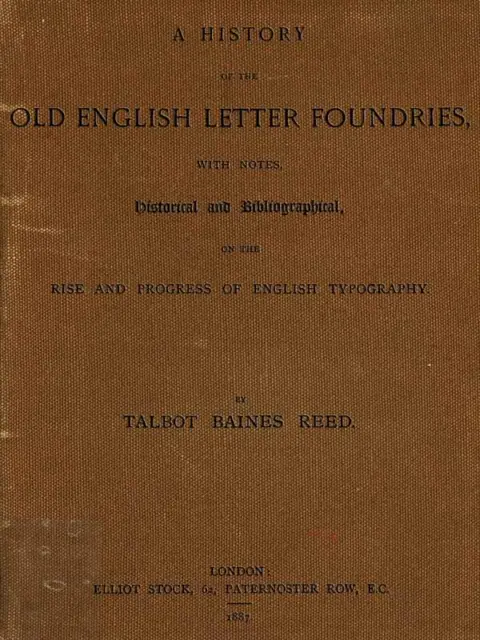
A History of the Old English Letter Foundries with Notes, Historical and Bibliographical, on the Rise and Progress of English Typography.
Talbot Baines Reed
THE CLASSIC COLLECTION · 1896
"Roger Ingleton, Minor" by Talbot Baines Reed is a novel written in the late 19th century. The story revolves around young Roger Ingleton as he navigates a life filled with familial secrets and responsibilities after his father, the old squire, passes away. With the discovery of a sealed letter from his father suggesting the possible existence of an estranged older brother, the narrative hints at themes of identity, family, and the search for belonging. The opening of the novel introduces us to a snowy setting at Maxfield Manor, where the elder Roger Ingleton is revealed to have just died. The remaining family now includes two other Roger Ingletons: the old man's estranged son, once thought dead, whose fate remains uncertain, and the titular character, a young man eager to uncover the truth. The opening also establishes the character of Frank Armstrong, a tutor concerned for his pupil's well-being as he begins to realize the challenges lying ahead for young Roger amidst the grief and potential revelations about his family. The narrative unfolds in a realistic manner, combining elements of mystery and emotional depth as it sets the stage for the protagonist's journey.
Introduction adapted from the source catalogue; source summaries may be automatically generated.
Free to read · English · 89,510 words · No account needed
MAKE TIME FOR A GOOD BOOK
On by default. Untick to stop anonymous reading totals. Each page counts after 10 seconds in view. How this works.
Anonymous counting is on unless you have switched it off.
It was no light task on a night like this to plough through the snow for five miles in search of help, and the lanes to Yeld were, even in open weather, none of the easiest. But the tutor was not the kind of man to trouble himself about difficulties of that sort, provided only he could find the doctor in, and transport him in a reasonable time to Maxfield.
As he passed the stables, he glanced within, on the off-chance of finding a horse available. But the place was empty, and not even a stable-boy could be made to hear his summons.
So he tramped out into the road, where the snow lay a foot deep, and with long strides carved his way through it towards Yeld. Half a mile on he overtook a country cart, heavily laden and stuck fast in the snow.
"Ah! Hodder," said he to the nonplussed old man in charge, "you may as
well give it up."
"So I are without your telling," growled the countryman.
"Very well; I want your horse for a couple of hours. The Squire's ill, and I have to fetch the doctor."
And without another word, and heedless of the ejaculations of the bewildered Hodder, he began to loose the animal's girths.
"I'm blamed if you have a hair of him," said the yokel.
"I don't want one. Here!" and he pitched him a half-crown. The man gaped stupidly at the unharnessing of his beast, and began to pump up for another protest.
But before the words were ready, Mr Armstrong had led the horse out of the shafts and had vaulted on his bare back.
"Eh," sputtered Hodder, "may I--"
"Good-bye and thanks," said the tutor, clapping his heels to the animal's flanks; "you shall have him back safe."
And he plunged away, leaving the gaping son of the soil, with his half- crown in his hand, to the laborious task of hoisting his lower jaw back into its normal position.
Dr Brandram, in whose medical preserves Maxfield Manor lay, was solacing himself with an after-dinner pipe in his little cottage at Yeld, when the tutor, crusted in snow from head to foot, broke unceremoniously on his privacy. An intuition told the doctor what was the matter before even his visitor could say--
"The Squire has had a stroke. Come at once."
The doctor put down his pipe, and, with a sigh, kicked off his cosy
slippers.
"He has chosen a bad night, Armstrong. How are the roads?"
"A foot deep. Shall you drive or ride?"
"I never ride."
"You'll need both horses to get through, and I can lend you a spent
third."
Your reading position is saved on this browser. Take it to another device with a library code. Reading pages adapt to text, rather than matching a printed edition.
Talbot Baines Reed
Talbot Baines Reed
Talbot Baines Reed
Talbot Baines Reed
BEHIND THE BOOK
This eBook is for the use of anyone anywhere in the United States and most other parts of the world at no cost and with almost no restrictions whatsoever. You may copy it, give it away or re-use it under the terms of the Project Gutenberg License included with this eBook or online at www.gutenberg.org. If you are not located in the United States, you will have to check the laws of the country where you are located before using this eBook. Read the source licence.
The original source file, including credits and licence, is retained by this library. Request an original-format copy at no charge. Please include the book title and Project Gutenberg identifier #21042.
KEEP YOUR CURIOSITY GOING
Coulson Kernahan

Maurice Baring
Frances Wright
Cécile Tormay

Frederic Jesup Stimson

W. H. P. (William Henry Pope) Jarvis