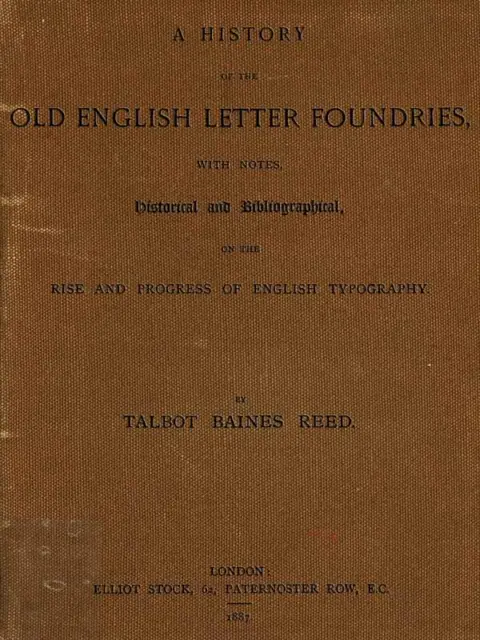
A History of the Old English Letter Foundries with Notes, Historical and Bibliographical, on the Rise and Progress of English Typography.
Talbot Baines Reed
THE CLASSIC COLLECTION · 1896
"Roger Ingleton, Minor" by Talbot Baines Reed is a novel written in the late 19th century. The story revolves around young Roger Ingleton as he navigates a life filled with familial secrets and responsibilities after his father, the old squire, passes away. With the discovery of a sealed letter from his father suggesting the possible existence of an estranged older brother, the narrative hints at themes of identity, family, and the search for belonging. The opening of the novel introduces us to a snowy setting at Maxfield Manor, where the elder Roger Ingleton is revealed to have just died. The remaining family now includes two other Roger Ingletons: the old man's estranged son, once thought dead, whose fate remains uncertain, and the titular character, a young man eager to uncover the truth. The opening also establishes the character of Frank Armstrong, a tutor concerned for his pupil's well-being as he begins to realize the challenges lying ahead for young Roger amidst the grief and potential revelations about his family. The narrative unfolds in a realistic manner, combining elements of mystery and emotional depth as it sets the stage for the protagonist's journey.
Introduction adapted from the source catalogue; source summaries may be automatically generated.
Free to read · English · 89,510 words · No account needed
MAKE TIME FOR A GOOD BOOK
On by default. Untick to stop anonymous reading totals. Each page counts after 10 seconds in view. How this works.
Anonymous counting is on unless you have switched it off.
"Silence, miss, and bear in mind what I tell you. Do you understand?"
Rosalind had taken up her brush and was painting furiously at her
picture.
Captain Oliphant having waited a minute for an answer and getting none, stalked out of the room a model of parental anguish. As for Miss Rosalind, she painted away for a quarter of an hour, and then said to herself--
"Is he?"
With which profound inquiry she laid down her brush and went to visit
her invalid cousin.
Roger was up, though still coughing, and ensconced in his study.
"How jolly of you to come!" said he.
"I came because I'd nothing else to do," said she, "I'm not jolly at
all."
"Why, what's the row?"
"Can't you guess? Don't you know that I owe you already for a week's board and lodgings and haven't earned sixpence to pay you."
"I shall put you in the county court," said Roger solemnly.
"It's no joke to me," said she.
"I know it isn't, and I wish to goodness I could help you out. By the way, though," added he, jumping up from his chair, "I've got it."
"Don't," said she; "you'll only start the cough. What have you got? An
idea?"
"Yes. Rosalind, do you know I'm going to get some painting-lessons?"
"Where? Oh, I wish I could afford some too. Is there any one near here
who teaches?"
"Yes. Some one who's just starting. A rather jolly girl, only she has an awful temper; and I'm afraid, when she sees what a poor hand I make, she'll have no patience with me."
Rosalind looked at him steadily, and then smiled.
"How nice of you! May I really try? I'll teach you all I know."
"Will you promise to be nice, and never to fly out at me?"
"No, I'll promise nothing of the sort. But if you learn well, I'll be
very proud."
"And your terms?"
She looked at him again.
"Would a shilling an hour be an awful lot?"
"No. It's very moderate. I accept the terms. I'll begin to-day."
This satisfactory bargain being concluded. Miss Rosalind inquired how
her new pupil's cold was.
"Nearly all right. I'm glad to have got rid of it before Armstrong
comes back."
"When will that be?"
"I don't know. He hasn't written a line. I hope he'll come soon."
"Are you awfully fond of him!" asked Rosalind.
"Rather," replied the boy.
"That's exactly what he said when I asked him if he was fond of you."
"Odd," said Roger with a laugh. "But, I say, what do you think of my den? Isn't it rather snug?"
Your reading position is saved on this browser. Take it to another device with a library code. Reading pages adapt to text, rather than matching a printed edition.
Talbot Baines Reed
Talbot Baines Reed
Talbot Baines Reed
Talbot Baines Reed
BEHIND THE BOOK
This eBook is for the use of anyone anywhere in the United States and most other parts of the world at no cost and with almost no restrictions whatsoever. You may copy it, give it away or re-use it under the terms of the Project Gutenberg License included with this eBook or online at www.gutenberg.org. If you are not located in the United States, you will have to check the laws of the country where you are located before using this eBook. Read the source licence.
The original source file, including credits and licence, is retained by this library. Request an original-format copy at no charge. Please include the book title and Project Gutenberg identifier #21042.
KEEP YOUR CURIOSITY GOING
Coulson Kernahan

Maurice Baring
Frances Wright
Cécile Tormay

Frederic Jesup Stimson

W. H. P. (William Henry Pope) Jarvis