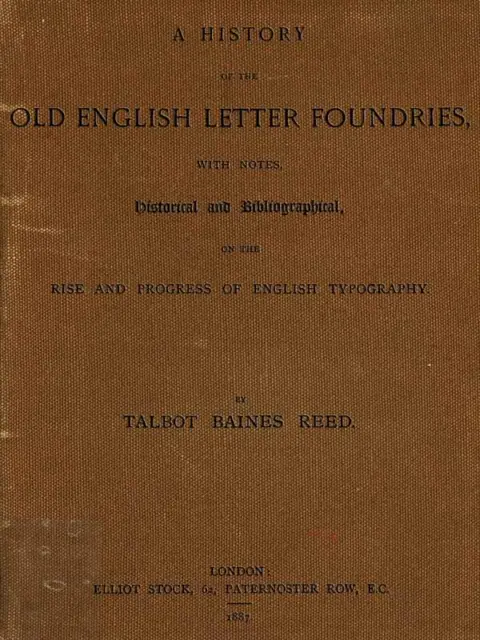
A History of the Old English Letter Foundries with Notes, Historical and Bibliographical, on the Rise and Progress of English Typography.
Talbot Baines Reed
THE CLASSIC COLLECTION · 1896
"Roger Ingleton, Minor" by Talbot Baines Reed is a novel written in the late 19th century. The story revolves around young Roger Ingleton as he navigates a life filled with familial secrets and responsibilities after his father, the old squire, passes away. With the discovery of a sealed letter from his father suggesting the possible existence of an estranged older brother, the narrative hints at themes of identity, family, and the search for belonging. The opening of the novel introduces us to a snowy setting at Maxfield Manor, where the elder Roger Ingleton is revealed to have just died. The remaining family now includes two other Roger Ingletons: the old man's estranged son, once thought dead, whose fate remains uncertain, and the titular character, a young man eager to uncover the truth. The opening also establishes the character of Frank Armstrong, a tutor concerned for his pupil's well-being as he begins to realize the challenges lying ahead for young Roger amidst the grief and potential revelations about his family. The narrative unfolds in a realistic manner, combining elements of mystery and emotional depth as it sets the stage for the protagonist's journey.
Introduction adapted from the source catalogue; source summaries may be automatically generated.
Free to read · English · 89,510 words · No account needed
MAKE TIME FOR A GOOD BOOK
On by default. Untick to stop anonymous reading totals. Each page counts after 10 seconds in view. How this works.
Anonymous counting is on unless you have switched it off.
"Who is this grandee?" he asked himself. "A man hired at a few pounds a year and fed at the Maxfield table, in order to help the heir to a little quite unnecessary knowledge of the ancient classics and modern sciences. What was the old dotard,"--the old dotard, by the way, was Captain Oliphant's private manner of referring to the lamented "dear one," whose name so often trembled on his lips in public,--"what was the old dotard thinking about? At any rate, I should like to know a little more about the fellow myself."
With this laudable intention he questioned Mrs Ingleton next morning.
"He is a good friend to dear Roger," said the mother. "Roger is devoted to him. I am sure you will get to like him, Edward. He is perhaps a little odd in his manner, but he has a good heart."
This was about all Mrs Ingleton knew, except that he was a University man and an accomplished musician.
Captain Oliphant was not much enlightened by this description. He sat down, and for the third time carefully read over the "dear one's" will.
"I think," said he at lunch-time, "I will stroll over to Yeld this afternoon and see Mr Pottinger. Roger, will you walk with me? A walk would do you good. You are looking pale, my boy."
"Oh, I'm all right," said Roger, whose cough, however, was still obstinate. "I'll come with pleasure."
A walk of five miles on a damp afternoon through drenched country lanes may be a good specific for a cough in India, but in England it occasionally fails in this respect. Roger was wet through when he reached Yeld.
"I shall not be long," said the Captain as they reached the attorney's door. "Don't catch cold, there's a good fellow. Remember your health is very precious."
Roger undertook to act on this considerate advice, and occupied his time of waiting by strolling up and down the High Street in the rain, paying a call here and there at one or two shops, and finally dropping in to see his friend Dr Brandram.
The Captain meanwhile was having an interesting chat with the attorney.
After introducing himself and receiving the suitable congratulations, he
said--
"Mr Ingleton's will, Mr Pottinger, so far as I can understand it, seems fairly simple, and I am ready and anxious to perform my part of its provisions."
"Yes. You see, after all, it is only a matter of two years' trouble. As soon as Master Roger comes of age you will be released."
"Unless," says the Captain, laughing, "he marries, becomes mad, or goes to prison, isn't that it? What a curious proviso!"
Your reading position is saved on this browser. Take it to another device with a library code. Reading pages adapt to text, rather than matching a printed edition.
Talbot Baines Reed
Talbot Baines Reed
Talbot Baines Reed
Talbot Baines Reed
BEHIND THE BOOK
This eBook is for the use of anyone anywhere in the United States and most other parts of the world at no cost and with almost no restrictions whatsoever. You may copy it, give it away or re-use it under the terms of the Project Gutenberg License included with this eBook or online at www.gutenberg.org. If you are not located in the United States, you will have to check the laws of the country where you are located before using this eBook. Read the source licence.
The original source file, including credits and licence, is retained by this library. Request an original-format copy at no charge. Please include the book title and Project Gutenberg identifier #21042.
KEEP YOUR CURIOSITY GOING
Coulson Kernahan

Maurice Baring
Frances Wright
Cécile Tormay

Frederic Jesup Stimson

W. H. P. (William Henry Pope) Jarvis