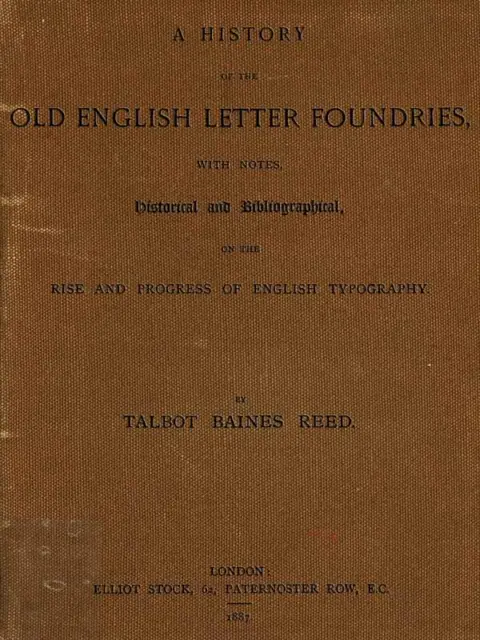
A History of the Old English Letter Foundries with Notes, Historical and Bibliographical, on the Rise and Progress of English Typography.
Talbot Baines Reed
THE CLASSIC COLLECTION · 1896
"Roger Ingleton, Minor" by Talbot Baines Reed is a novel written in the late 19th century. The story revolves around young Roger Ingleton as he navigates a life filled with familial secrets and responsibilities after his father, the old squire, passes away. With the discovery of a sealed letter from his father suggesting the possible existence of an estranged older brother, the narrative hints at themes of identity, family, and the search for belonging. The opening of the novel introduces us to a snowy setting at Maxfield Manor, where the elder Roger Ingleton is revealed to have just died. The remaining family now includes two other Roger Ingletons: the old man's estranged son, once thought dead, whose fate remains uncertain, and the titular character, a young man eager to uncover the truth. The opening also establishes the character of Frank Armstrong, a tutor concerned for his pupil's well-being as he begins to realize the challenges lying ahead for young Roger amidst the grief and potential revelations about his family. The narrative unfolds in a realistic manner, combining elements of mystery and emotional depth as it sets the stage for the protagonist's journey.
Introduction adapted from the source catalogue; source summaries may be automatically generated.
Free to read · English · 89,510 words · No account needed
MAKE TIME FOR A GOOD BOOK
On by default. Untick to stop anonymous reading totals. Each page counts after 10 seconds in view. How this works.
Anonymous counting is on unless you have switched it off.
"Oh, you!" said Roger, smiling; "yes, you'll need to look out how you behave, you know, or I shall have to terminate our engagement. Isn't it queer?"
Queer as it was, the tutor winced at the jest, and screwed his eye-glass a little deeper into his eye.
"Seriously, though," said Roger, "I'm awfully glad I've got you here to advise me. I want to do things well about the place, and keep square with the tenants, and improve a great many things. I noticed a whole lot of cottages to-day that want rebuilding. And I think I ought to build a club-room for the young fellows in the village, and give a new lifeboat to replace the `Vega,' What do you think?"
"I'll tell you this time to-morrow. Meanwhile what do you say to a ride before dark? It would do you good."
They had a long trot through the lanes and along the shore, ending with a canter over the downs, which landed the heir of Maxfield at home with a glow in his cheeks and an appetite such as he had not known for a week.
Next day the funeral took place in the family vault at the little churchyard of Yeld. The villagers, as in duty bound, flocked to pay their last respects to the old Squire, whose face for the last twenty years they had scarcely seen, and of whose existence, save on rent-day, many of them had been well-nigh ignorant.
Many an eye turned curiously to the slim, pale boy, as he stood alone, the last of his house, at the open tomb; and many a speculation as to his temper and prospects occupied minds which were supposed to be intent on the solemn words of the Burial Service.
Roger himself, with that waywardness of the attention which afflicts us even in the gravest acts of our life, found himself listening to the words in a sort of dream, while his mind was occupied in reading over to himself the names of his ancestors inscribed on the panels of the vault.
"John Ingleton of Maxfield Manor, who died ye ninth day of June, 1760,
aetat 74.
"Peter Ingleton of Maxfield Manor, his son, obiit March 6, 1794.
"Paul Ingleton, only son of above Peter; born January 1, 1790, died
September 20, 1844.
"Ruth, beloved wife of Roger Ingleton, Esquire, of Maxfield Manor, who died on February 14, 1865, aged 37."
Now a new inscription would be added.
"Roger Ingleton, son of the above-named Paul Ingleton, who died January
10, 1885."
And when that was added, there would yet be space for another name
below.
Roger shuddered a little, and brought his mind back with an effort to the solemn act which was taking place.
Your reading position is saved on this browser. Take it to another device with a library code. Reading pages adapt to text, rather than matching a printed edition.
Talbot Baines Reed
Talbot Baines Reed
Talbot Baines Reed
Talbot Baines Reed
BEHIND THE BOOK
This eBook is for the use of anyone anywhere in the United States and most other parts of the world at no cost and with almost no restrictions whatsoever. You may copy it, give it away or re-use it under the terms of the Project Gutenberg License included with this eBook or online at www.gutenberg.org. If you are not located in the United States, you will have to check the laws of the country where you are located before using this eBook. Read the source licence.
The original source file, including credits and licence, is retained by this library. Request an original-format copy at no charge. Please include the book title and Project Gutenberg identifier #21042.
KEEP YOUR CURIOSITY GOING
Coulson Kernahan

Maurice Baring
Frances Wright
Cécile Tormay

Frederic Jesup Stimson

W. H. P. (William Henry Pope) Jarvis