THE CLASSIC COLLECTION✦An outlaw’s diary: the CommuneCLASSIC FREE BOOKS
An outlaw’s diary: the Commune
Cécile Tormay
THE CLASSIC COLLECTION · 1899
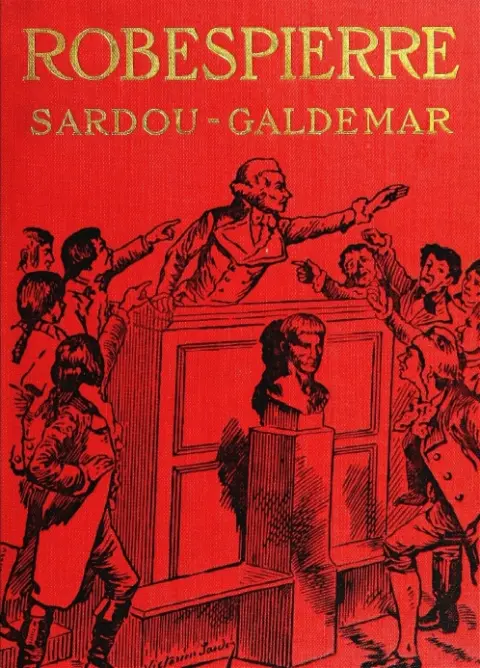
"Robespierre" by Ange Galdemar is a historical novel written in the late 19th century. The book is based on Victorien Sardou's play and explores the complex life of Maximilien Robespierre, a leading figure of the French Revolution. It delves into themes of power, ambition, and personal sacrifice amid the tumultuous backdrop of revolutionary France, focusing on characters such as Robespierre himself, Monsieur de Pontivy, and Clarisse. The opening of "Robespierre" introduces readers to the Hôtel de Pontivy, where we meet Monsieur de Pontivy as he searches for a lost document important for a secret debate in Parliament. Here, the reader is introduced to his daughter Clarisse, who navigates a sheltered life and shares a complicated relationship with both her father and Robespierre, her father's secretary. The tension rises as it becomes apparent that their lives are entwined through shared ambitions and the unacknowledged consequences of their interactions. The initial chapter sets the stage for the unfolding drama, hinting at themes of love, betrayal, and the heavy burdens of honor and reputation that will develop as the story progresses.
Introduction adapted from the source catalogue; source summaries may be automatically generated.
Free to read · English · 71,073 words · No account needed
MAKE TIME FOR A GOOD BOOK
On by default. Untick to stop anonymous reading totals. Each page counts after 10 seconds in view. How this works.
Anonymous counting is on unless you have switched it off.
The Recorder of the Revolutionary Tribunal now passed the grating, accompanied by Haly, the concierge, and followed by turnkeys and gendarmes, who, on entering the courtyard, formed themselves in line. The Recorder was a little man, fat and full-blooded, his face twisted into a sly, ugly smile. He seemed highly amused at the spectacle, and seated himself under the acacia, talking to the concierge, who seemed surprised to see him, and said--
"I thought the Tribunal would not sit to-morrow on account of the Festival of the Supreme Being?"
"You are right! But they will sit the day after to-morrow. You
understand, I want to be free to-morrow and to take part in the
festival...."
And with a cynical laugh he called for a glass of wine, which he
emptied at a draught.
"Attention! We must begin business!" he said; and with this he unfolded the paper, the terrible paper, wherein the fate of the victims had been decided in advance. But the day was near its close, the Recorder could not see, and had to ask for a lantern.
The courtyard was full now.
Prisoners from the neighbouring yards had assembled in answer to the call. All this little world was affected by various feelings; some were resigned, some hopeful, some indifferent or frightened as they looked at the messenger of death, who seemed quite unconscious of his ignominy.
What names would fall from his lips? There were some, worn out and weary, looking forward to death as a release, who would have willingly put theirs into his mouth. Others, more feeble, who were undergoing the full horrors of suspense, stood in breathless fear, almost choked with anguish. Oh! that horrible hope of hearing another's name called, rather than one's own! And yet...
The Recorder was becoming impatient.
"Where is that lantern!" he shouted. "Is every one asleep here?"
A few of the prisoners had refrained from joining the anxious crowd; either from habit or indifference, without disturbing themselves, they continued playing or conversing as before. Clarisse and Thérèse were seated at a little distance, their eyes fixed on the dread official, while Olivier, standing near, ready to defend them, watched the affecting scene with strained anxiety.
The Recorder was swearing now.
"Is that cursed lantern never coming? So much the worse! I shall
commence without it."
And he rose and tried to decipher the names in the dark.
"The first name is Bour ... no, Lour..."
Here a voice interrupted him in indignant protest.
"Oh! don't read like that! You double their sufferings. It is
horrible! too horrible!"
It was Olivier.
"Who dares to speak here?" thundered the Recorder.
Clarisse desperately pulled her son by the arm.
Your reading position is saved on this browser. Take it to another device with a library code. Reading pages adapt to text, rather than matching a printed edition.
BEHIND THE BOOK
This eBook is for the use of anyone anywhere in the United States and most other parts of the world at no cost and with almost no restrictions whatsoever. You may copy it, give it away or re-use it under the terms of the Project Gutenberg License included with this eBook or online at www.gutenberg.org. If you are not located in the United States, you will have to check the laws of the country where you are located before using this eBook. Read the source licence.
The original source file, including credits and licence, is retained by this library. Request an original-format copy at no charge. Please include the book title and Project Gutenberg identifier #71538.
KEEP YOUR CURIOSITY GOING
Cécile Tormay

Moritz Busch
Coulson Kernahan
John L. Ransom

Maurice Baring
Frances Wright