THE CLASSIC COLLECTION✦An outlaw’s diary: the CommuneCLASSIC FREE BOOKS
An outlaw’s diary: the Commune
Cécile Tormay
THE CLASSIC COLLECTION · 1901
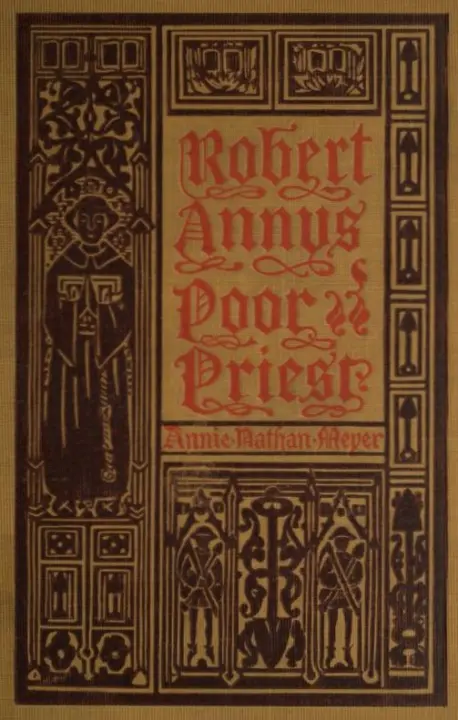
"Robert Annys: Poor Priest. A Tale of the Great Uprising" by Annie Nathan Meyer is a historical novel written in the early 20th century. The story revolves around Robert Annys, a poor priest who becomes embroiled in the tensions and injustices of 14th-century England amidst the backdrop of social upheaval and revolutionary ideas. The narrative explores themes of faith, social justice, and the crisis within the Church as Annys grapples with his convictions and the realities of the world around him. The opening of the book introduces Robert Annys standing before the majestic Ely Minster on a November evening in 1379. He is depicted as a solitary figure in rough clothing, reflecting on his commitment to the poor and the teachings of his mentor, John Wyclif. Annys, who dedicates his life to spreading the Gospel among the impoverished, is increasingly disillusioned by the oppressive structures of the Church and society. He experiences a moment of awakening as he witnesses the stark contrast between the grandeur of the Minster and the harsh realities of his people's lives. The chapter sets the stage for his internal conflict, his admiration for the sentiments of the revolutionary priest John Ball, and his eventual decision to embrace his role as a reformer for the oppressed, marking a significant turning point in the narrative.
Introduction adapted from the source catalogue; source summaries may be automatically generated.
Free to read · English · 72,126 words · No account needed
MAKE TIME FOR A GOOD BOOK
On by default. Untick to stop anonymous reading totals. Each page counts after 10 seconds in view. How this works.
Anonymous counting is on unless you have switched it off.
Where three roads from the neighboring villages met, there was formed a great open space in which a thousand or more persons could easily find room without crowding. Here had gathered together the people, eager to see and hear their beloved leader, John Ball.
While Ball was resting at the tavern, after his long tramp, the crowd amused itself welcoming vociferously the late comers, cracking jokes, and singing songs. A tall fellow made his way among them, crying:--
"Busk ye, busk ye, John Ball hath rung your bell. God do bote, for now
is tyme."
"By my troth, then, it will be heard from one end of England to the other!" exclaimed a powerfully built, fierce-looking dyer, whose hands, stained a purplish red by his trade, added to his sanguinary appearance.
"'Tis fairly so. We shall yet all be free men," agreed a mild-mannered, lanky youth, with a slight halt in his speech.
"Here come John the cobbler, and Will the tinker, both as sober as owls," called out a youngster.
"Ho, John, John, thy lass will turn a cold front on thee, and thou smooth not the frown on thine ugly phiz!" cried one who was blue with the cold, and danced about first on one foot and then the other to keep his blood circulating.
A short distance from him, a long-nosed, peaked-faced chap, a bit unsteady on his legs, was haranguing a group.
"Here's a nut to crack," he was saying; "who can answer me this: What do the priests prefer over Luke, Mark, and the Book?"
"Nay, then, not I," snarled one who was in no mood for conundrums, "not I, seeing that I cannot boast thy wit, Simon Lackless."
Lackless grinned broadly and placed one lean finger to his long nose, waggishly. "Why, 'tis fair enough," he said; "the priests do prefer Lucre to Luke, Marks to Mark, and the Bag to the Book."
"Ha! ha! ha!" laughed the people about him, passing the joke along from
one to the other.
But Lackless had not overlooked the sneer; he now pointed to the speaker and called out in a loud voice, "Poor Wat! We must forgive him, seeing he is so meek at home and must vent his cooped-up spleen on some one!"
Wat sought another part of the crowd, discomfited.
"I wot a good saw," exclaimed an old man, leaning heavily on a staff; "but there, do not ask me for it, for my sides ache with laughing a'ready."
But they would not let him off. "Come now, let's have it," they begged. Some laughed outright from sympathy with the old man's merriment.
Your reading position is saved on this browser. Take it to another device with a library code. Reading pages adapt to text, rather than matching a printed edition.
BEHIND THE BOOK
This eBook is for the use of anyone anywhere in the United States and most other parts of the world at no cost and with almost no restrictions whatsoever. You may copy it, give it away or re-use it under the terms of the Project Gutenberg License included with this eBook or online at www.gutenberg.org. If you are not located in the United States, you will have to check the laws of the country where you are located before using this eBook. Read the source licence.
The original source file, including credits and licence, is retained by this library. Request an original-format copy at no charge. Please include the book title and Project Gutenberg identifier #46519.
KEEP YOUR CURIOSITY GOING
Cécile Tormay

Moritz Busch
Coulson Kernahan
John L. Ransom

Maurice Baring
Frances Wright