THE CLASSIC COLLECTION✦The orchestra and orchestral musicCLASSIC FREE BOOKS
The orchestra and orchestral music
W. J. (William James) Henderson
THE CLASSIC COLLECTION · 1901
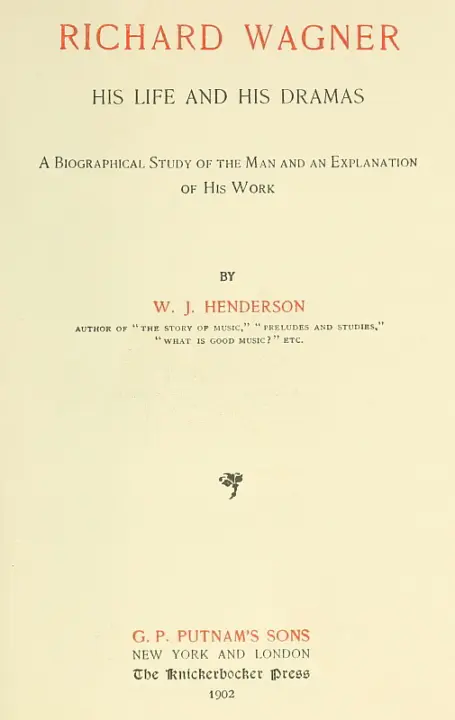
"Richard Wagner: His Life and His Dramas" by W. J. Henderson is a biographical study written in the early 20th century. This work aims to provide readers with a comprehensive understanding of the life of Richard Wagner, detailing both his personal history and the artistic aspirations that drove his compositions. By examining his life and the intricacies of his major works, the book likely caters to both music enthusiasts and those interested in Wagner's complex character. The opening of the book introduces the ancestry and early life of Richard Wagner, setting the stage for his prolific career. It details the challenges faced by Wagner's family after the early death of his father and how these circumstances influenced his upbringing. The passage highlights young Wagner's burgeoning talent, his influences, and the beginning of his journey toward becoming a celebrated composer. Notably, it discusses the pivotal moments in Wagner’s childhood, including his encounters with notable figures like Weber, which instigated his aspiration to create innovative musical dramas. Thus, the introduction establishes Wagner’s early promises and foreshadows his tumultuous but groundbreaking journey in music.
Introduction adapted from the source catalogue; source summaries may be automatically generated.
Free to read · English · 129,514 words · No account needed
MAKE TIME FOR A GOOD BOOK
On by default. Untick to stop anonymous reading totals. Each page counts after 10 seconds in view. How this works.
Anonymous counting is on unless you have switched it off.
"Die Feen," 16 et seq., 148
"Die Glückliche Bärenfamilie," 32
"Die Hochzeit," 14, 15
"Die Hohe Braut," 30, 31
"DIE MEISTERSINGER VON NÜRNBERG", study of, 328 et seq.;
artistic doctrine of, 343, 344;
Beckmesser, character of, 335;
begun, 64, 330;
book finished, 120, 330;
characters historical, 333, 335;
Cosima Wagner on, 341;
critical view of, 342;
first performances, 328, 329;
meisterlied and minnelied, construction and relations of, 334;
meistersingers, customs of, 333;
meistersingers, origin of, 332;
minnesingers, forerunners of meistersingers, 330-332;
Müglin, Heinrich, his "Long Tone" used by Wagner, 345;
music, 344 et seq.;
music, Act II., finale of, 352;
music, begun, 120, 330;
music, characteristics of, 353;
music, chorale, Act I., and theme, 347;
music, completed, 330;
music, monologue of Sachs, 350;
music, significant beauty of Meistersinger themes, 345;
original casts, 328, 329;
pendant to "Tannhäuser," 330;
period of the comedy, 333;
prelude, 344;
prize song, 340;
produced at Munich, 131, 328;
quintet in, 340;
Sachs, history of, 333, 336;
story of, 336 et seq.;
symbolism in, 343;
Walther not Wagner, 343
"Die Sarazener," 50, 61;
see also "Manfred"
Dietsch, Pierre Louis, 46, 115
"DIE WALKÜRE," 396 et seq.;
see also "Der Ring des Nibelungen"; begun, 94;
book finished, 365;
Brünnhilde, character of, 402;
Brünnhilde's punishment, meaning of, 401;
curse, 398;
ethical ideas in, 397-399, 401, 402;
finished, 105;
first performances, 358;
Fricka's importance, 397 et seq.;
music, 434;
see also LEADING MOTIVES;
when written, 365;
original casts, 358, 359;
produced at Bayreuth, 141;
produced at Munich, 132;
rehearsal at Zurich, 105;
second act, meaning of, 397;
second act, Wagner on, 400;
sin and its punishment in, 397;
sources of, 396;
story of, 396 et seq.;
sword in, 397;
"Todesverkündigung," 400;
work on at Zurich, 121;
Wotan's plan, 401;
Wotan's plan overthrown by Fricka, 397
"Die Wibelungen," 72
Dom Pedro of Brazil, 109
Dorn, Heinrich, 8, 9, 31
"Dors, mon enfant," 42
Drama, spoken, Wagner's study, 181
Dramas, Wagner's, 213 et seq.
Dumersan, 38, 41
"Du Métier de Virtuose," 44
Edda, the Elder, discovered, 373, 374;
mythology in, 385;
Poetic, 375;
Sigurd and Brünnhilde in, 375
Edda, the Prose, or Younger, mythology in, 385 et seq.;
when written, 373
Eilhart von Oberge, 297
"Eine Faust" overture, 38-40, 97
Ellis, W.A., "1849, A Vindication," 78;
translation of Wagner's Prose Works, 16
"End of a Musician in Paris," 47
Festspielhaus at Bayreuth, 136, 138;
builders and artists of, 143;
described, 142
Feuerbach, 216
Feustel, Frederick, 138, 152
Fischer, Wilhelm, 45, 47
"Flying Dutchman," see "Der Fliegende Holländer"
France, mixture of peoples in, 296
Gasparini, A., 41
Geoffrey of Monmouth, 296, 453
German Music, Wagner's essay on, 41
Geyer, Ludwig, 2, 3;
"Slaughter of the Innocents," 3
Gluck, 169 et seq.
Your reading position is saved on this browser. Take it to another device with a library code. Reading pages adapt to text, rather than matching a printed edition.
W. J. (William James) Henderson
W. J. (William James) Henderson
BEHIND THE BOOK
This eBook is for the use of anyone anywhere in the United States and most other parts of the world at no cost and with almost no restrictions whatsoever. You may copy it, give it away or re-use it under the terms of the Project Gutenberg License included with this eBook or online at www.gutenberg.org. If you are not located in the United States, you will have to check the laws of the country where you are located before using this eBook. Read the source licence.
The original source file, including credits and licence, is retained by this library. Request an original-format copy at no charge. Please include the book title and Project Gutenberg identifier #44767.
KEEP YOUR CURIOSITY GOING

Charles G. (Charles Griffith) Ross
Hannah Webster Foster

Emily Lawless
Edwin Hamlin Carr

Charles De Lano Hine
Andrew Ure