THE CLASSIC COLLECTION✦The orchestra and orchestral musicCLASSIC FREE BOOKS
The orchestra and orchestral music
W. J. (William James) Henderson
THE CLASSIC COLLECTION · 1901
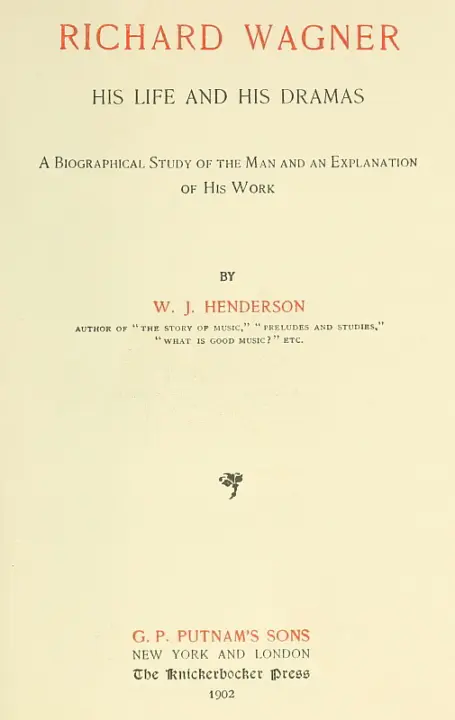
"Richard Wagner: His Life and His Dramas" by W. J. Henderson is a biographical study written in the early 20th century. This work aims to provide readers with a comprehensive understanding of the life of Richard Wagner, detailing both his personal history and the artistic aspirations that drove his compositions. By examining his life and the intricacies of his major works, the book likely caters to both music enthusiasts and those interested in Wagner's complex character. The opening of the book introduces the ancestry and early life of Richard Wagner, setting the stage for his prolific career. It details the challenges faced by Wagner's family after the early death of his father and how these circumstances influenced his upbringing. The passage highlights young Wagner's burgeoning talent, his influences, and the beginning of his journey toward becoming a celebrated composer. Notably, it discusses the pivotal moments in Wagner’s childhood, including his encounters with notable figures like Weber, which instigated his aspiration to create innovative musical dramas. Thus, the introduction establishes Wagner’s early promises and foreshadows his tumultuous but groundbreaking journey in music.
Introduction adapted from the source catalogue; source summaries may be automatically generated.
Free to read · English · 129,514 words · No account needed
MAKE TIME FOR A GOOD BOOK
On by default. Untick to stop anonymous reading totals. Each page counts after 10 seconds in view. How this works.
Anonymous counting is on unless you have switched it off.
"'Rienzi' is a work of the composer's youth, unequal, but already full of force and strength, brilliant and full of fire. The reformatory ideas of the author are not yet apparent. The libretto is cut according to the rules of tradition--choruses, ensembles, resounding marches, grand airs, trios, septets, ballet--nothing is wanting. The music, without betraying any imitation in particular, has a strong Italian colouring, but the individuality of the composer is shown as well in the heroic grandeur of his broad melodies as in the warmth and riches of his instrumentation. In short, 'Rienzi' is already the work of an independent master without being that of an innovator."
In the last sentence M. Schuré has nearly touched the truth, but I am inclined to think that he and Mr. Hueffer somewhat overrate the importance of this work. It is most probable that the melody of the prayer will come to be accepted as the one inspired thing in the whole score. Certainly the air of Adriano, so often sung on the concert stage, is but a weak and bombastic imitation of a Weber grand aria of the style of "Ocean, thou mighty monster," with leanings toward the manner employed in the monologue of Ortrud in Act II. of "Lohengrin."
We may therefore dismiss "Rienzi" as a mistake of Wagner's youth. He had not yet found himself. He might have achieved popularity and made money with this sort of writing, and knowing his great vanity and love of luxury we should not have been surprised if he had continued to produce works of this pattern if the first one had brought him immediate success. We ought, perhaps, to be very grateful to the years of privation in Paris which developed the real Wagner, though it is possible that his own ambition to stand alone would have had the desired result in the course of time, even had the years 1840 and 1841 been easier for him.
Romantic Opera in Three Acts.
First performed at the Royal Saxon Court Theatre, Dresden, Jan. 2,
1843.
Original Cast.
Senta Mme. Schroeder-Devrient. The Dutchman Wächter. Daland Risse. Erik Reinhold. Mary Mme. Wächter. Helmsman Bielezizky.
Conductor, Richard Wagner.
Riga and Cassel, 1843; Berlin, 1844; Zurich, 1852; Schwerin, Weimar, and Breslau, 1853; Frankfort and Wiesbaden, 1854; Hanover, Carlsruhe, and Prague, 1857; Mayence and Vienna, 1860; Königsberg, 1861; Lucerne, 1862; Munich, 1864; Stuttgart, 1865; Olmütz, 1866; Rotterdam and Dessau, 1869; Hamburg, Darmstadt, Mannheim, Gratz, 1870; London (Italian), July 23, 1870; Vienna, Brunswick, and Brünn, 1871; Brussels and Stockholm, 1872; Budapesth, Stettin, Augsburg, Magdeburg, Sondershausen, and Baden, 1874; Strassburg, 1875; Lübeck, Freiburg, and Salzburg, 1876; Philadelphia, 1876; Dublin and Bologna, 1877; Würzburg, 1877; New York, Jan. 26, 1877; Innspruck, 1880.
First performed in America as "Il Vascello Fantasma," in Philadelphia, Nov. 8, 1876, by the Pappenheim Company.
Your reading position is saved on this browser. Take it to another device with a library code. Reading pages adapt to text, rather than matching a printed edition.
W. J. (William James) Henderson
W. J. (William James) Henderson
BEHIND THE BOOK
This eBook is for the use of anyone anywhere in the United States and most other parts of the world at no cost and with almost no restrictions whatsoever. You may copy it, give it away or re-use it under the terms of the Project Gutenberg License included with this eBook or online at www.gutenberg.org. If you are not located in the United States, you will have to check the laws of the country where you are located before using this eBook. Read the source licence.
The original source file, including credits and licence, is retained by this library. Request an original-format copy at no charge. Please include the book title and Project Gutenberg identifier #44767.
KEEP YOUR CURIOSITY GOING

Charles G. (Charles Griffith) Ross
Hannah Webster Foster

Emily Lawless
Edwin Hamlin Carr

Charles De Lano Hine
Andrew Ure