THE CLASSIC COLLECTION✦The orchestra and orchestral musicCLASSIC FREE BOOKS
The orchestra and orchestral music
W. J. (William James) Henderson
THE CLASSIC COLLECTION · 1901
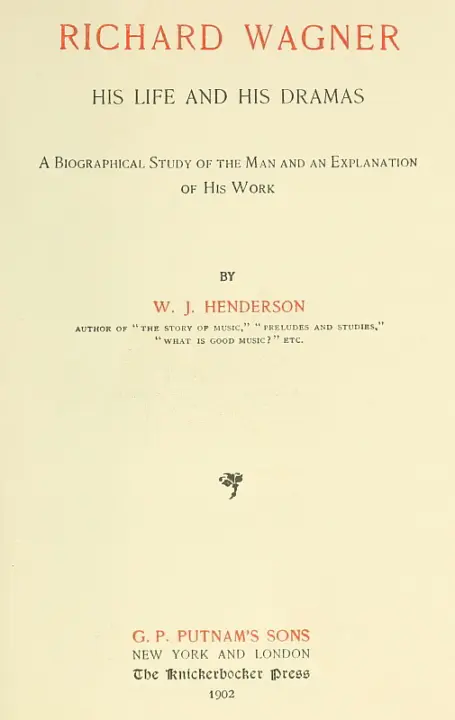
"Richard Wagner: His Life and His Dramas" by W. J. Henderson is a biographical study written in the early 20th century. This work aims to provide readers with a comprehensive understanding of the life of Richard Wagner, detailing both his personal history and the artistic aspirations that drove his compositions. By examining his life and the intricacies of his major works, the book likely caters to both music enthusiasts and those interested in Wagner's complex character. The opening of the book introduces the ancestry and early life of Richard Wagner, setting the stage for his prolific career. It details the challenges faced by Wagner's family after the early death of his father and how these circumstances influenced his upbringing. The passage highlights young Wagner's burgeoning talent, his influences, and the beginning of his journey toward becoming a celebrated composer. Notably, it discusses the pivotal moments in Wagner’s childhood, including his encounters with notable figures like Weber, which instigated his aspiration to create innovative musical dramas. Thus, the introduction establishes Wagner’s early promises and foreshadows his tumultuous but groundbreaking journey in music.
Introduction adapted from the source catalogue; source summaries may be automatically generated.
Free to read · English · 129,514 words · No account needed
MAKE TIME FOR A GOOD BOOK
On by default. Untick to stop anonymous reading totals. Each page counts after 10 seconds in view. How this works.
Anonymous counting is on unless you have switched it off.
Arthurian legends, see "Parsifal" and "Tristan und Isolde"
Artistic career of Wagner, periods of, 213, 214
ART-THEORIES OF WAGNER, 167 et seq.;
alliteration, 200 et seq.;
ballet, 487;
commercialism opposed to, 174, 176;
discovery of, 176;
drama, not opera, 204;
early, 18 et seq., 228;
emotions, musical treatment of, 183, 185, 197, 205, 208, 209, 216;
ethical ideas, 215;
feeling and understanding, 182;
form, adopted, 186 et seq., 198, 199;
forms, abolished, 178, 185 et seq., 197;
fully developed, nature of, 167 et seq.;
good and evil principles, war of, 216;
Greek drama, relations to, 179, 184, 207, 218;
historical drama as opposed to mythical, 183 et seq.;
ideal of his work, 206;
incompatibility with "opera" discovered, 177;
later, conceived, 53;
later, expanded, 61, 74;
leitmotiv system, 186, 187, 190 et seq.;
leitmotive classified, 193;
leitmotive, development of, 193 et seq.;
libretto a drama, 178;
lyric drama, relation to, 168 et seq.;
materials of poetic drama, 182, 183;
melody, endless, 186, 187;
metaphysics, 216, 217;
misunderstood by admirers, 161;
misunderstood by public, 167;
moods, embodiment of, 198, 205, 206;
music for music's sake, 178;
music, office of, in drama, 190;
musical system, 186, 189 et seq., 196, 197, 198, 208, 209;
myth, advantage of in drama, 183 et seq.;
nationalism, 167, 208;
opera, old style, differences of, 168 et seq.;
opposed to public taste, 61, 66, 67, 69, 70, 160, 161;
orchestra, 189, 190, 206;
organic union of arts, 178, 180, 186;
philosophical basis of dramas, 216;
propagation of, 67, 85 et seq.;
prose works embodying, 86 et seq., 179 et seq.;
realism as opposed to high art, 206, 207;
reforms included in, 178;
Schopenhauer's ideas, 184, 216, 217;
staff-rhyme, 200 et seq.;
symbolism in drama, 204 et seq.;
text and music, union of, 186, 202, 203, 219;
understood by Liszt, 81;
verse-form, 200 et seq.;
woman, saving grace, 215;
"Word-tone-speech," 204
"Art-work of the Future," 86, 179, 180
Attila, 369 et seq.
Auber, "La Muette de Portici," influence on Wagner, 18, 43
Auditorium darkened, 140
Autobiographic sketch, 52
Ballet in "Tannhäuser," 114, 115
Ballet, Wagner and the, 114, 487
Barbarossa, Friedrich, 72
Bayreuth, becomes famous, 140;
festivals, deficit of first, 144, 146;
festivals, directed by Mme. Wagner, 153;
festivals, still popular, 153;
plan nearly fails, 139;
theatre, see Festspielhaus; Wagner goes to, 136;
why selected, 137
Bayreuther Blätter, 147, 150
"Beethoven," essay by Wagner, 134
Beethoven influences Wagner, 6
Belart, Hans, "Richard Wagner in Zurich," 111
Bellini, Wagner's admiration for, 18, 33
Belloni, 82
Berlioz, Hector, 42, 43, 57, 112
Beroul, 297
Bertram-Mayer, Mme., 131
Borron, Robert de, 297, 454
Boston, Wagner nights, 104
Brandt, Karl, 143
Bruckwald, Otto, 143
Brückner Brothers, 143
Your reading position is saved on this browser. Take it to another device with a library code. Reading pages adapt to text, rather than matching a printed edition.
W. J. (William James) Henderson
W. J. (William James) Henderson
BEHIND THE BOOK
This eBook is for the use of anyone anywhere in the United States and most other parts of the world at no cost and with almost no restrictions whatsoever. You may copy it, give it away or re-use it under the terms of the Project Gutenberg License included with this eBook or online at www.gutenberg.org. If you are not located in the United States, you will have to check the laws of the country where you are located before using this eBook. Read the source licence.
The original source file, including credits and licence, is retained by this library. Request an original-format copy at no charge. Please include the book title and Project Gutenberg identifier #44767.
KEEP YOUR CURIOSITY GOING

Charles G. (Charles Griffith) Ross
Hannah Webster Foster

Emily Lawless
Edwin Hamlin Carr

Charles De Lano Hine
Andrew Ure