THE CLASSIC COLLECTION✦The orchestra and orchestral musicCLASSIC FREE BOOKS
The orchestra and orchestral music
W. J. (William James) Henderson
THE CLASSIC COLLECTION · 1901
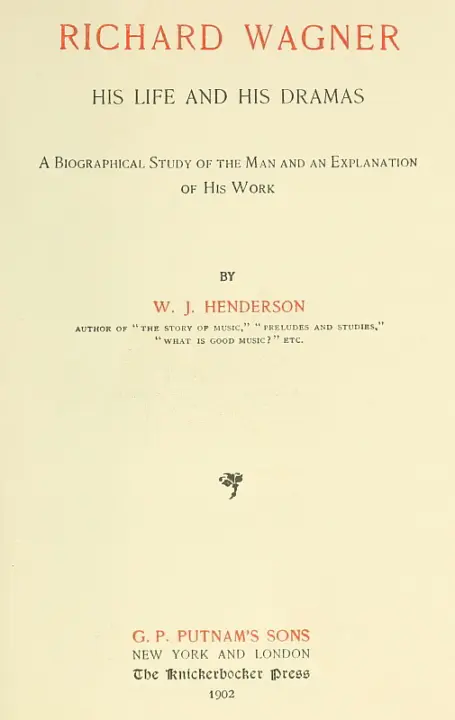
"Richard Wagner: His Life and His Dramas" by W. J. Henderson is a biographical study written in the early 20th century. This work aims to provide readers with a comprehensive understanding of the life of Richard Wagner, detailing both his personal history and the artistic aspirations that drove his compositions. By examining his life and the intricacies of his major works, the book likely caters to both music enthusiasts and those interested in Wagner's complex character. The opening of the book introduces the ancestry and early life of Richard Wagner, setting the stage for his prolific career. It details the challenges faced by Wagner's family after the early death of his father and how these circumstances influenced his upbringing. The passage highlights young Wagner's burgeoning talent, his influences, and the beginning of his journey toward becoming a celebrated composer. Notably, it discusses the pivotal moments in Wagner’s childhood, including his encounters with notable figures like Weber, which instigated his aspiration to create innovative musical dramas. Thus, the introduction establishes Wagner’s early promises and foreshadows his tumultuous but groundbreaking journey in music.
Introduction adapted from the source catalogue; source summaries may be automatically generated.
Free to read · English · 129,514 words · No account needed
MAKE TIME FOR A GOOD BOOK
On by default. Untick to stop anonymous reading totals. Each page counts after 10 seconds in view. How this works.
Anonymous counting is on unless you have switched it off.
The principal characteristic of the music of "Die Meistersinger" is its lyric quality. There are no tragic passions to be depicted, no evil thoughts to be expressed. Beckmesser alone has malice, and that is of a petty, foolish sort, best treated, as it is in this exquisite work, with ridicule. The other personages are all lovable; the motives all kindly. The underlying elements which are in contest, the opposing principles, whose workings make the ethical basis of the drama, are artistic, the old against the new, the formal against the free. The expression of each must of necessity be lyric, the one in well-regulated rhythms, the other in rushing bursts of apparently spontaneous melody. But the total result is one great spring ode, throbbing with the very heart-beats of young poesy and song, and sure at all times and in all places to captivate those who have ears to hear and souls to understand.
A Stage Festival Play
for
Three Days and One Preliminary Evening.
First performed in its entirety at Bayreuth, August, 1876; Munich, 1878; Vienna, Leipsic, 1879; Hamburg, 1880; Berlin, 1881; London, Königsberg, Hanover, Danzig, Breslau, Bremen, Barmen, 1882; New York, Metropolitan Opera House, March 4, 5, 8 and 11, 1889.
Prologue to "Der Ring des Nibelungen."
First performed at the Royal Court Theatre, Munich, September 22,
1869.
Original Cast.
Wotan Kindermann. Donner Heinrich. Froh Nachbaur. Loge Vogl. Alberich Fischer. Mime Schlosser. Fasolt Polzer. Fafner Bausewein. Fricka Fräulein Stehle. Freia Fräulein Müller. Erda Fräulein Seehofer. Woglinde Wellgunde Frau Vogel. Flosshilde Fräulein Ritter.
This performance was against the wish of Wagner. The first authorised performance was that at the Festspielhaus, Bayreuth, August 13, 1876, when the cast was as follows:
Wotan Franz Betz. Donner Eugen Gura. Froh Georg Unger. Loge Heinrich Vogel. Alberich Carl Hill. Mime Carl Schlosser. Fasolt Albert Eilers. Fafner Franz von Reichenberg. Fricka Friedericke Grün. Freia Marie Haupt. Erda Luise Jäide. Woglinde Lilli Lehmann. Wellgunde Marie Lehmann. Flosshilde Marie Lammert.
Weimar, Vienna, Leipsic, Hamburg, Brunswick, 1878; Mannheim, Cologne, 1879; Frankfort, London, 1882.
First performed in America at the Metropolitan Opera House, New York,
Jan. 4, 1889.
Cast.
Wotan Emil Fischer. Donner Alois Grienauer. Froh Albert Mittelhauser. Loge Max Alvary. Alberich Joseph Beck. Mime Wilhelm Sedlmayer. Fasolt Ludwig Mödlinger. Fafner Eugen Weiss. Fricka Fanny Moran-Olden. Freia Katti Bettaque. Erda Hedwig Reil. Woglinde Sophie Traubmann. Wellgunde Felice Koschoska. Flosshilde Hedwig Reil.
Conductor, Anton Seidl.
Music Drama in Three Acts.
First evening of the trilogy, "Der Ring des Nibelungen."
First performed at the Royal Court Theatre in Munich, contrary to the author's wish, on Aug. 26, 1870.
Original Cast.
Siegmund Vogl. Hunding Bausewein. Wotan Kindermann. Sieglinde Frau Vogl. Brünnhilde Fräulein Stehle. Fricka Fräulein Kaufmann.
Your reading position is saved on this browser. Take it to another device with a library code. Reading pages adapt to text, rather than matching a printed edition.
W. J. (William James) Henderson
W. J. (William James) Henderson
BEHIND THE BOOK
This eBook is for the use of anyone anywhere in the United States and most other parts of the world at no cost and with almost no restrictions whatsoever. You may copy it, give it away or re-use it under the terms of the Project Gutenberg License included with this eBook or online at www.gutenberg.org. If you are not located in the United States, you will have to check the laws of the country where you are located before using this eBook. Read the source licence.
The original source file, including credits and licence, is retained by this library. Request an original-format copy at no charge. Please include the book title and Project Gutenberg identifier #44767.
KEEP YOUR CURIOSITY GOING

Charles G. (Charles Griffith) Ross
Hannah Webster Foster

Emily Lawless
Edwin Hamlin Carr

Charles De Lano Hine
Andrew Ure