THE CLASSIC COLLECTION✦The orchestra and orchestral musicCLASSIC FREE BOOKS
The orchestra and orchestral music
W. J. (William James) Henderson
THE CLASSIC COLLECTION · 1901
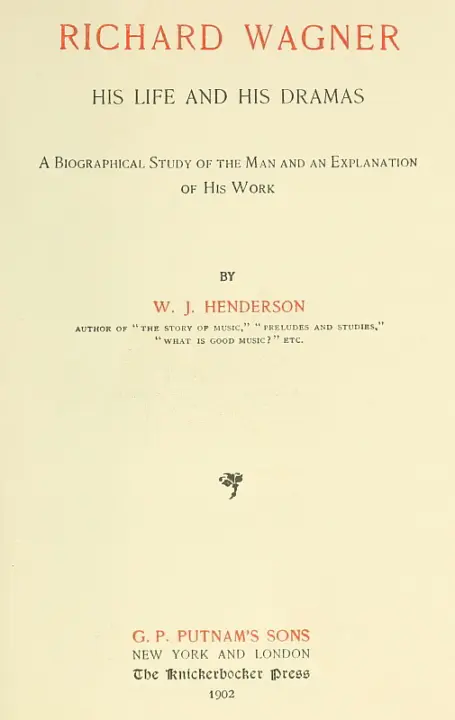
"Richard Wagner: His Life and His Dramas" by W. J. Henderson is a biographical study written in the early 20th century. This work aims to provide readers with a comprehensive understanding of the life of Richard Wagner, detailing both his personal history and the artistic aspirations that drove his compositions. By examining his life and the intricacies of his major works, the book likely caters to both music enthusiasts and those interested in Wagner's complex character. The opening of the book introduces the ancestry and early life of Richard Wagner, setting the stage for his prolific career. It details the challenges faced by Wagner's family after the early death of his father and how these circumstances influenced his upbringing. The passage highlights young Wagner's burgeoning talent, his influences, and the beginning of his journey toward becoming a celebrated composer. Notably, it discusses the pivotal moments in Wagner’s childhood, including his encounters with notable figures like Weber, which instigated his aspiration to create innovative musical dramas. Thus, the introduction establishes Wagner’s early promises and foreshadows his tumultuous but groundbreaking journey in music.
Introduction adapted from the source catalogue; source summaries may be automatically generated.
Free to read · English · 129,514 words · No account needed
MAKE TIME FOR A GOOD BOOK
On by default. Untick to stop anonymous reading totals. Each page counts after 10 seconds in view. How this works.
Anonymous counting is on unless you have switched it off.
The dramatic power of "Tannhäuser" is not to be sought in evidences of the development of the future Wagnerian system except in the fidelity of the music to the underlying thought, and of the masterful employment of operatic materials hitherto used wholly with a view to musical effectiveness. In characterisation, too, this score shows an advance over that of "Der Fliegende Holländer," which itself was far ahead of its contemporaries. Wagner himself lays stress upon the deep significance of passages of free composition. For example, he says that in the stanza which Tannhäuser sings in the finale of the second act ("Zum Heil den Sündigen zu Führen")--a stanza which is usually buried by the ensemble--"lies the whole significance of the catastrophe of Tannhäuser, and indeed the whole essence of Tannhäuser; all that to me makes him a touching phenomenon is expressed here alone." And various remarks in his long and--for the theatre--important essay on the performing of "Tannhäuser" show how far from his mind in the preparation of this work was the fully developed Wagnerian system of "Tristan und Isolde." The union of the arts tributary to the drama in the "art work of the future" had already been conceived by him, and the greatness of "Tannhäuser," together with the causes of its radical difference from the typical opera of its time, must be sought in the evidences of Wagner's successful employment of this union. Neither verse nor music had yet disclosed the complete Wagner; but here we find the master in his transitional stage. The puissant eloquence of the vital scenes of "Tannhäuser" will long keep it before the public in spite of its inherent weaknesses.
Romantic Opera in Three Acts.
First performed at the Court Theatre, Weimar, August 28, 1850.
Original Cast.
Lohengrin Beck. Telramund Milde. King Henry Höfer. Herald Pätsch. Ortrud Fräulein Fastlinger. Elsa Fräulein Agthe.
Wiesbaden, 1853; Stettin, Breslau, Frankfort, Schwerin, Leipsic, 1854; Hanover, Darmstadt, Riga, Prague, Hamburg, Cologne, 1855; Würzburg, Mayence, Carlsruhe, 1856; Munich, Sondershausen, Vienna, 1857; Dresden, Berlin, Mannheim, 1859; Danzig, Königsberg, 1860; Rotterdam, 1862; Gratz, 1863; Budapesth, 1866; Dessau, 1867; Milan, Cassel, Baden, St. Petersburg, 1868; Olmütz, Stuttgart, Gotha, 1869; Brussels, Brunswick, Magdeburg, The Hague, Copenhagen, 1870; Bologna, New York, 1871; Nuremberg, Florence, 1872; Lübeck, 1873; Stockholm, Strassburg, 1874; Boston, 1875; London, Covent Garden, May 8, 1875; Dublin, 1875; Basle, Trieste, 1876; San Francisco, Philadelphia, Chemnitz, Crefeld, Temesvar, Salzburg, Melbourne, Lemburg, 1877; Görlitz, Barmen, Regensburg, Rome, 1878; Altona, Liegnitz, 1879; London (English), Genoa, 1880; Liverpool, Antwerp, Venice, Nice, Naples, Moscow, Madrid, Münster, 1881; Innspruck, Barcelona, 1882.
First performed in America in German at the Stadt Theater, New York, April 3, 1871, under Adolf Neuendorff.
Cast.
Your reading position is saved on this browser. Take it to another device with a library code. Reading pages adapt to text, rather than matching a printed edition.
W. J. (William James) Henderson
W. J. (William James) Henderson
BEHIND THE BOOK
This eBook is for the use of anyone anywhere in the United States and most other parts of the world at no cost and with almost no restrictions whatsoever. You may copy it, give it away or re-use it under the terms of the Project Gutenberg License included with this eBook or online at www.gutenberg.org. If you are not located in the United States, you will have to check the laws of the country where you are located before using this eBook. Read the source licence.
The original source file, including credits and licence, is retained by this library. Request an original-format copy at no charge. Please include the book title and Project Gutenberg identifier #44767.
KEEP YOUR CURIOSITY GOING

Charles G. (Charles Griffith) Ross
Hannah Webster Foster

Emily Lawless
Edwin Hamlin Carr

Charles De Lano Hine
Andrew Ure