THE CLASSIC COLLECTION✦The orchestra and orchestral musicCLASSIC FREE BOOKS
The orchestra and orchestral music
W. J. (William James) Henderson
THE CLASSIC COLLECTION · 1901
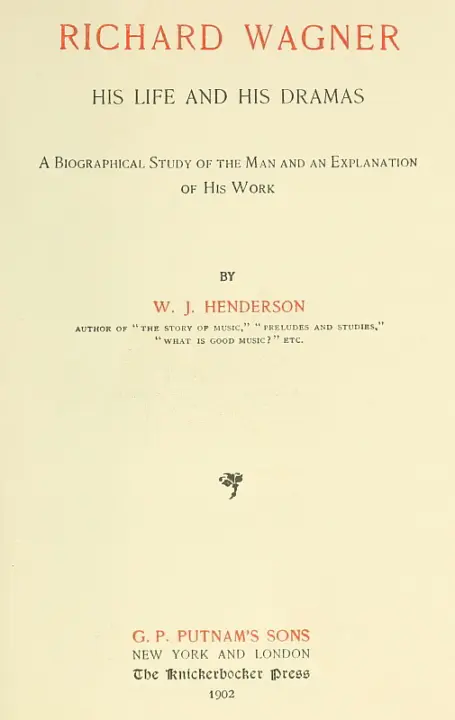
"Richard Wagner: His Life and His Dramas" by W. J. Henderson is a biographical study written in the early 20th century. This work aims to provide readers with a comprehensive understanding of the life of Richard Wagner, detailing both his personal history and the artistic aspirations that drove his compositions. By examining his life and the intricacies of his major works, the book likely caters to both music enthusiasts and those interested in Wagner's complex character. The opening of the book introduces the ancestry and early life of Richard Wagner, setting the stage for his prolific career. It details the challenges faced by Wagner's family after the early death of his father and how these circumstances influenced his upbringing. The passage highlights young Wagner's burgeoning talent, his influences, and the beginning of his journey toward becoming a celebrated composer. Notably, it discusses the pivotal moments in Wagner’s childhood, including his encounters with notable figures like Weber, which instigated his aspiration to create innovative musical dramas. Thus, the introduction establishes Wagner’s early promises and foreshadows his tumultuous but groundbreaking journey in music.
Introduction adapted from the source catalogue; source summaries may be automatically generated.
Free to read · English · 129,514 words · No account needed
MAKE TIME FOR A GOOD BOOK
On by default. Untick to stop anonymous reading totals. Each page counts after 10 seconds in view. How this works.
Anonymous counting is on unless you have switched it off.
Weimar, 1849; Schwerin and Breslau, Freiburg and Wiesbaden, 1852; Königsberg, Hamburg, Darmstadt, Elbing, Cassel, Frankfort, Posen, Leipsic, Riga, Barmen, Bremen, Bromberg, Cologne, Danzig, Düsseldorf, Prague, and Stralsund, 1853; Wolfendbüttel, Rostock, Reval, Neisse, Magdeburg, Glogau, Mayence, Gumbinnen, Gratz, Aix-la-Chapelle, Augsburg, and Stettin, 1854; Strassburg, Lübeck, Coburg, Bamberg, Munich, Mannheim, Antwerp, Zurich, Würzburg, Carlsruhe, Hanover, 1855; Berlin, 1856; Vienna, Dessau, and Sondershausen, 1857; Stuttgart, 1859; New York, April 4, 1859; Rotterdam, 1860; Paris, 1861; Brunswick, 1861; Olmütz and Amsterdam, 1862; Munich, Paris version, 1867; The Hague, 1870; Budapesth, 1871; Bologna, 1872; Brussels, 1873; Lucerne, 1874; Copenhagen, 1875; London (Italian), May 6, 1876; New York (Italian) and Moscow, 1877; Trieste, 1878; Innspruck and Salzburg, 1880; Ghent and London (English), 1881.
First performed in America at the Stadt Theater, New York, April 4,
1859.
Cast.
Hermann Graff. Tannhäuser Pickaneser. Wolfram Lehmann. Walther Lotti. Biterolf Urchs. Heinrich der Schreiber Bolten. Reimar von Zweter Brandt. Elizabeth Mme. Siedenburg. Venus Mme. Pickaneser. Shepherd (Not given).
Conductor, Carl Bergmann.
With "Tannhäuser" we enter upon what may fairly be called the transition period of the genius of Wagner. While in certain passages this work is quite as much indebted to older opera as "Der Fliegende Holländer," and in others falls into a cheap and tawdry style of melody quite unworthy of its composer, it nevertheless contains parts which rise to heights never before attained except perhaps in Beethoven's "Fidelio." The book will especially repay study, for in it we find the first complete demonstration of Wagner's powers as a dramatist and a dramatic poet. His skilful weaving of the dramatic web out of materials scattered and apparently unrelated places him among the masters of theatrical writing. It will be our pleasure first to examine the sources of the drama and the manner in which Wagner employed them.
"Tannhäuser" was first conceived by Wagner in 1841, and the scenic sketches, with the provisional title "Venusberg, Romantic Opera," were made in 1842. The poem was finished on May 22, 1843. Owing to his being occupied with the preparations for the production of "Der Fliegende Holländer" and with other matters, Wagner did not complete the score till April 13, 1845. When the work was in preparation for performance at the Paris Grand Opéra in 1861, Wagner rewrote some portion of the score. The reader will recall that the members of the Jockey Club demanded their usual terpsichorean titbit, but that Wagner would not consent to write an ordinary ballet and thrust it into his drama at a certain hour. He insisted that the ballet should take its proper place in the dramatic scheme and that it should have a meaning.
Your reading position is saved on this browser. Take it to another device with a library code. Reading pages adapt to text, rather than matching a printed edition.
W. J. (William James) Henderson
W. J. (William James) Henderson
BEHIND THE BOOK
This eBook is for the use of anyone anywhere in the United States and most other parts of the world at no cost and with almost no restrictions whatsoever. You may copy it, give it away or re-use it under the terms of the Project Gutenberg License included with this eBook or online at www.gutenberg.org. If you are not located in the United States, you will have to check the laws of the country where you are located before using this eBook. Read the source licence.
The original source file, including credits and licence, is retained by this library. Request an original-format copy at no charge. Please include the book title and Project Gutenberg identifier #44767.
KEEP YOUR CURIOSITY GOING

Charles G. (Charles Griffith) Ross
Hannah Webster Foster

Emily Lawless
Edwin Hamlin Carr

Charles De Lano Hine
Andrew Ure