THE CLASSIC COLLECTION✦Letters on LiteratureCLASSIC FREE BOOKS
Letters on Literature
Andrew Lang
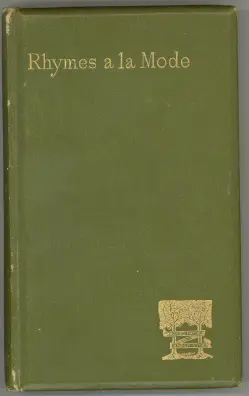
THE CLASSIC COLLECTION · 1885
"Rhymes a la Mode" by Andrew Lang is a collection of poetic works written during the late 19th century, likely within the Victorian era. The book features a variety of lyrical forms, including ballades, sonnets, and rondeaux, exploring themes of art, nature, love, and the passage of time, often with a humorous or satirical touch. Andrew Lang, known for his literary contributions and collections of folklore, captures both the spirit of his time and the timelessness of human experience in this compilation. In "Rhymes a la Mode," Lang presents a medley of verses that reflect on the intricacies of life and art through various poetic forms. Organized into sections like "Art," "Science," and "Cameos," the poems take readers on a journey through personal reflections, social commentary, and mythological allusions. Pieces such as "The Fortunate Islands" and "Almae Matres" delve into paradise and nostalgia, while others like "Ballade of Middle Age" humorously critique the illusions of youth and the discoveries of adulthood. With a mixture of playful romance and sharp wit, Lang's collection weaves a rich tapestry of thoughts, beckoning readers to ponder their own experiences and the world around them.
Introduction adapted from the source catalogue; source summaries may be automatically generated.
Free to read · English · 12,463 words · No account needed
MAKE TIME FOR A GOOD BOOK
On by default. Untick to stop anonymous reading totals. Each page counts after 10 seconds in view. How this works.
Anonymous counting is on unless you have switched it off.
YEA, here the dew of Heaven upon the grain
Fails never, nor the ceaseless water-spring,
Near neighbour of Cephisus wandering,
That day by day revisiteth the plain.
Nor do the Goddesses the grove disdain,
But chiefly here the Muses quire and sing,
And here they love to weave their dancing ring,
With Aphrodite of the golden rein.
And here there springs a plant that knoweth not The Asian mead, nor that great Dorian isle, Unsown, untilled, within our garden plot It dwells, the grey-leaved olive; ne’er shall guile Nor force of foemen root it from the spot: Zeus and Athene guarding it the while!
(Œd. Col., 1655–1666.)
HOW Œdipous departed, who may tell
Save Theseus only? for there neither came
The burning bolt of thunder, and the flame
To blast him into nothing, nor the swell
Of sea-tide spurred by tempest on him fell.
But some diviner herald none may name
Called him, or inmost Earth’s abyss became
The painless place where such a soul might dwell.
Howe’er it chanced, untouched of malady,
Unharmed by fear, unfollowed by lament,
With comfort on the twilight way he went,
Passing, if ever man did, wondrously;
From this world’s death to life divinely rent,
Unschooled in Time’s last lesson, how we die.
(Soph., Fr., 587.)
(Sidero, the stepmother of Tyro, daughter of Salmoneus, cruelly entreated her in all things, and chiefly in this, that she let sheer her beautiful hair.)
AT fierce Sidero’s word the thralls drew near, And shore the locks of Tyro,—like ripe corn They fell in golden harvest,—but forlorn The maiden shuddered in her pain and fear, Like some wild mare that cruel grooms in scorn Hunt in the meadows, and her mane they sheer, And drive her where, within the waters clear, She spies her shadow, and her shame doth mourn.
Ah! hard were he and pitiless of heart Who marking that wild thing made weak and tame, Broken, and grieving for her glory gone, Could mock her grief; but scornfully apart Sidero stood, and watched a wind that came And tossed the curls like fire that flew and shone!
(Hippol., Eurip., 73–87.)
FOR thee soft crowns in thine untrampled mead I wove, my lady, and to thee I bear; Thither no shepherd drives his flocks to feed, Nor scythe of steel has ever laboured there; Nay, through the spring among the blossoms fair The brown bee comes and goes, and with good heed Thy maiden, Reverence, sweet streams doth lead About the grassy close that is her care!
Your reading position is saved on this browser. Take it to another device with a library code. Reading pages adapt to text, rather than matching a printed edition.
Andrew Lang
Andrew Lang
Andrew Lang

Andrew Lang
BEHIND THE BOOK
This eBook is for the use of anyone anywhere in the United States and most other parts of the world at no cost and with almost no restrictions whatsoever. You may copy it, give it away or re-use it under the terms of the Project Gutenberg License included with this eBook or online at www.gutenberg.org. If you are not located in the United States, you will have to check the laws of the country where you are located before using this eBook. Read the source licence.
The original source file, including credits and licence, is retained by this library. Request an original-format copy at no charge. Please include the book title and Project Gutenberg identifier #1645.
KEEP YOUR CURIOSITY GOING

Eric Mackay
Edmund Gosse
Sophia Margaretta Hensley
Gilbert Parker
George MacDonald

Elizabeth Bibesco