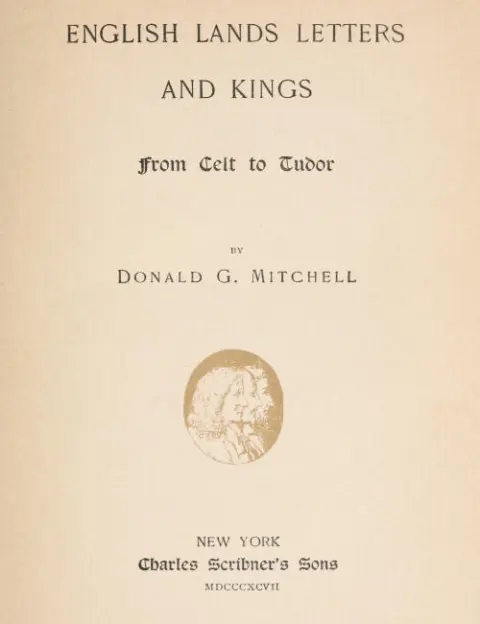
English Lands, Letters and Kings, vol. 1: From Celt to Tudor
Donald Grant Mitchell

THE CLASSIC COLLECTION · 1906
"Reveries of a Bachelor; or, A Book of the Heart" by Donald Grant Mitchell is a collection of reflective essays written in the mid-19th century. The book explores the thoughts and feelings of a bachelor contemplating life, love, and marriage, capturing the introspective and often whimsical nature of bachelorhood. Through its various reveries, it delves into the contrasts between solitude, companionship, and the bittersweet reality of desire, particularly through the lens of the unnamed bachelor reflecting on his experiences and musings. The opening of the book introduces us to the bachelor at his quaint farmhouse, where he finds solace by a roaring fire. Through rich and expressive language, he leads us into a deep reverie sparked by the comforting glow of the flames, which prompts him to contemplate marriage and its implications. He grapples with doubt and fear regarding the commitment of marriage, exploring the potential joys and sorrows that accompany such a life-altering decision. Moving through a series of thoughts, he wrestles with the balance of independence versus the desire for love, drawing readers into his intimate and often humorous introspections. As his thoughts shift from uncertainty to cheerfulness, and finally to the shadows of desolation, the bachelor reveals the complexities and paradoxes of the human experience, setting the tone for the rest of this reflective journey.
Introduction adapted from the source catalogue; source summaries may be automatically generated.
Free to read · English · 62,706 words · No account needed
MAKE TIME FOR A GOOD BOOK
On by default. Untick to stop anonymous reading totals. Each page counts after 10 seconds in view. How this works.
Anonymous counting is on unless you have switched it off.
And if, when a glowing thought comes into your brain, quick and sudden, you could tell it over as to a second self, to that sweet creature, who is not away, because she loves to be there; and if you could watch the thought catching that girlish mind, illuming that fair brow, sparkling in those pleasantest of eyes—how far better than to feel it slumbering, and going out, heavy, lifeless, and dead, in your own selfish fancy. And if a generous emotion steals over you—coming, you know not whither, would there not be a richer charm in lavishing it in caress, or endearing word, upon that fondest, and most dear one, than in patting your glossy-coated dog, or sinking lonely to smiling slumbers?
How would not benevolence ripen with such monitor to task it! How would not selfishness grow faint and dull, leaning ever to that second self, which is the loved one! How would not guile shiver, and grow weak, before that girl-brow and eye of innocence! How would not all that boyhood prized of enthusiasm, and quick blood, and life, renew itself in such presence!
The fire was getting hotter, and I moved into the middle of the room. The shadows the flames made were playing like fairy forms over floor, and wall, and ceiling.
My fancy would surely quicken, thought I, if such being were in attendance. Surely imagination would be stronger and purer if it could have the playful fancies of dawning womanhood to delight it. All toil would be torn from mind-labor, if but another heart grew into this present soul, quickening it, warming it, cheering it, bidding it ever—God speed!
Her face would make a halo, rich as a rainbow, atop of all such noisome things, as we lonely souls call trouble. Her smile would illumine the blackest of crowding cares; and darkness that now seats you despondent, in your solitary chair for days together, weaving bitter fancies, dreaming bitter dreams, would grow light and thin, and spread, and float away—chased by that beloved smile.
Your friend—poor fellow! dies: never mind, that gentle clasp of her fingers, as she steals behind you, telling you not to weep—it is worth ten friends!
Your sister, sweet one, is dead—buried. The worms are busy with all her fairness. How it makes you think earth nothing but a spot to dig graves upon!
—It is more: she, she says, will be a sister; and the waving curls as she leans upon your shoulder, touch your cheek, and your wet eyes turn to meet those other eyes—God has sent his angel, surely!
Your reading position is saved on this browser. Take it to another device with a library code. Reading pages adapt to text, rather than matching a printed edition.
Donald Grant Mitchell

Donald Grant Mitchell
Donald Grant Mitchell
Donald Grant Mitchell
BEHIND THE BOOK
This eBook is for the use of anyone anywhere in the United States and most other parts of the world at no cost and with almost no restrictions whatsoever. You may copy it, give it away or re-use it under the terms of the Project Gutenberg License included with this eBook or online at www.gutenberg.org. If you are not located in the United States, you will have to check the laws of the country where you are located before using this eBook. Read the source licence.
The original source file, including credits and licence, is retained by this library. Request an original-format copy at no charge. Please include the book title and Project Gutenberg identifier #62823.
KEEP YOUR CURIOSITY GOING

David Patterson (Spirit) Hatch

David Patterson (Spirit) Hatch

David Patterson (Spirit) Hatch

Ralph Waldo Emerson

Maurice Baring

Oscar Wilde & James McNeill Whistler