Miss Meredith
Amy Levy
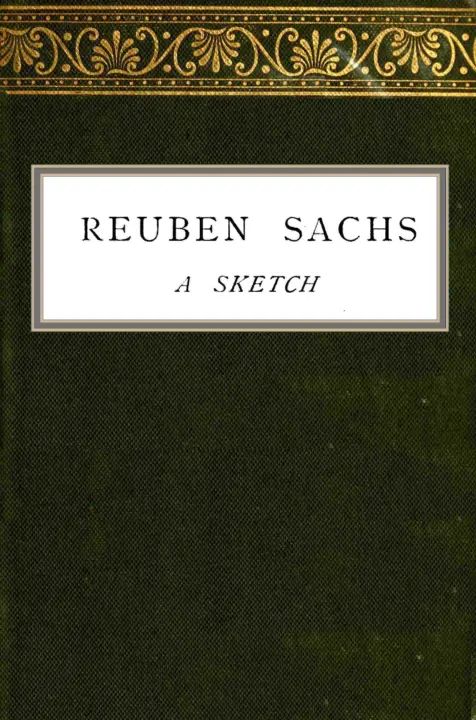
THE CLASSIC COLLECTION · 1888
"Reuben Sachs: A Sketch" by Amy Levy is a novel written in the late 19th century. The story revolves around Reuben Sachs, a promising young Jewish man navigating both his professional ambitions and personal life in London, against the backdrop of his family dynamics and the expectations of the Jewish community. The narrative dives into themes of identity, ambition, and the challenges of love, particularly focusing on Reuben's relationships with family and acquaintances. The opening of "Reuben Sachs" introduces the titular character as a successful and ambitious young man returning from a period abroad. His family, particularly his mother and sister, are in excited anticipation of his return. Reuben's charm and accomplishments stand out, yet he faces pressures related to health and family expectations, particularly regarding his future and potential marriage. As he reconnects with relatives and navigates social expectations, the narrative hints at deeper emotional currents involving his friendship with Judith Quixano, a cousin who embodies the complexities of his social world. The events set the stage for exploring both Reuben's personal aspirations and societal pressures, framing his story within the larger context of the Jewish experience in Victorian England.
Introduction adapted from the source catalogue; source summaries may be automatically generated.
Free to read · English · 34,576 words · No account needed
MAKE TIME FOR A GOOD BOOK
On by default. Untick to stop anonymous reading totals. Each page counts after 10 seconds in view. How this works.
Anonymous counting is on unless you have switched it off.
It was the first time for some weeks that they had dined alone together, and conversation did not flow freely.
Bertie looked up again, fixing his eyes, not on her face, but on the row of pearls at her throat.
“My dear, you will be very much shocked.”
“Yes?” said Judith interrogatively, eating her soup.
“Reuben Sachs is dead.”
“It is not true,” said Judith, and then she actually smiled.
The room was whirling round and round, a strange, thick mist was over everything, and through it came the muffled sound of Bertie’s voice:
“It occurred this afternoon, quite suddenly. I heard it at the club. He had not been well for some time, and had collapsed more or less the last week. But no one had any idea of danger. It seems that his heart was weak; he had been overdoing himself terribly, and cardiac disease was the immediate cause of his death--cardiac disease,” repeated Bertie, with mournful enjoyment of the phrase, and pulling a long face as he spoke.
Judith, sitting there like an automaton, eating something that tasted like sawdust, something that was difficult to swallow, was vividly conscious of only this--that Bertie must be silenced at any cost. Anything else could be borne, but not Bertie’s fluent regrets.
Another woman would have fainted: there had never been any mercy for her: but at least she would not sit there while Bertie talked of it.
So she lifted up her face, her stony face, and turned the current of his
talk.
Dinner came to an end at last and the automatic woman passed across to
the sitting-room.
Her husband followed her; she stared at him.
“You must take my excuses to Blanche. It is due to my family that I should not appear to-night in public.”
“Certainly, certainly; a mark of respect, Blanche will understand. We will neither of us go.”
She looked at him in horror, all her force of will gathered to a point: “Go--go! Blanche will expect it. There is no reason for you to stop here.”
“My dear girl, do you think I can’t stand an evening alone with you? It will be a change, quite a pleasant change.”
He had gone at last, and she stood there motionless by the mantelpiece, staring at the card for Lady Kemys’ “At home.”
“Infinite æons” seemed to divide the present moment from that other moment, half an hour ago, when she had told herself carelessly, indifferently, that she would meet Reuben that night.
Your reading position is saved on this browser. Take it to another device with a library code. Reading pages adapt to text, rather than matching a printed edition.
BEHIND THE BOOK
This eBook is for the use of anyone anywhere in the United States and most other parts of the world at no cost and with almost no restrictions whatsoever. You may copy it, give it away or re-use it under the terms of the Project Gutenberg License included with this eBook or online at www.gutenberg.org. If you are not located in the United States, you will have to check the laws of the country where you are located before using this eBook. Read the source licence.
The original source file, including credits and licence, is retained by this library. Request an original-format copy at no charge. Please include the book title and Project Gutenberg identifier #74419.
KEEP YOUR CURIOSITY GOING
Coulson Kernahan

Maurice Baring
Frances Wright
Cécile Tormay

Frederic Jesup Stimson

W. H. P. (William Henry Pope) Jarvis