Miss Meredith
Amy Levy
THE CLASSIC COLLECTION · 1888
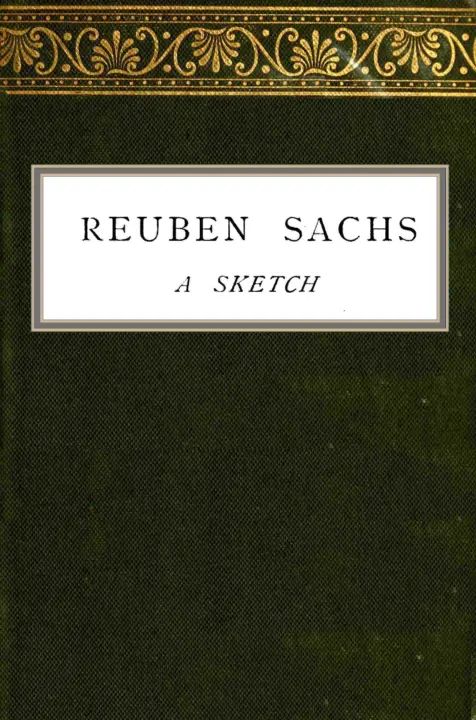
"Reuben Sachs: A Sketch" by Amy Levy is a novel written in the late 19th century. The story revolves around Reuben Sachs, a promising young Jewish man navigating both his professional ambitions and personal life in London, against the backdrop of his family dynamics and the expectations of the Jewish community. The narrative dives into themes of identity, ambition, and the challenges of love, particularly focusing on Reuben's relationships with family and acquaintances. The opening of "Reuben Sachs" introduces the titular character as a successful and ambitious young man returning from a period abroad. His family, particularly his mother and sister, are in excited anticipation of his return. Reuben's charm and accomplishments stand out, yet he faces pressures related to health and family expectations, particularly regarding his future and potential marriage. As he reconnects with relatives and navigates social expectations, the narrative hints at deeper emotional currents involving his friendship with Judith Quixano, a cousin who embodies the complexities of his social world. The events set the stage for exploring both Reuben's personal aspirations and societal pressures, framing his story within the larger context of the Jewish experience in Victorian England.
Introduction adapted from the source catalogue; source summaries may be automatically generated.
Free to read · English · 34,576 words · No account needed
MAKE TIME FOR A GOOD BOOK
On by default. Untick to stop anonymous reading totals. Each page counts after 10 seconds in view. How this works.
Anonymous counting is on unless you have switched it off.
Never by passion quite possessed,
And never quite benumbed by the world’s sway.
MATTHEW ARNOLD.
The party was never prolonged to a late hour on these occasions, and by ten o’clock there was no one left in the drawing-room in Portland Place except Mrs. Sachs, Mr. Leuniger, Mrs. Kohnthal and the young people in their respective trains.
The elders had got up a game of whist for the amusement of old Solomon, the termination of which their juniors awaited in conclave at the other end of the room.
Lionel and Sidney meanwhile, sleepy and overfed, quarrelled in a corner over the possession of a bound volume of the Graphic.
“Judith,” said Reuben, who had taken a seat opposite her, “do you know that you have made a conquest?”
“Is that such an unheard-of occurrence?”
Reuben laughed gently, and Rose cried:
“It is Mr. Lee-Harrison! I know it from the way he looked at supper.”
“Yes, it is Bertie.” Reuben looked straight in Judith’s eyes. “He says you exactly fulfil his idea of Queen Esther.”
“Ah,” cried Esther Kohnthal, “I have always had a theory about her. When she was kneeling at the feet of that detestable Ahasuerus, she was thinking all the time of some young Jew whom she mashed, and who mashed her, and whom she renounced for the sake of her people!”
A momentary silence fell among them, then Reuben, looking down, said slowly: “Or perhaps she preferred the splendours of the royal position even to the attractions of that youth whom you suppose her to--er--have mashed.”
He was not fond of Esther at the best of times; now he glanced at her under his eyelids with an expression of unmistakable dislike.
“I wonder,” cried Rose, throwing herself into the breach, “what Mr. Lee-Harrison thought of it all.”
“I think,” said Leo, “that he was shocked at finding us so little like the people in Daniel Deronda.”
“Did he expect,” cried Esther, “to see our boxes in the hall, ready packed and labelled Palestine?”
“I have always been touched,” said Leo, “at the immense good faith with which George Eliot carried out that elaborate misconception of hers.”
“Now Leo is going to begin,” cried Rose; “he never has a good word for his people. He is always running them down.”
“Horrid bad form,” said Reuben; “besides being altogether a mistake.”
“Oh, I have nothing to say against us at all,” answered Leo ironically, “except that we are materialists to our fingers’ ends. That we have outlived, from the nature of things, such ideals as we ever had.”
Your reading position is saved on this browser. Take it to another device with a library code. Reading pages adapt to text, rather than matching a printed edition.
BEHIND THE BOOK
This eBook is for the use of anyone anywhere in the United States and most other parts of the world at no cost and with almost no restrictions whatsoever. You may copy it, give it away or re-use it under the terms of the Project Gutenberg License included with this eBook or online at www.gutenberg.org. If you are not located in the United States, you will have to check the laws of the country where you are located before using this eBook. Read the source licence.
The original source file, including credits and licence, is retained by this library. Request an original-format copy at no charge. Please include the book title and Project Gutenberg identifier #74419.
KEEP YOUR CURIOSITY GOING
Coulson Kernahan

Maurice Baring
Frances Wright
Cécile Tormay

Frederic Jesup Stimson

W. H. P. (William Henry Pope) Jarvis