Miss Meredith
Amy Levy
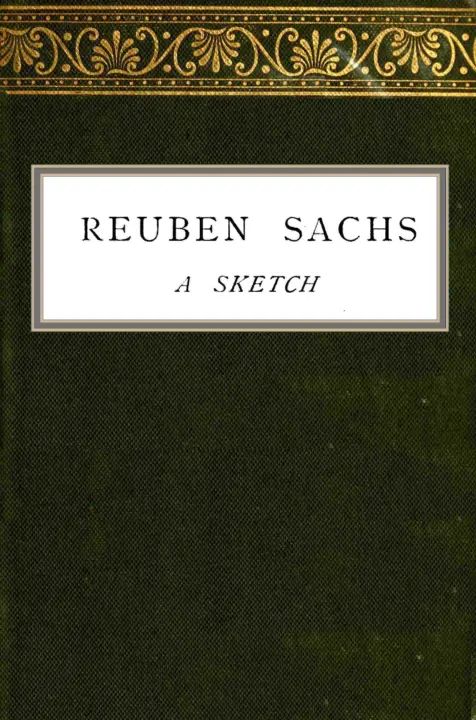
THE CLASSIC COLLECTION · 1888
"Reuben Sachs: A Sketch" by Amy Levy is a novel written in the late 19th century. The story revolves around Reuben Sachs, a promising young Jewish man navigating both his professional ambitions and personal life in London, against the backdrop of his family dynamics and the expectations of the Jewish community. The narrative dives into themes of identity, ambition, and the challenges of love, particularly focusing on Reuben's relationships with family and acquaintances. The opening of "Reuben Sachs" introduces the titular character as a successful and ambitious young man returning from a period abroad. His family, particularly his mother and sister, are in excited anticipation of his return. Reuben's charm and accomplishments stand out, yet he faces pressures related to health and family expectations, particularly regarding his future and potential marriage. As he reconnects with relatives and navigates social expectations, the narrative hints at deeper emotional currents involving his friendship with Judith Quixano, a cousin who embodies the complexities of his social world. The events set the stage for exploring both Reuben's personal aspirations and societal pressures, framing his story within the larger context of the Jewish experience in Victorian England.
Introduction adapted from the source catalogue; source summaries may be automatically generated.
Free to read · English · 34,576 words · No account needed
MAKE TIME FOR A GOOD BOOK
On by default. Untick to stop anonymous reading totals. Each page counts after 10 seconds in view. How this works.
Anonymous counting is on unless you have switched it off.
“We are going to get some lunch,” said Rose, moving off; “Judith has to go and see her people.”
She, too, loved the social aspects of the place no less than its business ones. Her pale, prominent, sleepy eyes, under their heavy white lids, saw quite as much and as quickly as Adelaide’s dancing, glittering, hard little organs of vision.
The girls lunched in the refreshment room, having obtained leave of absence from the family meal, then set out together from the shop.
At the corner of Westbourne Grove they parted, Rose going towards home, Judith committing herself to a large blue omnibus.
The Walterton Road is a dreary thoroughfare, which, in respect of unloveliness, if not of length, leaves Harley Street, condemned of the poet, far behind.
It is lined on either side with little sordid gray houses, characterized by tall flights of steps and bow-windows, these latter having for frequent adornment cards proclaiming the practice of various humble occupations, from the letting of lodgings to the tuning of pianos.
About half way up the street Judith stopped the omnibus, and mounted the steps to a house some degrees less dreary-looking than the majority of its neighbours. Fresh white curtains hung in the clean windows, while steps, scraper and doorbell bore witness to the hand of labour.
Mrs. Quixano herself opened the door to her daughter, and drew her by the hand into the sitting-room, across the little hall to which still clung the odour of the midday mutton.
“Many happy returns of the day, mamma,” said Judith, kissing her and
offering her parcel.
“I am sure it is very good of you to remember, my dear,” answered her mother, leaning back in her chair and taking in every detail of the girl’s appearance; her gown, her bonnet, the tinge of sunburn on her fresh young cheek, a certain indescribable air of softness, of maidenliness which was hers to-day.
Israel Leuniger’s sister was a stout, comely woman of middle-age; red-haired, white-skinned, plump, with a projecting under-lip and comfortable double chin.
She was disappointed with her life, but she made the best of it; loving her husband, though unable to sympathize with him; planning, working unremittingly for her six children; extracting the utmost benefit from the narrowest of means; a capable person who did her duty according to her own lights.
“So Reuben Sachs has come back,” she said, after some conversation.
Judith glanced up quickly with a bright, gentle look.
“Yes, and he is ever so much better; quite himself again.”
Mrs. Quixano grumbled some inarticulate reply. Personally, she would not have been sorry if he had failed to return from the antipodes.
Your reading position is saved on this browser. Take it to another device with a library code. Reading pages adapt to text, rather than matching a printed edition.
BEHIND THE BOOK
This eBook is for the use of anyone anywhere in the United States and most other parts of the world at no cost and with almost no restrictions whatsoever. You may copy it, give it away or re-use it under the terms of the Project Gutenberg License included with this eBook or online at www.gutenberg.org. If you are not located in the United States, you will have to check the laws of the country where you are located before using this eBook. Read the source licence.
The original source file, including credits and licence, is retained by this library. Request an original-format copy at no charge. Please include the book title and Project Gutenberg identifier #74419.
KEEP YOUR CURIOSITY GOING
Coulson Kernahan

Maurice Baring
Frances Wright
Cécile Tormay

Frederic Jesup Stimson

W. H. P. (William Henry Pope) Jarvis