
The Following of the Star: A Romance
Florence L. (Florence Louisa) Barclay
THE CLASSIC COLLECTION · 1920
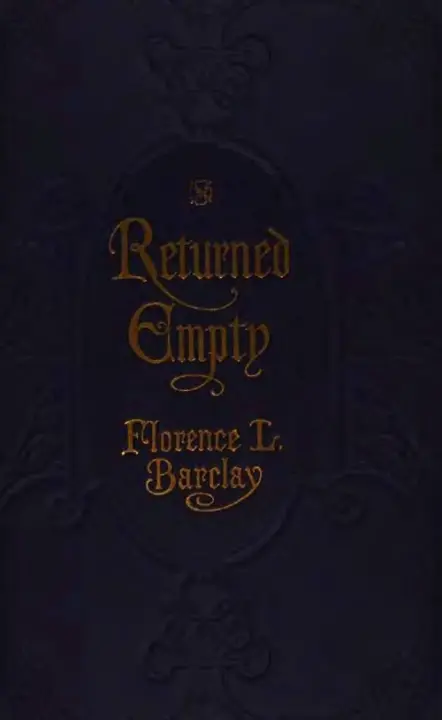
"Returned Empty" by Florence L. Barclay is a novel written in the early 20th century. The story follows the life of Luke Sparrow, a lonely man who has struggled with feelings of emptiness and a yearning for belonging since his infancy, when he was abandoned as a baby. The book explores profound themes of identity, love, and the quest for a true home as Luke navigates his existence, encapsulating his inner turmoil and relentless search for connection. The opening of the novel paints a vivid picture of Luke's life, beginning with a reflective scene on his thirtieth birthday. Alone and contemplating his life, he remembers the label tied to him as a baby, "Returned Empty," a phrase that underscores the essence of his existence. As he swims near a mysterious house, he becomes an unexpected observer of a family scene that evokes a deep sense of longing within him—an encounter that ignites his desire to find a place he can call home. This moment marks the beginning of his journey toward understanding himself and potentially reclaiming the connections he has lost, suggesting that his story will unfold with a mix of poignant introspection and romantic intrigue.
Introduction adapted from the source catalogue; source summaries may be automatically generated.
Free to read · English · 28,273 words · No account needed
MAKE TIME FOR A GOOD BOOK
On by default. Untick to stop anonymous reading totals. Each page counts after 10 seconds in view. How this works.
Anonymous counting is on unless you have switched it off.
He wrote with a peculiar detachment, never obtruding his own personality; viewing events in their larger meaning, as well as in careful completeness of minor detail; yet with no throb of human sentiment, no personal touch of intimate feeling.
Later on, he went in a similar capacity to India, and wrote one of the finest descriptions on record of the royal Durbar.
He moved amid scenes of varied interest; he made many acquaintances, but
no close friends.
His distant travels accomplished, he would return to his comfortless rooms, and work in solitude.
That within him which might have responded to love, and leapt into intimacy, seemed shut away behind prison bars. When Love drew near, he could but look forth with haunted eyes, watching while Love, rebuffed, moved sadly away.
He was a lonely man.
When he allowed himself a holiday, he packed a small knapsack, went by the fastest route possible to Scotland, Cornwall, Devon or Norfolk—anywhere where he could find a rugged coast; long stretches of gorse and heather; villages, which he could reach by nightfall.
Each morning he would be on the shore at sunrise, swimming, with strong, eager strokes, up the golden path toward the dazzling glory of the rising sun. Or, if he chanced, at close of day, to find himself where the coast faced westward, he would slip into the water at sunset and glide, with slow, dreamy motion and folded arms, up the crimson way toward the setting sun.
No day seemed complete to him unless it began and ended in the sea.
So, on this 12th of September, though the sun was sinking behind distant moors, when the waters called, he made his way down the cliff, walked half a mile or so along the shore until he found cover among rocks; then swam swiftly out to sea, recapturing the crimson ball as it disappeared behind the pine woods.
When he turned for a last sight of it, he noticed a fine old house, standing castle-like on the summit of the cliff, just above the rocks beside which he had left his clothes. It had not been in view when he had quitted the high path for the beach and the lee of the cliffs.
He swam back to the shore, dressed, lighted his pipe, and sat among the rocks till twilight fell.
The moon appeared, a huge yellow ball, rising out of the sea.
He found himself humming an old song he had picked up the year before, while on a walking tour through Brittany.
“Au clair de la lune,
Mon ami Pierrot!
Prête-moi ta plume
Pour écrire un mot.
Your reading position is saved on this browser. Take it to another device with a library code. Reading pages adapt to text, rather than matching a printed edition.
Florence L. (Florence Louisa) Barclay
Florence L. (Florence Louisa) Barclay
Florence L. (Florence Louisa) Barclay
Florence L. (Florence Louisa) Barclay
BEHIND THE BOOK
This eBook is for the use of anyone anywhere in the United States and most other parts of the world at no cost and with almost no restrictions whatsoever. You may copy it, give it away or re-use it under the terms of the Project Gutenberg License included with this eBook or online at www.gutenberg.org. If you are not located in the United States, you will have to check the laws of the country where you are located before using this eBook. Read the source licence.
The original source file, including credits and licence, is retained by this library. Request an original-format copy at no charge. Please include the book title and Project Gutenberg identifier #60307.
KEEP YOUR CURIOSITY GOING
Coulson Kernahan

Maurice Baring
Frances Wright
Cécile Tormay

Frederic Jesup Stimson

W. H. P. (William Henry Pope) Jarvis