
The Following of the Star: A Romance
Florence L. (Florence Louisa) Barclay
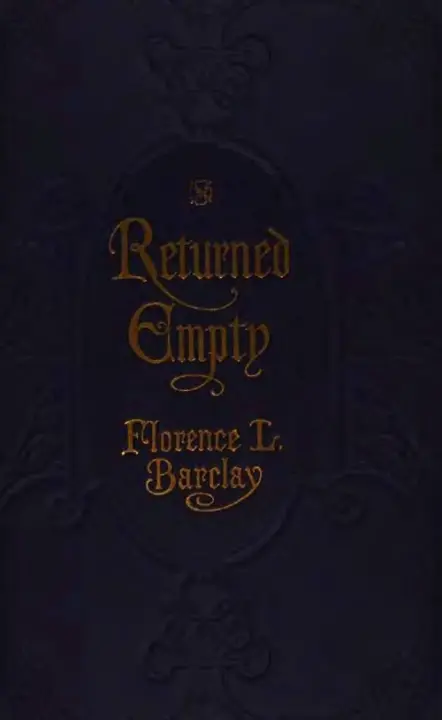
THE CLASSIC COLLECTION · 1920
"Returned Empty" by Florence L. Barclay is a novel written in the early 20th century. The story follows the life of Luke Sparrow, a lonely man who has struggled with feelings of emptiness and a yearning for belonging since his infancy, when he was abandoned as a baby. The book explores profound themes of identity, love, and the quest for a true home as Luke navigates his existence, encapsulating his inner turmoil and relentless search for connection. The opening of the novel paints a vivid picture of Luke's life, beginning with a reflective scene on his thirtieth birthday. Alone and contemplating his life, he remembers the label tied to him as a baby, "Returned Empty," a phrase that underscores the essence of his existence. As he swims near a mysterious house, he becomes an unexpected observer of a family scene that evokes a deep sense of longing within him—an encounter that ignites his desire to find a place he can call home. This moment marks the beginning of his journey toward understanding himself and potentially reclaiming the connections he has lost, suggesting that his story will unfold with a mix of poignant introspection and romantic intrigue.
Introduction adapted from the source catalogue; source summaries may be automatically generated.
Free to read · English · 28,273 words · No account needed
MAKE TIME FOR A GOOD BOOK
On by default. Untick to stop anonymous reading totals. Each page counts after 10 seconds in view. How this works.
Anonymous counting is on unless you have switched it off.
Lady Tintagel was alone.
She stood at the far end of the drawing-room.
When he entered she was leaning against the mantelpiece, looking down
into the fire.
She turned, still gripping the marble edge with her left hand.
She wore a gown of trailing black velvet and stood on a white Angora
rug.
Miles of rose carpet lay between him and the fireplace.
He seemed to be walking uphill, as he came toward her.
When he reached the rug at last, he and she seemed to be standing together on the summit of a delectable mountain. His mind still ran on his unsuitable attire, but he forgot the sentence he had prepared.
“I couldn’t,” was his lame apology.
She looked at him, and smiled. “You—wouldn’t,” she said.
There was such complete understanding in the grave regard of her kind eyes, in the low tones of her voice, so sweet and full of music.
It was all strangely intimate. As he stood beside her, lines he had heard years before flashed into his mind.
“Two men looked out through prison bars;
One saw mud; the other, stars.”
Hitherto he had seen mud—always mud. In her presence he realised the possibility of seeing stars—undreamed of stars.
And his prison bars themselves seemed vanishing.
Something captive in him broke its chains and leapt out into liberty.
And still she spoke no word; but her eyes dwelt on him with that all-enveloping, comprehending look of tenderness.
An unspoken sentence seemed to hang suspended. The silence was tense with it, as when a great orchestra, ready to sound the opening strain of a mighty symphony, waits, with eye, hand, and ear alert, for the first beat of the lifted baton.
But, on the instant, came an anti-climax.
“Dinner is served, my lady,” announced a deferential voice.
She laughed. “I suppose one must eat,” she said; and his common sense wondered why she said it, and why the same thought, unspoken, had been in his own mind.
She laid her hand within his arm, and they moved slowly down the room together. Walking so with her, he noted that she was slightly taller than he. She leaned on him. He felt vividly alive. Where was his shell—his shell of morbid reserve, in which he had hidden himself since his babyhood?
He tried to ask her how it came about that she had been expecting him; but something restrained the question.
Your reading position is saved on this browser. Take it to another device with a library code. Reading pages adapt to text, rather than matching a printed edition.
Florence L. (Florence Louisa) Barclay
Florence L. (Florence Louisa) Barclay
Florence L. (Florence Louisa) Barclay
Florence L. (Florence Louisa) Barclay
BEHIND THE BOOK
This eBook is for the use of anyone anywhere in the United States and most other parts of the world at no cost and with almost no restrictions whatsoever. You may copy it, give it away or re-use it under the terms of the Project Gutenberg License included with this eBook or online at www.gutenberg.org. If you are not located in the United States, you will have to check the laws of the country where you are located before using this eBook. Read the source licence.
The original source file, including credits and licence, is retained by this library. Request an original-format copy at no charge. Please include the book title and Project Gutenberg identifier #60307.
KEEP YOUR CURIOSITY GOING
Coulson Kernahan

Maurice Baring
Frances Wright
Cécile Tormay

Frederic Jesup Stimson

W. H. P. (William Henry Pope) Jarvis