
Last letters from the living dead man
David Patterson (Spirit) Hatch
THE CLASSIC COLLECTION · 1759
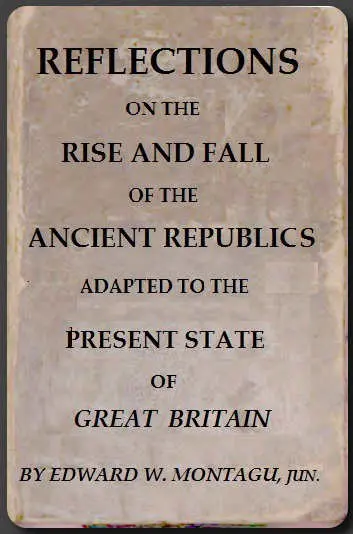
"Reflections on the Rise and Fall of the Ancient Republicks" by Edward W. Montagu is a historical account written in the early 19th century. The work examines the ancient republics such as Sparta, Athens, and Rome, drawing lessons that relate to the political climate of Great Britain at the time. Montagu aims to explore the factors that contributed to the rise and decline of these states, suggesting that contemporary issues in Britain resonate with those of the past. The opening portion of the book sets the stage for Montagu's exploration by introducing the historical context of various republics, particularly focusing on the governance of Sparta under Lycurgus. It discusses how Lycurgus addressed the deep-rooted issues of civil strife and inequality in Spartan society, ultimately leading to his significant reforms that promoted equality and a strong sense of civic duty among citizens. Montagu emphasizes the importance of unity and public virtue to maintain a free state, warning against the disunity that plagued ancient republics as a precursor to their downfall. The narrative establishes a foundation for Montagu's reflections, highlighting the dangers of neglecting the lessons of history in the face of contemporary political turmoil.
Introduction adapted from the source catalogue; source summaries may be automatically generated.
Free to read · English · 84,030 words · No account needed
MAKE TIME FOR A GOOD BOOK
On by default. Untick to stop anonymous reading totals. Each page counts after 10 seconds in view. How this works.
Anonymous counting is on unless you have switched it off.
At the expiration of the truce, which was made for one year only, the Latins took the field with a powerful army. Aulus Posthumius was created dictator by the Romans, and a decisive battle was fought near the lake Regillus, in which the Romans were completely victors. Sextus Tarquin was killed upon the spot, and old Tarquin the father died soon after. As soon as this war was ended, the senate, regardless of their promise, ordered all those suits for debt to be determined according to law, which had been suspended during the war. This faithless proceeding raised such violent commotions amongst the people, that a foreign war was judged the best expedient to divert the storm which threatened the aristocracy. The haughty Appius Claudius, and Publius Servilius, a man of a very different character, were nominated consuls by Posthumius and his colleague, which seems a manifest invasion of the rights of the people.[252] A war was resolved upon against the Volscians, but the Plebeians again refused to obey the summons for enlisting. Servilius adhered to the maxims of Valerius, and advised an immediate decree for the abolition of the debts. But he was furiously opposed by the inexorable Appius,[253] who called him a flatterer of the people, and declared that it would be giving up the government to the people when they had it in their power to live under an aristocracy. After much time was spent in these debates, Servilius, who was a popular man, prevailed upon the Plebeians, by his entreaties, and raised an army of volunteers, with which he marched against the enemy. The Volscians, who placed their chief dependance upon the disunion which prevailed amongst the Romans, submitted to whatever terms the consul should think proper to impose, and delivered three hundred hostages chosen out of their principal families, as a security for their behaviour. But this submission was far from real, and was calculated only to amuse the Romans and gain time for their military preparations. War was once more decreed against the Volscians; but whilst the senate was deliberating about the number of the forces proper to be employed, a man advanced in years appeared in the forum and implored the assistance of the people. Famine sat pictured in his pale and meagre face,[254] and the squalid hue of his dress indicated the extremes of poverty and wretchedness. This man, who was not unknown to the people, and, according to report, had borne a command in the army, first showed several honourable scars in his breast, remains of the wounds he had received in the service of his country, and then informed them: “that he had been present in eight and twenty battles, and frequently received rewards bestowed only upon superior bravery: that in the Sabine war his cattle were driven off by the enemy, his estate plundered, and his house reduced to ashes: that under these unhappy circumstances he was compelled to borrow money to pay the publick taxes; that this debt, accumulated by usury, reduced him to the sad necessity of selling the estate descended to him from his ancestors, with what little effects he had remaining: but that all this proving insufficient, his devouring debts, like a wasting consumption, had attacked his person, and he, with his two sons, were delivered up as slaves, and led away to the slaughterhouse by his creditors.” When he had said this, he threw off his rags, and showed his back yet bleeding from the scourge of his merciless master. This sight inflamed the people greatly, but the debtors breaking out of their creditor’s houses, most of whom were loaded with chains and fetters, raised their fury even to madness. If any one desired them to take up arms in defence of their country, the debtors showed their chains,[255] as the reward they had met with for their past services, and asked with indignation, whether such blessings were worth fighting for. Whilst numbers of them openly declared that it was much more eligible to be slaves to the Volscians than the Patricians. The senate, quite disconcerted by the violence of the tumult, entreated Servilius to take the management of the people. For an express was just arrived from the Latins, with advice that a numerous army of the enemy had already entered their territories. Servilius remonstrated to the people the consequences of disunion at so critical a juncture, and pacified them by the assurance that the senate would confirm whatever concessions he should make; he then ordered the crier to proclaim that no citizen who voluntarily enlisted should be subject to the demands or insults of his creditors whilst the army continued in the field. The people now flocked in with cheerfulness, and the levies were soon completed. Servilius took the field and defeated the Volscians, made himself master of their camp, took several of their cities, and divided the whole plunder amongst his soldiers. At the news of this success the sanguinary Appius ordered all the Volscian hostages to be brought into the forum,[256] there to be whipped and publickly beheaded. And when at his return Servilius demanded a triumph, he loudly opposed it, called him a factious man, and accused him of defrauding the treasury of the booty, and prevailed upon the senate to deny him that honour. Servilius, enraged at this usage, entered the city in triumph with his army, amidst the acclamations of the people, to the great mortification of the Patricians.
Your reading position is saved on this browser. Take it to another device with a library code. Reading pages adapt to text, rather than matching a printed edition.
BEHIND THE BOOK
This eBook is for the use of anyone anywhere in the United States and most other parts of the world at no cost and with almost no restrictions whatsoever. You may copy it, give it away or re-use it under the terms of the Project Gutenberg License included with this eBook or online at www.gutenberg.org. If you are not located in the United States, you will have to check the laws of the country where you are located before using this eBook. Read the source licence.
The original source file, including credits and licence, is retained by this library. Request an original-format copy at no charge. Please include the book title and Project Gutenberg identifier #45592.
KEEP YOUR CURIOSITY GOING
David Patterson (Spirit) Hatch
Cécile Tormay

Moritz Busch
Coulson Kernahan
John L. Ransom

Ralph Waldo Emerson