
Last letters from the living dead man
David Patterson (Spirit) Hatch
THE CLASSIC COLLECTION · 1759
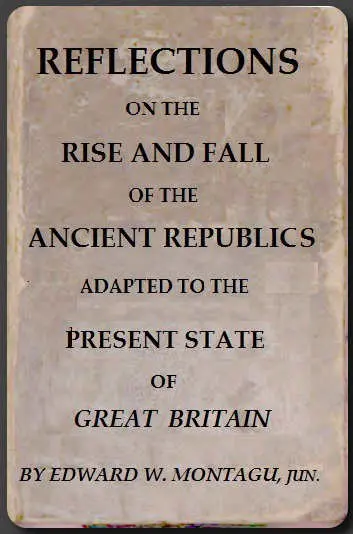
"Reflections on the Rise and Fall of the Ancient Republicks" by Edward W. Montagu is a historical account written in the early 19th century. The work examines the ancient republics such as Sparta, Athens, and Rome, drawing lessons that relate to the political climate of Great Britain at the time. Montagu aims to explore the factors that contributed to the rise and decline of these states, suggesting that contemporary issues in Britain resonate with those of the past. The opening portion of the book sets the stage for Montagu's exploration by introducing the historical context of various republics, particularly focusing on the governance of Sparta under Lycurgus. It discusses how Lycurgus addressed the deep-rooted issues of civil strife and inequality in Spartan society, ultimately leading to his significant reforms that promoted equality and a strong sense of civic duty among citizens. Montagu emphasizes the importance of unity and public virtue to maintain a free state, warning against the disunity that plagued ancient republics as a precursor to their downfall. The narrative establishes a foundation for Montagu's reflections, highlighting the dangers of neglecting the lessons of history in the face of contemporary political turmoil.
Introduction adapted from the source catalogue; source summaries may be automatically generated.
Free to read · English · 84,030 words · No account needed
MAKE TIME FOR A GOOD BOOK
On by default. Untick to stop anonymous reading totals. Each page counts after 10 seconds in view. How this works.
Anonymous counting is on unless you have switched it off.
The tyranny of Tarquin had made the very name of king so odious to the Romans in general, that the Patricians, who were the chief conductors of this revolution, found it no difficult matter to establish an aristocracy upon the ruins of monarchy.[250] Two magistrates were appointed, termed consuls, vested with the regal power, whose office was annual and elective. The senate was filled up out of the most eminent of the Plebeians, after they had first been created Patricians, and the people restored to their right of holding assemblies, of giving their votes and doing whatever they were entitled to by former customs. But the power of the people was rather nominal than real. For though the consuls were annually elected by the suffrages of the people, a privilege which carried the appearance of a democracy, yet as the votes were taken by centuries, not by tribes, the Patricians were generally masters of the election. It is remarkable that, after the expulsion of Tarquin, Dionysius constantly terms the new government an aristocracy. It evidently appears too through the whole remaining part of his history, that there was a selfish and haughty faction amongst the Patricians, who affected a tyrannical oligarchy, and aimed at reducing the Plebeians to a state of servitude. Valerius, surnamed Poplicola, the most humane patriot of all those who were concerned in banishing the Tarquins, introduced some beneficent laws, which, according to Dionysius, gave great relief to the Plebeians. For by one he made it capital for any person to exercise any magistracy over the Romans, unless that office should be received from the people: as he ordered by another, that no Roman should be punished without a legal trial; and that if any Roman should be condemned by any magistrate to be fined, whipped, or put to death, the condemned person might appeal from the sentence of that magistrate to the people, and should be liable to no punishment until his fate had been determined by their suffrages. A plain proof that the Plebeians until that time laboured under grievances not very consistent with their pretended liberty. Another proof may be drawn from the wretched state of the Plebeians, under the cruel oppressions arising from the avarice and extortions of the Patricians, which first gave birth to those perpetual seditions, which fill the history of that republick. For as the Roman soldiers, who were all free citizens, not only paid their proportion of the taxes, but were obliged to serve in the field at their own expense during the whole campaign, this frequently obliged them to borrow money at high interest of the Patricians, who had engrossed by far the greater part of publick wealth. But as the Roman territories were often ravaged by their neighbours in those wars, which Tarquin perpetually incited to procure the recovery of his crown, the loss fell heaviest upon the Plebeians, who were frequently stript of all their effects, and reduced to the utmost poverty. Hence unable to pay the principal of their debts, joined to an accumulated load of usury upon usury, they were surrendered by the judges to the discretion of their creditors. These unfeeling wretches confined their debtors in chains, tortured their bodies with whips, and treated them with such inhumanity, that great numbers of the Romans were in as bad a situation as the poor Athenians when Solon first undertook the administration. The effects of this detestable treatment of people, who had been taught to call themselves free, appeared about twelve years after the erection of their new government. For when the Tarquins had raised up a confederacy of thirty cities of the Latins against them, the Plebeians peremptorily refused to enlist until a vote was passed for the abolition of their debts. As persuasions had no effect, the senate met upon the occasion. Valerius, the son of the humane Poplicola, pleaded strongly in favour of the people, but was violently opposed by Appius Claudius, a haughty and imperious man, who is termed by Dionysius an abettor of the oligarchy, and head of that faction, which were enemies to the people. The moderate men amongst the senators proposed, that the debts should be paid out of the publick treasury; a measure which would preserve the poor for the service of the state, and prevent any injustice to the creditors. Salutary as this measure must seem, the opposition was so great that nothing was agreed to, and the result of the debates was, “that no decree should be made at present relating to this affair, but that as soon as the war should be concluded with success, the consuls should lay it before the senate, and take their vote upon the occasion. That in the mean time no debt should be sued for, and that the execution of all laws, except those relating to the war, should be suspended.” This decree did not wholly quiet the ferment amongst the people. Several of the poorer sort demanded an immediate abolition of their debts, as the condition for their taking a share in the dangers of the war, and looked upon this delay rather as an imposition. The senate, who, as the event showed, were determined never to grant their request, and yet were afraid of new commotions, resolved to abolish the consulship, and all other magistracies for the present, and to invest a new magistrate with absolute and unlimited power, and subject to no account for his actions. This new officer was termed the dictator, and the duration of his office was limited to six months, at the end of which term the consuls were to resume their former authority. The chief reason, as Dionysius informs us, which induced the senate to make use of this dangerous expedient, was to evade that law which Poplicola had procured in favour of the Plebeians, which made it death for a magistrate to punish a Roman without a legal trial, or before he was condemned by the people.[251] The senate then made a decree for the election of a dictator, and the Plebeians ignorant, as Dionysius observes, of the importance of that decree, not only confirmed the resolutions of the senate, but gave up to them the power of choosing the person who should be invested with that dignity. Titus Lartius, one of the consuls, was nominated by his colleague according to the form at that time agreed upon in the senate. When the dictator appeared in all the pomp and grandeur of his new office, he struck a terror into the most turbulent, and the people, thus tricked out of that law which was their only protection, immediately submitted. Lartius, who seems to have been one of the greatest men of his time, ordered in a general register of all the Romans, and formed his army after that wise method first instituted by Servius Tullius. When he took the field he persuaded the Latins, by his singular address, to disband their forces and conclude a truce, and thus diverted the impending storm without fighting. He then returned home, and resigned his office before the time was expired, without having exercised any one act of severity upon a single Roman. A noble instance of moderation and publick virtue!
Your reading position is saved on this browser. Take it to another device with a library code. Reading pages adapt to text, rather than matching a printed edition.
BEHIND THE BOOK
This eBook is for the use of anyone anywhere in the United States and most other parts of the world at no cost and with almost no restrictions whatsoever. You may copy it, give it away or re-use it under the terms of the Project Gutenberg License included with this eBook or online at www.gutenberg.org. If you are not located in the United States, you will have to check the laws of the country where you are located before using this eBook. Read the source licence.
The original source file, including credits and licence, is retained by this library. Request an original-format copy at no charge. Please include the book title and Project Gutenberg identifier #45592.
KEEP YOUR CURIOSITY GOING
David Patterson (Spirit) Hatch
Cécile Tormay

Moritz Busch
Coulson Kernahan
John L. Ransom

Ralph Waldo Emerson