
Last letters from the living dead man
David Patterson (Spirit) Hatch
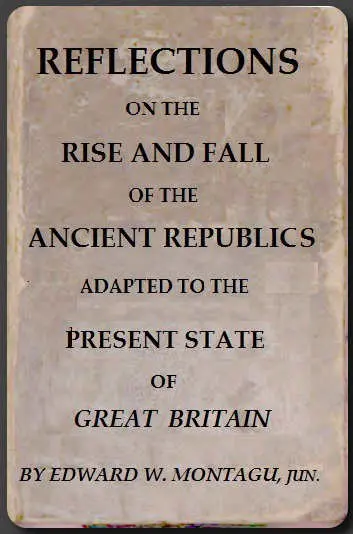
THE CLASSIC COLLECTION · 1759
"Reflections on the Rise and Fall of the Ancient Republicks" by Edward W. Montagu is a historical account written in the early 19th century. The work examines the ancient republics such as Sparta, Athens, and Rome, drawing lessons that relate to the political climate of Great Britain at the time. Montagu aims to explore the factors that contributed to the rise and decline of these states, suggesting that contemporary issues in Britain resonate with those of the past. The opening portion of the book sets the stage for Montagu's exploration by introducing the historical context of various republics, particularly focusing on the governance of Sparta under Lycurgus. It discusses how Lycurgus addressed the deep-rooted issues of civil strife and inequality in Spartan society, ultimately leading to his significant reforms that promoted equality and a strong sense of civic duty among citizens. Montagu emphasizes the importance of unity and public virtue to maintain a free state, warning against the disunity that plagued ancient republics as a precursor to their downfall. The narrative establishes a foundation for Montagu's reflections, highlighting the dangers of neglecting the lessons of history in the face of contemporary political turmoil.
Introduction adapted from the source catalogue; source summaries may be automatically generated.
Free to read · English · 84,030 words · No account needed
MAKE TIME FOR A GOOD BOOK
On by default. Untick to stop anonymous reading totals. Each page counts after 10 seconds in view. How this works.
Anonymous counting is on unless you have switched it off.
To what can we attribute the late ill conducted war with Spain, but to the ambition of party. How was the nation stunned with the noise of Spanish depredations from the press! how loudly did the same outcry resound in parliament! yet when the leaders of that powerful opposition had carried their point by their popular clamours; when they had pushed the nation into that war; when they had drove an overgrown minister from the helm, and nestled themselves in power, how quickly did they turn their backs upon the honest men of their party, who refused to concur in their measures! how soon did they convince the nation, by screening that very minister who had been so many years the object of their resentment, and by carrying on their own war (as I may term it) with the same or greater lukewarmness than what they had so lately exclaimed against in the same minister. They convinced, I say, the whole nation, that the welfare of the publick, and the protection of our trade, had not the least share in the real motives of their conduct.
But as the Carthaginian history, during this period, is intimately blended with the Roman, to avoid repetition, I am obliged to defer my farther remarks upon the conduct of this people, until I speak of the difference between the civil and military polity, and manners of both those nations.
[197] Arist. de Republ. lib. 2. cap. 9. lit. 4.
[198] Polyb. lib. 6. p. 692.
[199] Id. ibid.
[200] Ibid.
[201] Polyb. lib 6. p. 681.
[202] Excerpt. ex Polyb. de virtutibus et vitiis, p. 1426.
[203] Perses, &c.
[204] Varro.
Excudent alii spirantia mollius æra:
Credo equidem, vivos ducent de marmore vultus.
Virg. Æneid. lib. 6.
Tu regere imperio populos, Romane, memento
(Hæ tibi erunt artes) pacique imponere morem
Parcere subjectis, &c. Ibid.
[206] Polyb. lib. 1. p. 92...3.
[207] Polyb. p. 98...9.
[208] Diodor. Sicul. lib. 20. p. 735...36.
[209] Livy. lib. 28. p. 58...9.
[210] Appian, de Bell. Punick. p. 36.
[211] Polyb. lib. 1. p. 104....5.
[212] Polyb. lib. 1. p. 115.
[213] Ibid. lib. 1. p. 115.
[214] Polyb. lib. 1. p. 115.
[215] Idem. ibid. 117.
[216] Polyb. Ἀγαθὸς πεττευτὴς ibid. p. 119.
[217] Id. ibid. Πολιτικοὺς ἱππεῖς καὶ πεζοὺς p. 120.
[218] Polyb. lib. 1. p. 119.
[219] Polyb. lib. 1. p. 119.
[220] Polyb. Id. ibid. p. 121.
[221] Polyb. lib. 1. p. 122.
[222] Τοὺς ὑπολοίπους τῶν ἐν ταῖς ἡλικίαις καθοπλίσαντες (οἷον ἐσχάτην τρέχοντες ταύτην) ἐξαπέστελλον πρὸς τὸν Βάρκαν Polyb. lib. 1. p. 122.
[223] Polyb. lib. 2. p. 172.
[224] Μιᾷ γνώμῃ. Polyb. lib. 3. p. 234.
[225] This will be explained in another place.
[226] Lib. 3. p. 236.
[227] Id. ibid. p. 237.
[228] Polyb. lib. 3. 243....44.
[229] Polyb. id. ibid.
[230] Polyb. lib. 3. p. 259.
[231] Livy, lib. 21. p. 132.
[232] Ib. p. 135.
[233] Liv. lib. 21. p. 135. 36.
[234] Id. ibid.
[235] Liv. lib. 3. p. 142....43.
[236] Polyb. lib. 11. p. 888....89.
[237] Appian. de Bell. Annib. 323. Edit. Hen. Steph.
[238] Lib. 23 p. 265....66.
[239] Liv. lib. 30. p. 135.
[240] Lib. 22, p. 240.
[241] Appian. de Bell. Hannib. p. 328.
[242] Iberic. p. 259.
[243] Appian. id. ibid.
Your reading position is saved on this browser. Take it to another device with a library code. Reading pages adapt to text, rather than matching a printed edition.
BEHIND THE BOOK
This eBook is for the use of anyone anywhere in the United States and most other parts of the world at no cost and with almost no restrictions whatsoever. You may copy it, give it away or re-use it under the terms of the Project Gutenberg License included with this eBook or online at www.gutenberg.org. If you are not located in the United States, you will have to check the laws of the country where you are located before using this eBook. Read the source licence.
The original source file, including credits and licence, is retained by this library. Request an original-format copy at no charge. Please include the book title and Project Gutenberg identifier #45592.
KEEP YOUR CURIOSITY GOING
David Patterson (Spirit) Hatch
Cécile Tormay

Moritz Busch
Coulson Kernahan
John L. Ransom

Ralph Waldo Emerson