
Last letters from the living dead man
David Patterson (Spirit) Hatch
THE CLASSIC COLLECTION · 1759
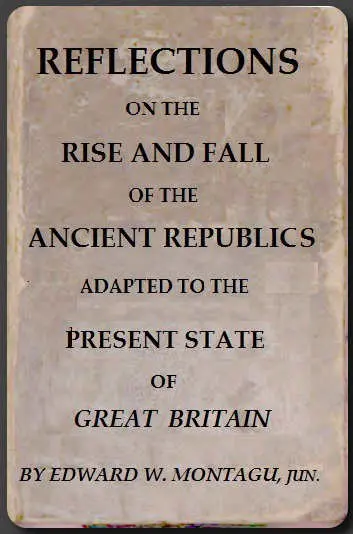
"Reflections on the Rise and Fall of the Ancient Republicks" by Edward W. Montagu is a historical account written in the early 19th century. The work examines the ancient republics such as Sparta, Athens, and Rome, drawing lessons that relate to the political climate of Great Britain at the time. Montagu aims to explore the factors that contributed to the rise and decline of these states, suggesting that contemporary issues in Britain resonate with those of the past. The opening portion of the book sets the stage for Montagu's exploration by introducing the historical context of various republics, particularly focusing on the governance of Sparta under Lycurgus. It discusses how Lycurgus addressed the deep-rooted issues of civil strife and inequality in Spartan society, ultimately leading to his significant reforms that promoted equality and a strong sense of civic duty among citizens. Montagu emphasizes the importance of unity and public virtue to maintain a free state, warning against the disunity that plagued ancient republics as a precursor to their downfall. The narrative establishes a foundation for Montagu's reflections, highlighting the dangers of neglecting the lessons of history in the face of contemporary political turmoil.
Introduction adapted from the source catalogue; source summaries may be automatically generated.
Free to read · English · 84,030 words · No account needed
MAKE TIME FOR A GOOD BOOK
On by default. Untick to stop anonymous reading totals. Each page counts after 10 seconds in view. How this works.
Anonymous counting is on unless you have switched it off.
Had that large supply been sent to Hannibal with the same unanimity and despatch with which it was voted, it is more than probable, that so consummate a general would have soon been master of Rome, and transferred the empire of the world to Carthage. For the Romans were so exhausted after the terrible defeat at Cannæ, that Livy is of opinion, that Hannibal would have given the finishing blow to that republick, if he had marched directly to Rome from the field of battle, as he was advised to do by his general of horse Maherbal.[240] That many of the nobility upon the first news of this fatal event, were in actual consultation about the means of quitting Italy, and looking out for a settlement in some other part of the world, and he affirms, that the safety both of the city and empire of Rome must be attributed (as it was then firmly believed at Rome) to the delay of that single day only, on which Maherbal gave that advice to Hannibal. Appian confirms the distressful situation of the Roman affairs at that juncture, and informs us, that including the slaughter at Cannæ, in which the Romans had lost most of their ablest officers, Hannibal had put to the sword two hundred and fifty thousand of their best troops in the space of two years only, from the beginning of the second Punick war inclusive.[241] It is easy, therefore, to imagine how little able the Roman armies, consisting chiefly of new levies, would have been to face such a commander as Hannibal, when supported by the promised re-enforcement of sixty-four thousand fresh men, besides money and elephants in proportion. For Hannibal, though deprived of all supplies from Carthage by the malice of the Hannonian faction, maintained his ground above fourteen years more after his victory at Cannæ, in spite of the utmost efforts of the Romans. A truth which Livy himself acknowledges with admiration and astonishment at his superior military capacity. From that period therefore, after the battle of Cannæ, when Hannibal was first disappointed of the promised supplies from Carthage, we ought properly to date the fall of that republick, which must be wholly imputed to the inveterate malice of the profligate Hanno and his impious faction, who were determined, as Hannibal observed before, to ruin the contrary party, though by means which must be inevitably attended with the destruction of their country. Appian insinuates,[242] that Hannibal first engaged in this war more from the importunity of his friends, than even his own passion for military glory and hereditary hatred to the Romans. For Hanno and his faction (as Appian tells us) no longer dreading the power of Hamilcar and Asdrubal his son-in-law,[243] and holding Hannibal extremely cheap upon account of his youth, began to persecute and oppress the Barcan party with so much rage and hatred, that the latter were obliged by letter to implore assistance from Hannibal, and to assure him that his own interest and safety was inseparable from theirs. Hannibal (as Appian adds) was conscious of the truth of this remark, and well knew that the blows, which seemed directed at his friends, were levelled in reality at his own head, and judged that a war with the Romans, which would be highly agreeable to the generality of his countrymen, might prove the surest means of counter-working his enemies, and preserving himself and his friends from the fury of a pliant and fickle populace, already inflamed against his party by the intrigues of Hanno. He concluded therefore, according to Appian, that a war with so formidable and dangerous a power, would divert the Carthaginians from all inquiries relative to his friends, and oblige them to attend wholly to an affair, which was of the last importance to their country. Should Appian’s account of the cause of this war be admitted as true, it would be a yet stronger proof of the calamitous effects of party disunion; though it would by no means excuse Hannibal. For Hanno and his party would be equally culpable for driving a man of Hannibal’s abilities to such a desperate measure, purely to screen himself and his party from their malice and power. But the blame for not supporting Hannibal after the battle of Cannæ, when such support would have enabled him to crush that power, which by their means recovered strength sufficient to subvert their own country, must be thrown entirely upon Hanno and his party. It was a crime of the blackest dye, and an act of the highest treason against their country, and another terrible proof of the fatal effects of party disunion. Nor was this evil peculiar to Carthage only, but was equally common in the Roman and Grecian republicks. Nay, could we trace all our publick measures up to their first secret springs of action, I do not doubt (notwithstanding the plausible reasons which might have been given to the publick to palliate such measures) but we should find our own country rashly engaged in wars detrimental to her true interests, or obliged to submit to a disadvantageous peace, just as either was conducive to the private interest of the prevailing party. Will not our own annals furnish us with some memorable instances of the truth of this assertion too recent to be denied? was not the treatment which the great duke of Marlborough received from Bolingbroke, the English Hanno, parallel to that which the victorious Hannibal met with from the Carthaginian, after the battle of Cannæ? did not Bolingbroke, from the worst of party motives, displace that ever victorious general, desert our allies, and sacrifice the brave and faithful Catalans, and the city of Barcelona, in at least as shameful a manner as the Romans did their unhappy friends at Saguntum? did not the same minister by the fatal treaty of Utrecht, rob the nation of all those advantages, which she had reason to hope for from a long and successful war? did he not by the same treaty, give our mortal enemy France time to retrieve her affairs, and recover from that low state to which the duke of Marlborough had reduced her, and even to arrive at that power, at present so terrible to us and to all Europe?
Your reading position is saved on this browser. Take it to another device with a library code. Reading pages adapt to text, rather than matching a printed edition.
BEHIND THE BOOK
This eBook is for the use of anyone anywhere in the United States and most other parts of the world at no cost and with almost no restrictions whatsoever. You may copy it, give it away or re-use it under the terms of the Project Gutenberg License included with this eBook or online at www.gutenberg.org. If you are not located in the United States, you will have to check the laws of the country where you are located before using this eBook. Read the source licence.
The original source file, including credits and licence, is retained by this library. Request an original-format copy at no charge. Please include the book title and Project Gutenberg identifier #45592.
KEEP YOUR CURIOSITY GOING
David Patterson (Spirit) Hatch
Cécile Tormay

Moritz Busch
Coulson Kernahan
John L. Ransom

Ralph Waldo Emerson