
Last letters from the living dead man
David Patterson (Spirit) Hatch
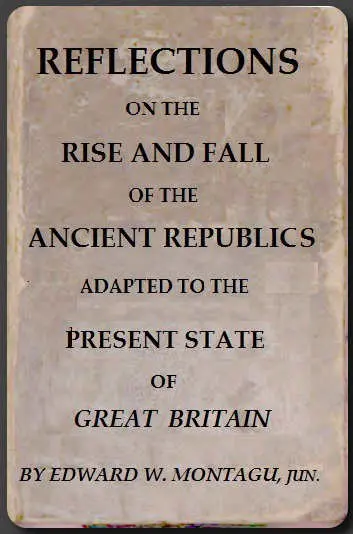
THE CLASSIC COLLECTION · 1759
"Reflections on the Rise and Fall of the Ancient Republicks" by Edward W. Montagu is a historical account written in the early 19th century. The work examines the ancient republics such as Sparta, Athens, and Rome, drawing lessons that relate to the political climate of Great Britain at the time. Montagu aims to explore the factors that contributed to the rise and decline of these states, suggesting that contemporary issues in Britain resonate with those of the past. The opening portion of the book sets the stage for Montagu's exploration by introducing the historical context of various republics, particularly focusing on the governance of Sparta under Lycurgus. It discusses how Lycurgus addressed the deep-rooted issues of civil strife and inequality in Spartan society, ultimately leading to his significant reforms that promoted equality and a strong sense of civic duty among citizens. Montagu emphasizes the importance of unity and public virtue to maintain a free state, warning against the disunity that plagued ancient republics as a precursor to their downfall. The narrative establishes a foundation for Montagu's reflections, highlighting the dangers of neglecting the lessons of history in the face of contemporary political turmoil.
Introduction adapted from the source catalogue; source summaries may be automatically generated.
Free to read · English · 84,030 words · No account needed
MAKE TIME FOR A GOOD BOOK
On by default. Untick to stop anonymous reading totals. Each page counts after 10 seconds in view. How this works.
Anonymous counting is on unless you have switched it off.
Thus fell the Athenians, and their fall involved the rest of Greece in one common ruin. The decadence of this once glorious and free state was begun by Pericles, who first introduced venality amongst the people for the support of luxury; continued by the venal orators, who encouraged that corruption to maintain their influence over the people; but finished by that fatal disunion between the only two men, whose publick virtue and abilities could have saved their country from destruction.
Athens, however, by her fall, has left us some instructions highly useful for our present conduct. Warned by her fate we may learn ... that the most effectual method which a bad minister can take, to tame the spirit of a brave and free people, and to melt them down to slavery, is to promote luxury, and encourage and diffuse a taste for publick diversions ... that luxury, and a prevailing fondness for publick diversions, are the never-failing forerunners of universal idleness, effeminacy, and corruption ... that there cannot be a more certain symptom of the approaching ruin of a state than when a firm adherence to party is fixed upon as the only test of merit, and all the qualifications requisite to a right discharge of every employment, are reduced to that single standard ... that these evils take root, and spread by almost imperceptible degrees in time of peace and national affluence; but, if left to their full and natural effects without controul, they will inevitably undermine and destroy the most flourishing and best founded constitution ... that in times of peace and affluence, luxury, and a fondness for diversions, will assume the specious names of politeness, taste, and magnificence. Corruption will put on different masks. In the corruptors it will be termed able management, encouraging the friends of the administration, and cementing a mutual harmony, and mutual dependence between the three different estates of the government.[173] In the corrupted it will be denominated loyalty, attachment to the government, and prudence in providing for one’s own family. That in such times these evils will gain a fresh accession of strength from their very effects; because corruption will occasion a greater circulation of the publick money; and the dissipation of luxury, by promoting trade,[174] will gild over private vices with the plausible appearance of publick benefits ... that when a state so circumstanced, is forced into a war with any formidable power, then, and not until then, these baleful evils will show themselves in their true colours, and produce their proper effects. The counsels in such a state will be weak and pusillanimous, because the able and honest citizens, who aim solely at the publick welfare, will be excluded from all share in the government from party motives ... their measures will terminate in poor shifts, and temporary expedients, calculated only to amuse, or divert the attention of the people from prying too closely into their iniquitous conduct. Their fleets and armies will be either employed in useless parade, or will miscarry in action from the incapacity of their commanders, because, as all the chief posts will be filled up with the creatures of the prevailing faction, such officers will be more intent upon enriching themselves than annoying the enemy; and will act as shall be judged most conducive to the private interest of their party, not to the publick service of their country. For they will naturally imagine, that the same power, which placed them in the command, will have weight enough to screen them from the resentment of an injured people ... their supplies for the extraordinary expenses of the war will be raised with difficulty; ... because, as so great a part of the publick money will be absorbed by the number of pensions and lucrative employments, and diverted to other purposes of corruption, the funds destined for the publick service will be found greatly deficient. If the rich are applied to, in such depraved times, to contribute their superfluous wealth towards the publick expenses, their answer will be the same which Scopas the rich Thessalian made to a friend, who asked him for a piece of furniture, which he judged wholly useless to the possessor, because it was quite superfluous.[175] “You mistake, my friend; the supreme happiness of our lives consists in those things which you call superfluous, not in those things which you call necessaries.” The people, accustomed to sell themselves to the best bidder, will look upon the wages of corruption as their birthright, and will necessarily rise in their demands, in proportion as luxury, like other fashions, descends from the higher to the lower classes. Heavy and unequal taxes must consequently be imposed to make up this deficiency; and the operations of the war must either be retarded by the slowness in collecting the produce, or the money must be borrowed at high interest and excessive premiums, and the publick given up a prey to the extortion of usurers. If a venal and luxurious Demades should be at the head of the ruling party,[176] such an administration would hardly find credit sufficient to support their measures, as the moneyed men would be averse to trusting their property in such rapacious hands;[177] for the chain of self-interest, which links such a set of men together, will reach from the highest quite down to the lowest officer of the state; because the higher officers, for the mutual support of the whole, must connive at the frauds and rapines of the inferior, or screen them if detected.
Your reading position is saved on this browser. Take it to another device with a library code. Reading pages adapt to text, rather than matching a printed edition.
BEHIND THE BOOK
This eBook is for the use of anyone anywhere in the United States and most other parts of the world at no cost and with almost no restrictions whatsoever. You may copy it, give it away or re-use it under the terms of the Project Gutenberg License included with this eBook or online at www.gutenberg.org. If you are not located in the United States, you will have to check the laws of the country where you are located before using this eBook. Read the source licence.
The original source file, including credits and licence, is retained by this library. Request an original-format copy at no charge. Please include the book title and Project Gutenberg identifier #45592.
KEEP YOUR CURIOSITY GOING
David Patterson (Spirit) Hatch
Cécile Tormay

Moritz Busch
Coulson Kernahan
John L. Ransom

Ralph Waldo Emerson