
Last letters from the living dead man
David Patterson (Spirit) Hatch
THE CLASSIC COLLECTION · 1759
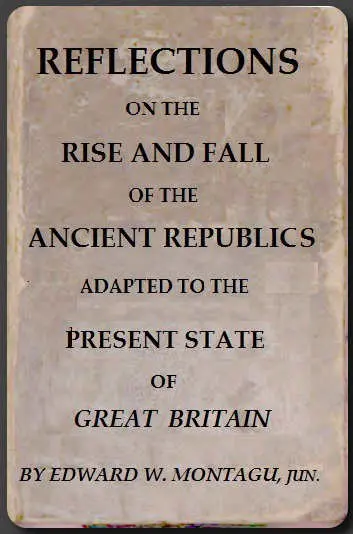
"Reflections on the Rise and Fall of the Ancient Republicks" by Edward W. Montagu is a historical account written in the early 19th century. The work examines the ancient republics such as Sparta, Athens, and Rome, drawing lessons that relate to the political climate of Great Britain at the time. Montagu aims to explore the factors that contributed to the rise and decline of these states, suggesting that contemporary issues in Britain resonate with those of the past. The opening portion of the book sets the stage for Montagu's exploration by introducing the historical context of various republics, particularly focusing on the governance of Sparta under Lycurgus. It discusses how Lycurgus addressed the deep-rooted issues of civil strife and inequality in Spartan society, ultimately leading to his significant reforms that promoted equality and a strong sense of civic duty among citizens. Montagu emphasizes the importance of unity and public virtue to maintain a free state, warning against the disunity that plagued ancient republics as a precursor to their downfall. The narrative establishes a foundation for Montagu's reflections, highlighting the dangers of neglecting the lessons of history in the face of contemporary political turmoil.
Introduction adapted from the source catalogue; source summaries may be automatically generated.
Free to read · English · 84,030 words · No account needed
MAKE TIME FOR A GOOD BOOK
On by default. Untick to stop anonymous reading totals. Each page counts after 10 seconds in view. How this works.
Anonymous counting is on unless you have switched it off.
He demonstrated to them, that the glorious principle, which had so long preserved the liberty of Greece, and had enabled them to triumph over the whole force and opulence of the mighty power of Persia, was that common hatred, that general detestation of corruption, which prevailed so universally amongst their generous forefathers.[164] That, in those times of publick virtue, to receive presents from any foreign power was deemed a capital crime. That if any man should be found so shamefully profligate, as to sell himself to any one, who had designs upon the liberty of Greece; or should endeavour to introduce corruption into his own country; death without mercy would have been his punishment here, and his memory branded with indelible and eternal infamy hereafter. That the statesmen and generals of those happier times, were absolute strangers to that most criminal and infamous kind of traffick; which was grown so common and so universal, that honour, fame, character, the liberty and welfare of their country were all set to sale, and sold publickly by auction to the best bidder.[165] He then made use of his utmost art, backed with the greatest strength of reasoning, to persuade the people, to give up that fund to the support of the army and navy (the service to which it had been originally appropriated) which from the time of Pericles had been applied solely to defray the expenses of the theatre. He showed next the folly and danger of confiding the defence of the state to mercenary forces, who had already served them so ill. He informed them, that their allies the Olynthians earnestly insisted, that the troops sent to their assistance might no longer be composed of venal hirelings as before, but of native Athenians, animated with a zeal for the glory of their country, and warm in the interest of the common cause. Both these motions were opposed by the corrupt party who adhered to Philip. The people were unwilling to give up that fund, even to the most pressing exigencies of the state, which enabled them to gratify their favourite passion; thus the opposition of the people quashed the former of these motions. But though the urgent, and repeated remonstrances of Demosthenes prevailed in favour of the latter, yet the demagogues, who omitted no opportunity of convincing Philip, how well he employed his money, took care to reduce the promised succours to a very small number, and to procure Chares, a creature of their own, to be placed at the head of the expedition.[166] Small as those succours were, yet they did the Olynthians essential service. But as all the eloquence of Demosthenes could not prevail upon his countrymen to make more vigorous efforts, the city of Olynthus fell the year following into the hands of Philip by the treachery of Euthycrates and Lasthenes, two of the leading citizens.[167] Philip still continued his encroachments upon the allies of Athens; sometimes cajoling, sometimes bullying the Athenians; just as he found either method most conducive to his purpose, in which he was punctually seconded by the corrupt demagogues. But at last the joint attack which he made upon the cities of Perynthus and Byzantium, from whose territories the Athenians drew their chief supplies of corn, at once opened their eyes, and roused them from their indolence. They equipped a very large armament with great expedition; but the Philippick faction had still influence enough with the people, to obtain the command of it for their friend Chares. The conduct of this general was exactly answerable to the opinion and hopes of his friends, who had procured him that employment. Chares, voluptuous, yet sordidly avaricious; vain and assuming, yet without either courage or capacity; rapacious, and intent only upon enriching himself at the expense either of friend or foe, was refused admittance by the inhabitants of Byzantium; who from experience were too well acquainted with his character. Enraged at such an unexpected affront; this doughty general employed his time in parading along the coasts, detested by his allies whom he plundered, and despised by his enemies whom he had not the courage to face. The Athenians, sensible of their folly, displaced Chares, and gave the command to Phocion. The able and honest Phocion was received with open arms by the Byzantines, and quickly convinced his countrymen, that he was more than a match for Philip. He not only drove that ambitious monarch out of the territories of the allies; but compelled him to retire with great loss and precipitation into his own dominions, where Phocion made several glorious and successful incursions. Philip now throwing off the masque, marched his army towards Athens, with a resolution to humble that people, who were the chief obstacle to his ambitious views. Demosthenes alone took the lead upon this occasion, and persuaded his countrymen to join the Thebans with all the force they could raise, and make head against the invader. Philip finding his measures quite disconcerted by this confederacy, sent an embassy to Athens to propose terms of peace, and to profess his desire of living in amity with the Athenians. Phocion, anxious about the success of a war, which he knew his countrymen had not virtue enough to support, and where the loss of a single battle must be fatal to the state, pleaded strongly for pacifick measures. But the flaming zeal of Demosthenes prevailed. Phocion was not only insulted, but excluded from all share in the command of the army by the infatuated people. Chares, so notorious for his cowardice and incapacity, who (as Diodorus Siculus informs us[168]) knew no more the duty of a general than the meanest private soldier in the army, and one Lysicles, a man of daring courage, but rash and ignorant, were appointed commanders in chief. As Demosthenes had pushed on the people to this war, and was at that time at the head of affairs, this fatal step must be entirely attributed to his private pique at Phocion for opposing his measures. Phocion had more than once beaten Philip with much inferior forces, and was indisputably the ablest general of the age, and the only man whom Philip was afraid of. The conduct therefore of Demosthenes was so rash and weak in the management of this war,[169] that Plutarch resolves the whole into a certain divine fatality; which, in the circumvolution of mundane affairs, had limited the freedom of Greece to that particular point of time. The battle of Chæronea, which ensued quickly after, gave the Athenians a too fatal proof of the superior foresight and sagacity of Phocion, and their own superlative folly in the choice of their generals. The battle was fought with equal bravery and obstinacy on both sides, and the confederates behaved as well as men could do upon the occasion; but their defeat was owing entirely to the incapacity of the Athenian commanders. This was so apparent,[170] that Philip observing a capital blunder committed by Lysicles in the heat of the action,[171] turned about coolly, and remarked to his officers, “that the Athenians knew not how to conquer.” This fault in point of generalship quickly turned the scale in favour of the abler Philip, who knew his trade too well to let slip so material an advantage. The Athenians were totally routed, and that fatal day put a period to the liberty and independency of Greece.[172]
Your reading position is saved on this browser. Take it to another device with a library code. Reading pages adapt to text, rather than matching a printed edition.
BEHIND THE BOOK
This eBook is for the use of anyone anywhere in the United States and most other parts of the world at no cost and with almost no restrictions whatsoever. You may copy it, give it away or re-use it under the terms of the Project Gutenberg License included with this eBook or online at www.gutenberg.org. If you are not located in the United States, you will have to check the laws of the country where you are located before using this eBook. Read the source licence.
The original source file, including credits and licence, is retained by this library. Request an original-format copy at no charge. Please include the book title and Project Gutenberg identifier #45592.
KEEP YOUR CURIOSITY GOING
David Patterson (Spirit) Hatch
Cécile Tormay

Moritz Busch
Coulson Kernahan
John L. Ransom

Ralph Waldo Emerson