
Last letters from the living dead man
David Patterson (Spirit) Hatch
THE CLASSIC COLLECTION · 1759
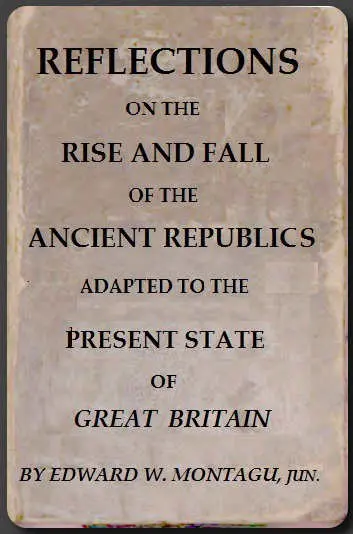
"Reflections on the Rise and Fall of the Ancient Republicks" by Edward W. Montagu is a historical account written in the early 19th century. The work examines the ancient republics such as Sparta, Athens, and Rome, drawing lessons that relate to the political climate of Great Britain at the time. Montagu aims to explore the factors that contributed to the rise and decline of these states, suggesting that contemporary issues in Britain resonate with those of the past. The opening portion of the book sets the stage for Montagu's exploration by introducing the historical context of various republics, particularly focusing on the governance of Sparta under Lycurgus. It discusses how Lycurgus addressed the deep-rooted issues of civil strife and inequality in Spartan society, ultimately leading to his significant reforms that promoted equality and a strong sense of civic duty among citizens. Montagu emphasizes the importance of unity and public virtue to maintain a free state, warning against the disunity that plagued ancient republics as a precursor to their downfall. The narrative establishes a foundation for Montagu's reflections, highlighting the dangers of neglecting the lessons of history in the face of contemporary political turmoil.
Introduction adapted from the source catalogue; source summaries may be automatically generated.
Free to read · English · 84,030 words · No account needed
MAKE TIME FOR A GOOD BOOK
On by default. Untick to stop anonymous reading totals. Each page counts after 10 seconds in view. How this works.
Anonymous counting is on unless you have switched it off.
This mighty armament, which carried the flower of the Athenian forces, was the most splendid, the best fitted out, and the most expensive, that had ever sailed from any of the Grecian ports to that very time.[91] But the first thing we meet with in this expedition, is (what might naturally be expected) a disagreement between the three generals as to the manner of beginning their operations.[92] Alcibiades indeed brought them both over to his opinion; but whilst he was disputing with his colleagues in Sicily, his enemies at Athens were by no means idle. The affair of the statues, and the pollution of the sacred mysteries, were again brought upon the carpet. The people, naturally suspicious, never inquired into the character of the informers, or the validity of the evidence, but admitted all that offered without distinction; and, giving easy credit to the most abandoned wretches, apprehended several of the most eminent citizens, and committed them to prison.[93] One of these persuaded another of his fellow prisoners, who was most liable to suspicion, to take the crime upon himself, and to impeach some others as his accomplices.[94] Urging this as a reason, that whether what he confessed should be true or false, he would at least secure his own pardon, and calm the present suspicions of the people. Andocides, for that was the name of this person according to Plutarch, though it is omitted by Thucydides, was prevailed upon by this kind of reasoning to acknowledge himself guilty of defacing the statues, and to inform against some others as accomplices in the same act of impiety.[95] Upon this declaration the informer received his pardon, and all those who were not mentioned in his information their liberty:[96] but processes were made out against as many as he had named, and all who were apprehended were tried, condemned, and executed upon his single evidence. Those who escaped by flight were sentenced to die, and a price set upon their heads by a publick proclamation. Whether the persons condemned were guilty or innocent was not at all clear, according to Thucydides. Plutarch tells us, that the friends and acquaintance of Alcibiades, who fell into the hands of the people, were severely handled on this occasion.[97] It is certain therefore that the information was chiefly levelled at him by the artifice of the opposite faction; for Thucydides informs us almost in the very next sentence, that the people received the information against Alcibiades with all the fury of prejudice, at the instigation of such of his enemies as had accused him before he sailed upon the expedition.[98] And since they now had not the least doubt of his being concerned in the affair of defacing the statues, they were more than ever convinced that he was equally guilty of the pollution of the mysteries, and that both those crimes were committed by him and his associates with the same design of subverting the popular government. For a body of Spartan troops happened to make an incursion, in that very juncture, as far as the Isthmus, upon some design or other against the Bœotians. This unlucky incident confirmed the people in their suspicions that this was a scheme concerted beforehand with Alcibiades, covered with the specious pretext of attacking the Bœotians;[99] and that if the plot had not been happily discovered in time, and the execution of it prevented by the death of the conspirators, their city would most inevitably have been betrayed to the Spartans.[100] Thus on every side suspicions fell strongly upon Alcibiades, and the people determining to put him to death, sent a private express to Sicily to recall him and such of his friends as were named in the information. The officers dispatched in the Salaminian galley, which was sent on that occasion, were ordered to acquaint Alcibiades, that he was desired to return with them to Athens to clear himself of those things which were objected to him before the people; but they received a strict charge not to offer to take him or his friends into custody; not only from the dread of some mutiny amongst their own soldiers upon his account, but for fear the allied troops, whom his influence had engaged, should desert and abandon the enterprise.[101] Alcibiades obeyed the summons, and taking his friends, who were included in the information, into his own ship, left Sicily in company with the Salaminian galley, seemingly as if returning to Athens; but, whether he only suspected, or, which is more probable, had received intelligence of the measures taken by his enemies in his absence, he, with his friends, went ashore at Thuria, and gave the Athenian officers the slip, not caring to stand the sentence of the credulous and prejudiced people.[102] The officers finding all their search after him quite fruitless, returned to Athens without him, and the Athenians passed sentence of death upon him and all those who accompanied him, and confiscated their estates for non-appearance.[103] Thus, instead of uniting their joint efforts to promote the success of an enterprise upon which they had staked their all, the infatuated Athenians were intent upon nothing but the cabals and intrigues of faction; and the folly of the people, managed by their ambitious and selfish demagogues, deprived the state of the only commander from whom they could rationally hope for success in that hazardous expedition. A measure which occasioned the total ruin both of their fleet and army, and gave a fatal shock to their republick; for the soldiers were not only greatly dispirited at the loss of a chief, in whose abilities they placed the most entire confidence, but Alcibiades, in revenge for his usage, took refuge amongst the Spartans, and prevailed upon them to send such supplies to the Syracusans as completed the destruction of the Athenians in that country.[104] Nicias was taken and put to death by the enemy; not a single ship returned, and few of the men escaped either slaughter or captivity.[105] The news of this terrible defeat threw the city into the utmost consternation.[106] They at first gave up all hopes, and imagined they should quickly see the enemy’s fleet in the Pyræum whilst they were in this exhausted and defenceless condition. However, the dread of the impending danger had this good effect that it made the populace extremely tractable, and ready to support their magistrates in whatever measures they judged most conducive to the common safety.[107] Nor could any thing but union and harmony amongst themselves have possibly saved them in the midst of so many enemies, with which they were surrounded. For all the Greeks in general were highly elated, as Thucydides tells us, with the ill success of the Athenians in Sicily.[108] Those who had hitherto observed a strict neutrality in this war wanted no solicitations to join in crushing that unhappy people, but rather thought it glorious to have a share in a war which they concluded would be but of short duration. The Spartan allies were more than ever desirous of delivering themselves from the calamities of war which they had so long suffered; whilst those states, which until that time had received laws from the Athenians, exerted themselves above their strength to support the revolt which they were then meditating. They judged of the situation of affairs from the blind impulse of passion, regardless of the dictates of reason, and fancied the next campaign would finish the ruin of the Athenians. The Spartans, promising themselves the certain dominion over all Greece, if the Athenians were once reduced, made vast preparations for the war, to which all their allies contributed their utmost; all got ready for opening the campaign the spring following.[109]
Your reading position is saved on this browser. Take it to another device with a library code. Reading pages adapt to text, rather than matching a printed edition.
BEHIND THE BOOK
This eBook is for the use of anyone anywhere in the United States and most other parts of the world at no cost and with almost no restrictions whatsoever. You may copy it, give it away or re-use it under the terms of the Project Gutenberg License included with this eBook or online at www.gutenberg.org. If you are not located in the United States, you will have to check the laws of the country where you are located before using this eBook. Read the source licence.
The original source file, including credits and licence, is retained by this library. Request an original-format copy at no charge. Please include the book title and Project Gutenberg identifier #45592.
KEEP YOUR CURIOSITY GOING
David Patterson (Spirit) Hatch
Cécile Tormay

Moritz Busch
Coulson Kernahan
John L. Ransom

Ralph Waldo Emerson