
Last letters from the living dead man
David Patterson (Spirit) Hatch
THE CLASSIC COLLECTION · 1759
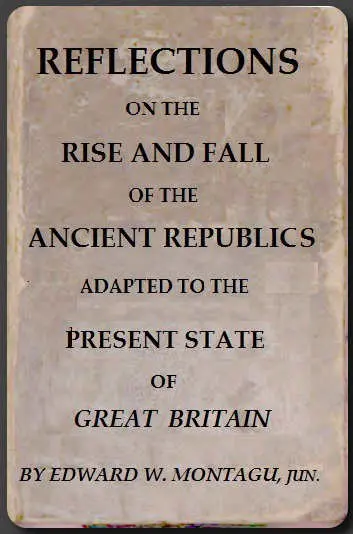
"Reflections on the Rise and Fall of the Ancient Republicks" by Edward W. Montagu is a historical account written in the early 19th century. The work examines the ancient republics such as Sparta, Athens, and Rome, drawing lessons that relate to the political climate of Great Britain at the time. Montagu aims to explore the factors that contributed to the rise and decline of these states, suggesting that contemporary issues in Britain resonate with those of the past. The opening portion of the book sets the stage for Montagu's exploration by introducing the historical context of various republics, particularly focusing on the governance of Sparta under Lycurgus. It discusses how Lycurgus addressed the deep-rooted issues of civil strife and inequality in Spartan society, ultimately leading to his significant reforms that promoted equality and a strong sense of civic duty among citizens. Montagu emphasizes the importance of unity and public virtue to maintain a free state, warning against the disunity that plagued ancient republics as a precursor to their downfall. The narrative establishes a foundation for Montagu's reflections, highlighting the dangers of neglecting the lessons of history in the face of contemporary political turmoil.
Introduction adapted from the source catalogue; source summaries may be automatically generated.
Free to read · English · 84,030 words · No account needed
MAKE TIME FOR A GOOD BOOK
On by default. Untick to stop anonymous reading totals. Each page counts after 10 seconds in view. How this works.
Anonymous counting is on unless you have switched it off.
Alcibiades now appeared upon the stage; a man composed of a motley mixture of virtues and vices, of good and bad qualities; one who could assume even the most opposite characters; and with more ease, than a chameleon can change its colours, appear a very contrast to himself just as his interest or ambition required.[76] This state Proteus was strongly piqued at the growing power and reputation of Nicias. His lust of power was too great to bear either a superior or an equal;[77] and he determined at all events to supplant him, alike regardless either of the equity of the means, or of the consequences of it to his country. The Athenians were not a little displeased with the Spartans, who had not been very punctual in fulfilling the conditions of the treaty.[78] Alcibiades finding his countrymen in a humour very proper for his purpose, inflamed them violently against Nicias, whom he publickly accused as a secret friend and wellwisher to that people. Nicias endeavoured to ward off the blow, and prevent his countrymen from coming to an open rupture; but the intrigues of Alcibiades prevailed, who procured himself to be elected general, and fresh hostilities to be commenced against the allies of Sparta.[79]
The seventeenth year of this memorable war is remarkable for that fatal expedition against Sicily, which gave a mortal blow to the Athenian grandeur, and affords a signal instance of the terrible consequences of faction. The Egestians, a small state in Sicily, applied to the Athenians for assistance against the oppressions of the Syracusans. Alcibiades, looking upon it as an object worthy of his ambition, undertook the cause of these suppliants, and knew so well how to flatter the vanity of his countrymen, that a large armament was decreed by the people for that purpose, and Nicias, Alcibiades, and Lamachus, a daring but able officer, were elected generals.[80] Nicias was the only person who had the honesty or courage to oppose a measure which he judged not only rash, but to the last degree impolitick; but the Athenians were deaf to all his remonstrances. The relief of the Egestians was only the pretext; for the entire dominion of Sicily, as Thucydides assures us, was the real object they had in view when they gave orders for that powerful armament.[81] Alcibiades had promised them an easy conquest of that island, which he looked upon only as a prelude to much greater enterprises; and the besotted people had already swallowed up Italy, Carthage, and Africa in their idle imaginations.[82] Both factions concurred in the vigorous prosecution of this measure, though from very different motives: the friends of Alcibiades, from the view of aggrandizing their chief by that vast accession of wealth and glory which they hoped for from this expedition: his enemies, from the hopes of supplanting him in his absence, and gaining the lead in the administration.[83] Thus the true interest of the state was equally sacrificed to the selfish and private views of each party! But, in the midst of these vast preparations, an odd accident threw the whole city into confusion, and at once alarmed the superstition and jealousy of the people. The terms, or statues of Mercury, were all defaced in one and the same night by some unknown persons; nor could the Athenians ever discover the real authors of this reputed sacrilege.[84] Proclamations were issued with a free pardon, and reward for any of the accomplices who could make a discovery, and the information of strangers and slaves was allowed as legal evidence; but no information could be procured as to the true authors of that particular fact; a circumstance which to me does not appear at all surprising: for it was evidently, in my opinion, a piece of party-craft played off against Alcibiades by the opposite faction, who knew that to attack the established religion, was to touch the master-spring of the passions of their countrymen.[85] Some slaves indeed, and other low persons (suborned, as Plutarch asserts, by Androcles,[86] one of the demagogues) deposed, that long before that, some statues had been mutilated, and the most sacred mysteries of their religion ridiculed, in a drunken frolick by some wild young fellows, and that Alcibiades was of the party.[87] This information, which, according to Plutarch, was a palpable contrivance of his enemies, enabled them to fix the odium of the last action upon Alcibiades.[88] The demagogues of the opposite faction greatly exaggerated the whole affair to the people. They accused him of a treasonable design against the popular government, and produced his contemptuous ridicule of the sacred mysteries, and the mutilation of Mercury’s statues, in support of their charge; as they urged his well known libertinism, and licentious life as a proof that he must be the author of those insults upon their religion. Alcibiades not only denied the charge, but insisted upon being brought immediately to a legal trial; declaring himself ready to undergo the punishment inflicted by the laws, if he should be found guilty.[89] He beseeched the people not to receive any informations against him in his absence, but rather to put him to death upon the spot if they judged him to be the offender. He urged too, how impolitick it would be to send him with the command of so great an army, whilst he lay under the imputation of a crime of that nature, before they had taken thorough cognizance of the affair: but his accusers dreading the effect which his interest with the army, and his well known influence over the allied troops, which had engaged in the expedition from their personal attachment to him, might have upon the people, if he should be brought to immediate trial, procured other demagogues of their party to dissuade the people from a measure which they judged would disconcert their scheme. These men pleaded the dangerous delay which such a proceeding might occasion, and urged the necessity of dispatch in an enterprise of such vast importance. They proposed therefore that the fleet should sail immediately, but that Alcibiades should return when a day was appointed for his trial.[90] For their intention was, as Thucydides remarks, to recall and bring him to his trial when the popular prejudice ran strong against him, which they knew they could easily spirit up in his absence. It was decreed, therefore, that Alcibiades should depart immediately upon the expedition.
Your reading position is saved on this browser. Take it to another device with a library code. Reading pages adapt to text, rather than matching a printed edition.
BEHIND THE BOOK
This eBook is for the use of anyone anywhere in the United States and most other parts of the world at no cost and with almost no restrictions whatsoever. You may copy it, give it away or re-use it under the terms of the Project Gutenberg License included with this eBook or online at www.gutenberg.org. If you are not located in the United States, you will have to check the laws of the country where you are located before using this eBook. Read the source licence.
The original source file, including credits and licence, is retained by this library. Request an original-format copy at no charge. Please include the book title and Project Gutenberg identifier #45592.
KEEP YOUR CURIOSITY GOING
David Patterson (Spirit) Hatch
Cécile Tormay

Moritz Busch
Coulson Kernahan
John L. Ransom

Ralph Waldo Emerson