
Last letters from the living dead man
David Patterson (Spirit) Hatch
THE CLASSIC COLLECTION · 1759
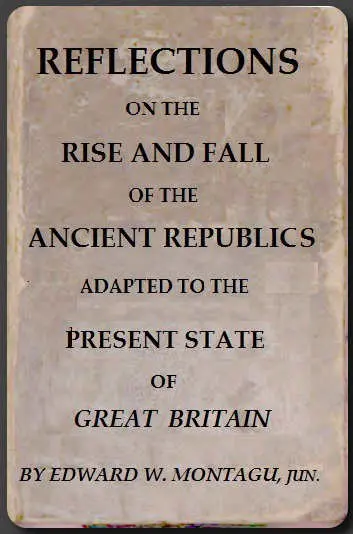
"Reflections on the Rise and Fall of the Ancient Republicks" by Edward W. Montagu is a historical account written in the early 19th century. The work examines the ancient republics such as Sparta, Athens, and Rome, drawing lessons that relate to the political climate of Great Britain at the time. Montagu aims to explore the factors that contributed to the rise and decline of these states, suggesting that contemporary issues in Britain resonate with those of the past. The opening portion of the book sets the stage for Montagu's exploration by introducing the historical context of various republics, particularly focusing on the governance of Sparta under Lycurgus. It discusses how Lycurgus addressed the deep-rooted issues of civil strife and inequality in Spartan society, ultimately leading to his significant reforms that promoted equality and a strong sense of civic duty among citizens. Montagu emphasizes the importance of unity and public virtue to maintain a free state, warning against the disunity that plagued ancient republics as a precursor to their downfall. The narrative establishes a foundation for Montagu's reflections, highlighting the dangers of neglecting the lessons of history in the face of contemporary political turmoil.
Introduction adapted from the source catalogue; source summaries may be automatically generated.
Free to read · English · 84,030 words · No account needed
MAKE TIME FOR A GOOD BOOK
On by default. Untick to stop anonymous reading totals. Each page counts after 10 seconds in view. How this works.
Anonymous counting is on unless you have switched it off.
[260] Sallust. Fragment. apud Augustin. de civitate Dei. lib.
2. cap. 18. edit. Froben. 1569.
[261] In the comitia tributa or assemblies by tribes the people voted in the same manner, as in the comitia curiata or assemblies by curiæ. The majority of single votes in every tribe constituted the voice of that tribe, and the majority of the tribes decided the question. But the Patricians conscious of their superiority in the comitia centuriata or assemblies by centuries, constantly refused to obey the plebiscita or decrees made by the people in their assemblies by tribes, which they insisted were binding to the Plebeians only. After the abolition of the decemvirate the people obtained a law: ... “that all laws passed in their assemblies by tribes should have equal force with those made in the assemblies by centuries, and should be equally obligatory to all the Romans without distinction.”
[262] The place of election.
[263] Proscriptiones innoxiorum ob divitias, cruciatus virorum illustrium, vastam urbem fuga et cædibus, bona civium miserorum quasi Cimbricam prædum, venum aut dono datam. Sall. Frag. p. 142.
[264] Ante Carthaginem deletam ... metus hostilis in bonis artibus civitatem retinebat. Sall. Bell. Jug. p. 80.
[265] Postquam remoto metu Punico mores non paulatim ut antea, sed torrentis modo præcipitati. Sall. Frag. p. 139.
... Rapere, consumere, sua parvi pendere, aliena cupere, pudorem, pudicitiam, divina humana promiscua, nihil pensi, neque moderati habere. De Bell. Cat. pag. 8.
[266] Cæpere nobilitas dignitatem, populus libertatem in
lubidinem vertere. Bell. Jug. p. 80.
[267] Postquam divitiæ honori esse cœperunt, et eas gloria, imperium, potentia sequebatur hebescere virtus, paupertas probro haberi, innocentia pro malevolentia duci cæpit. Bell. Cat. p. 8.
[268] Ita cum potentia avaritia sine modo, modestiaque
invadere, polluere, et vastare omnia, nihil pensi neque sancti
habere. p. 81.
Sibi quisque ducere, trahere rapere. De Bell. Jug. p. 81.
[269] Eos paulatim expulsos agris, inertia atque inopia incertas domos habere subegit: cæpere alienas opes petere, libertatem suam cum Republica venalem habere. Sall. Orat. 2. ad Cæsarem de Repub. Ordinand. p. 197.
[270] Ita omnia in duas partes abstracta sunt: respublica, quæ media fuerat, dilacerata. De Bell. Jug. p. 80.
[271] Pecuniæ cupido fidem, probitatem ceterasque bonas artes subvertit; pro his superbiam, crudelitatem deos negligere, omnia venalia habere edocuit. De Bell. Cat. p. 7.
[272] Cupido Imperii, id. p. 7.
[273] Primo pecuniæ, dein imperii cupido crevit, ea quasi materies omnium malorum fuere.... Post ubi contagio, quasi pestilentia, invasit, civitas immutata, imperium ex justissimo atque optumo, crudele intolerandumque factum. De Bell. Cat. p. 7.
[274] Aliud clausum in pectore, aliud promptum in lingua
habere, amicitias, inimicitiasq; vultum, quam ingenium bonum
habere. Ibid.
[275] Malitia præmiis exercetur; ubi ea demseris, nemo omnium
gratuito malus est. p. 200.
[276] Nam, ubi malos præmia sequuntur, haud facile quisquam gratuito bonus est. Sall. Orat. Philip. contra Lapid. p. 145.
Your reading position is saved on this browser. Take it to another device with a library code. Reading pages adapt to text, rather than matching a printed edition.
BEHIND THE BOOK
This eBook is for the use of anyone anywhere in the United States and most other parts of the world at no cost and with almost no restrictions whatsoever. You may copy it, give it away or re-use it under the terms of the Project Gutenberg License included with this eBook or online at www.gutenberg.org. If you are not located in the United States, you will have to check the laws of the country where you are located before using this eBook. Read the source licence.
The original source file, including credits and licence, is retained by this library. Request an original-format copy at no charge. Please include the book title and Project Gutenberg identifier #45592.
KEEP YOUR CURIOSITY GOING
David Patterson (Spirit) Hatch
Cécile Tormay

Moritz Busch
Coulson Kernahan
John L. Ransom

Ralph Waldo Emerson