THE CLASSIC COLLECTION✦A journey in search of ChristmasCLASSIC FREE BOOKS
A journey in search of Christmas
Owen Wister
THE CLASSIC COLLECTION · 1895
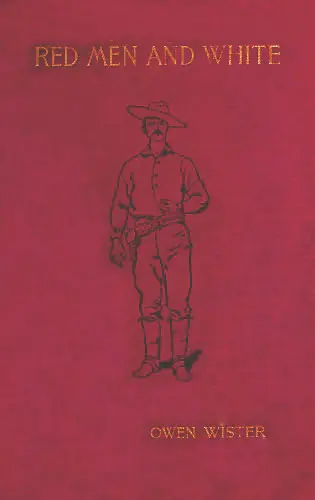
"Red Men and White" by Owen Wister is a collection of short stories written in the late 19th century. The narrative explores the complexities of life on the Western frontier, particularly focusing on the interactions between white settlers and Native American tribes. The stories are connected thematically and feature overlapping characters, suggesting a rich and intertwined tapestry of life during a pivotal time in American history. The opening of the collection sets the stage for these narratives by highlighting the dynamic circumstances of the Crow Indians and their evolving relationship with white settlers and soldiers. It introduces characters like young Cheschapah, a Crow Indian who struggles between his ambition for leadership and duty to his people, and Lieutenant Stirling whose observations about the Indians reveal deeper nuances. As tensions arise with the Sioux tribe visiting the Crows and the calculations of superstitions that could ignite conflict, a stark portrait of life on the frontier is painted—a world of fragile peace overshadowed by the threat of violence, cultural misunderstanding, and the quest for identity and recognition. This sets the tone for a thoughtful exploration of the intersections of cultures, conflict, and human ambition that defines the Wild West.
Introduction adapted from the source catalogue; source summaries may be automatically generated.
Free to read · English · 79,787 words · No account needed
MAKE TIME FOR A GOOD BOOK
On by default. Untick to stop anonymous reading totals. Each page counts after 10 seconds in view. How this works.
Anonymous counting is on unless you have switched it off.
He raised his head mechanically to listen. He had never been a bad man; had never wished to hurt anybody in his life before that he could remember; but as he pondered upon it in his slow, sure brain, he knew that he was glad he had done this, and was going to do more. He was going to follow those tracks pretty soon, and finish the whole job with his own hand. They had fooled him, and had taken trouble to do it; gone out of their way, made game of him to the quick; and when he remembered, for the twentieth time this morning, that day he had carried the package of gold-dust--some of it very likely his own--to the smooth-faced messenger at Folsom, Drylyn's stolid body trembled from head to foot, and he spoke blind, inarticulate words.
But down below there the screams were sounding. A brother miner came running by. Drylyn realized that he ought to be running too, of course, and so he ran. All the men were running from their various scattered claims, and Salvation Gap grew noisy and full of people at once. There was the sheriff also, come up last evening on the track of some stage-robbers, and quite opportune for this, he thought. He liked things to be done legally. The turmoil of execration and fierce curiosity thrashed about for the right man to pitch on for this crime. The murdered woman had been so good company, so hearty a wit, such a robust songstress, so tireless a dancer, so thoroughly everybody's friend, that it was inconceivable to the mind of Salvation Gap that anybody there had done it. The women were crying and wringing their hands--the Gazelle had been good to them too; the men were talking and cursing, all but Drylyn there among them, serious and strange-looking; so silent that the sheriff eyed him once or twice, though he knew nothing of the miner's infatuation. And then some woman shrieked out the name of Drylyn, and the crowd had him gripped in a second, to let him go the next, laughing at the preposterous idea. Saying nothing? Of course he didn't feel like talking. To be sure he looked dazed. It was hard luck on him. They told the sheriff about him and the Gazelle. They explained that Drylyn was "sort of loony, anyway," and the sheriff said, "Oh!" and began to wonder and surmise in this half-minute they had been now gathered, when suddenly the inevitable boot-prints behind the tent down the hill were found. The shout of discovery startled Drylyn as genuinely as if he had never known, and he joined the wild rush of people to the hill. Nor was this acting. The violence he had set going, and in which he swam like a straw, made him forget, or for the moment drift away from, his arranged thoughts, and the tracks on the hill had gone clean out of his head. He was become a mere blank spectator in the storm, incapable of calculation. His own handiwork had stunned him, for he had not foreseen that consequences were going to rise and burst like this. The next thing he knew he was in a pursuit, with pine-trees passing, and the hurrying sheriff remarking to the band that he proposed to maintain order. Drylyn heard his neighbor, a true Californian, whose words were lightest when his purpose was most serious, telling the sheriff that order was certainly Heaven's first law, and an elegant thing anywhere. But the anxious officer made no retort in kind, and only said that irregularities were damaging to the county's good name, and would keep settlers from moving in. So the neighbor turned to Drylyn and asked him when he was intending to wake up, as sleep-walking was considered to be unhealthy. Drylyn gave a queer, almost wistful, smile, and so they went along; the chatty neighbor spoke low to another man, and said he had never sized up the true state of Drylyn's feeling for the Gazelle, and that the sheriff might persuade some people to keep regular, when they found the man they were hunting, but he doubted if the sheriff would be persuading enough for Drylyn. They came out on a road, and the sleep-walker recognized a rock and knew how far they had gone, and that this was the stage-road between Folsom and Surprise Springs. They followed the road, and round a bend came on the man. He had been taking it easily, being in no hurry. He had come to this point by the stage the night before, and now he was waiting for its return to take him back to Folsom. He had been lunching, and was seated on a stone by a small creek. He looked up and saw them, and their gait, and ominous compactness. What he did was not the thing for him to do. He leaped into cover and drew his revolver. This attempt at defence and escape was really for the sake of the gold-dust he had in his pocket. But when he recognized the sheriff's voice, telling him it would go better with him if he did not try to kill any more people, he was greatly relieved that it was not highwaymen after him and his little gold, and he put up his pistol and waited for them, smiling, secure in his identity; and when they drew nearer he asked them how many people he had killed already. They came up and caught him and found the gold in a moment, ripping it from his pocket; and the yell they gave at that stopped his smiling entirely. When he found himself in irons and hurried along, he began to explain that there was some mistake, and was told by the chatty neighbor that maybe killing a woman was always a mistake, certainly one this time. As they walked him among them they gave small notice to his growing fright and bewilderment, but when he appealed to the sheriff on the score of old acquaintanceship, and pitifully begged to know what they supposed he had done, the miners laughed curiously. That brought his entreating back to them, and he assured them, looking in their faces, that he truly did need to be told why they wanted him. So they held up the gold and asked him whose that had been, and he made a wretched hesitation in answering. If anything was needed to clinch their certainty, that did. They could not know that the young successful lover had recognized Drylyn's strange face, and did not want to tell the truth before him, and hence was telling an unskilful lie instead. A rattle of wheels sounded among the pines ahead, and the stage came up and stopped. Only the driver and a friend were on it, and both of them knew the shot-gun messenger and the sheriff, and they asked in some astonishment what the trouble was. It had been stage-robbers the sheriff had started after, the driver thought. And--as he commented in friendly tones--to turn up with Wells and Fargo's messenger was the neatest practical joke that had occurred in the county for some time. The always serious and anxious sheriff told the driver the accusation, and it was a genuine cry of horror that the young lover gave at hearing the truth at last, and at feeling the ghastly chain of probability that had wound itself about him.
Your reading position is saved on this browser. Take it to another device with a library code. Reading pages adapt to text, rather than matching a printed edition.
Owen Wister

Owen Wister

Caspar Whitney & George Bird Grinnell & Owen Wister
Owen Wister
BEHIND THE BOOK
This eBook is for the use of anyone anywhere in the United States and most other parts of the world at no cost and with almost no restrictions whatsoever. You may copy it, give it away or re-use it under the terms of the Project Gutenberg License included with this eBook or online at www.gutenberg.org. If you are not located in the United States, you will have to check the laws of the country where you are located before using this eBook. Read the source licence.
The original source file, including credits and licence, is retained by this library. Request an original-format copy at no charge. Please include the book title and Project Gutenberg identifier #28675.
KEEP YOUR CURIOSITY GOING
Coulson Kernahan

Maurice Baring
Frances Wright
Cécile Tormay

Frederic Jesup Stimson

W. H. P. (William Henry Pope) Jarvis