
The Writing of News A Handbook with Chapters on Newspaper Correspondence and Copy Reading
Charles G. (Charles Griffith) Ross
THE CLASSIC COLLECTION · 1899
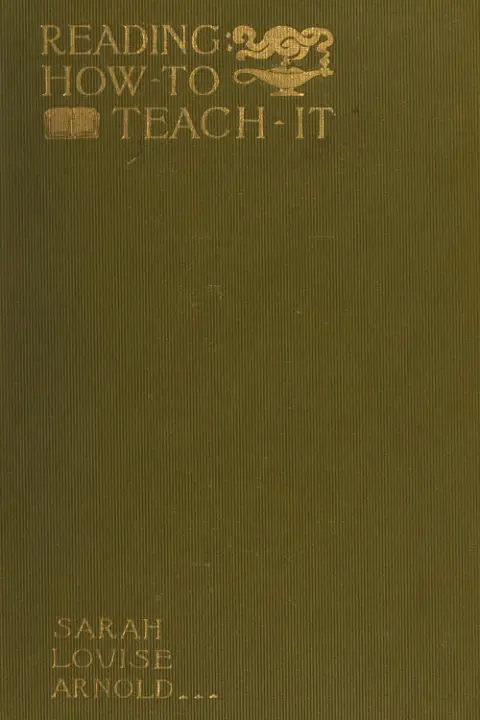
"Reading: How to Teach It" by Sarah Louise Arnold is an educational guide focused on methods for teaching reading effectively, written in the late 19th century. The book addresses the importance of not only teaching children how to read but also guiding them in understanding the purpose and value of reading throughout their lives. Drawing from her experiences as an educator, Arnold emphasizes cultivating a love for literature and meaningful engagement with texts. The opening of the book sets the tone for its instructional purpose by exploring the fundamental reasons why we read. Arnold argues that reading is not merely a practical skill but a gateway to knowledge, culture, and spiritual inspiration. She encourages teachers to recognize the intrinsic value of reading, from gaining practical information to accessing the long-cherished experiences and insights found in literature. By prompting readers to reflect on their motivations for reading, Arnold lays a foundation for discussing effective teaching strategies that foster a deeper understanding and appreciation of reading in students.
Introduction adapted from the source catalogue; source summaries may be automatically generated.
Free to read · English · 36,399 words · No account needed
MAKE TIME FOR A GOOD BOOK
On by default. Untick to stop anonymous reading totals. Each page counts after 10 seconds in view. How this works.
Anonymous counting is on unless you have switched it off.
Suitable for Use in the School-room.
The list is intended to be suggestive merely. Nearly all the poems are well known, and need only to be recalled to the mind of the teacher. They can readily be found at any good library. Most of them are suitable for memorizing. All may be read with advantage to the children in most grades.
Abou Ben Adhem. Leigh Hunt.
Aladdin. James Russell Lowell.
Alexander Selkirk. William Cowper.
Ancient Mariner, The. Samuel Taylor Coleridge.
April. Helen Hunt Jackson.
April Day, An. Mrs. Southey.
Arnold Von Winkelried. James Montgomery.
Autumn Fashions. Edith Thomas.
Bannockburn. Robert Burns.
Barefoot Boy, The. John Greenleaf Whittier.
Battle Hymn of the Republic. Julia Ward Howe.
Better Land, The. Felicia D. Hemans.
Bingen on the Rhine. Caroline Norton.
Blue and the Gray, The. F. M. Finch.
Break, Break, Break! Alfred Tennyson.
Breathes there the man, etc. Walter Scott.
Brook, The. Alfred Tennyson.
Bugle Song, The. Alfred Tennyson.
Builders, The. Henry Wadsworth Longfellow.
Burial of Moses, The. Mrs. Alexander.
Burial of Sir John Moore. Charles Wolfe.
Captain’s Daughter, The. James T. Fields.
Casabianca. Felicia D. Hemans.
Centennial Hymn. John Greenleaf Whittier.
Chambered Nautilus. Oliver Wendell Holmes.
Charge of the Light Brigade. Alfred Tennyson.
Cloud, The. Percy Bysshe Shelley.
Commemoration Ode. James Russell Lowell. (Lines on Lincoln.)
Courtship of Miles Standish. Henry Wadsworth Longfellow.
Daffodils. William Wordsworth.
Day is Done, The. Henry Wadsworth Longfellow.
Death of the Flowers. William Cullen Bryant.
Destruction of Sennacherib, The. George Gordon, Lord Byron.
Echo. Jean Ingelow.
Elegy Written in a Country Churchyard. Thomas Gray.
Emerson (from “Fable for Critics”). James Russell Lowell.
Eternal Goodness. John Greenleaf Whittier.
Evangeline. Henry Wadsworth Longfellow.
Eve of Waterloo, The. George Gordon, Lord Byron.
Excelsior. Henry Wadsworth Longfellow.
Fable for Critics (selections on Emerson, Whittier, Hawthorne, Holmes).
James Russell Lowell.
February. Mrs. A. D. T. Whitney.
Fiftieth Birthday of Agassiz, The. Henry Wadsworth Longfellow.
First Psalm. Bible.
First Snowfall, The. James Russell Lowell.
Flowers. Henry Wadsworth Longfellow.
Forest Hymn, The. William Cullen Bryant.
Forest Song. W. H. Venable.
Forsaken Merman, The. Robert Browning.
Fringed Gentian, The. William Cullen Bryant.
Frost Spirit, The. John Greenleaf Whittier.
Ginevra. Samuel Rogers.
Good Great Man, The. Samuel Taylor Coleridge.
Good Little Sister, The. Phœbe Cary.
Good Night and Good Morning. Lord Houghton.
Goody Blake and Harry Gill. William Wordsworth.
Gray Swan, The. Alice Cary.
Great, Wide, Beautiful World. Lilliput Lectures.
Hawthorne (in “Fable for Critics”). James Russell Lowell.
Heritage, The. James Russell Lowell.
Hervé Riel. Robert Browning.
Hiawatha. Henry Wadsworth Longfellow.
High Tide on the Coast of Lincolnshire. Jean Ingelow.
Hohenlinden. Thomas Campbell.
Holmes (in “Fable for Critics”). James Russell Lowell.
Horatius at the Bridge. Thomas Babington Macaulay.
Your reading position is saved on this browser. Take it to another device with a library code. Reading pages adapt to text, rather than matching a printed edition.
BEHIND THE BOOK
This eBook is for the use of anyone anywhere in the United States and most other parts of the world at no cost and with almost no restrictions whatsoever. You may copy it, give it away or re-use it under the terms of the Project Gutenberg License included with this eBook or online at www.gutenberg.org. If you are not located in the United States, you will have to check the laws of the country where you are located before using this eBook. Read the source licence.
The original source file, including credits and licence, is retained by this library. Request an original-format copy at no charge. Please include the book title and Project Gutenberg identifier #58461.
KEEP YOUR CURIOSITY GOING
Charles G. (Charles Griffith) Ross
Hannah Webster Foster

Emily Lawless
Edwin Hamlin Carr

Charles De Lano Hine
Andrew Ure