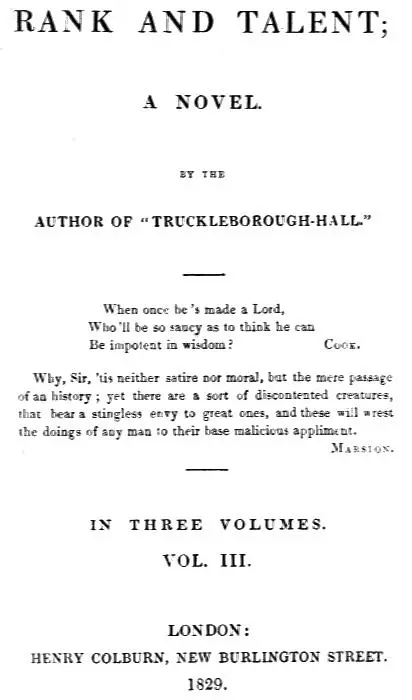
Rank and Talent; A Novel, Vol. 3 (of 3)
William Pitt Scargill
THE CLASSIC COLLECTION · 1829
"Rank and Talent; A Novel" by William Pitt Scargill is a novel written in the early 19th century. The story centers around the characters of Horatio Markham, a young barrister, and the Hon. Philip Martindale, who embodies the tension between social rank and moral character within the legal system and society. The opening chapters set the scene for a courtroom drama where class dynamics and personal grievances play a pivotal role in the unfolding narrative. The beginning of the novel introduces the excitement surrounding a trial taking place in the county-town, where Richard Smith, a poor cottager, is suing the wealthy Philip Martindale for assault and false imprisonment. The courtroom is filled with spectators eager to witness the clash between the oppressed and the powerful. As the proceedings unfold, Markham, though inexperienced, finds himself unexpectedly favored despite the derision of the seasoned defendant's counsel. The narrative also introduces John Martindale, Philip's relative, whose eccentric behavior and disdain for titles reveal a deeper commentary on wealth and status. Meanwhile, the aftermath of the trial and the consequences of Martindale's actions hint at larger themes of justice and morality that will likely permeate the rest of the novel.
Introduction adapted from the source catalogue; source summaries may be automatically generated.
Free to read · English · 57,394 words · No account needed
MAKE TIME FOR A GOOD BOOK
On by default. Untick to stop anonymous reading totals. Each page counts after 10 seconds in view. How this works.
Anonymous counting is on unless you have switched it off.
“And if thou ever happen that same way
To traveill, go to see that dreadful place.”
The following day dawned brighter. Though it was November, the sun had strength to struggle through the clouds; and much of the heavy weight that lay on Markham’s mind the preceding day was alleviated by brighter hopes and better thoughts. There was a pleasant re-action in his spirits, and he wondered how it was that he had been so depressed on the previous evening. He was cheerful and light-hearted in giving his orders concerning the removal of his luggage, and when he went aboard the vessel which was destined to convey him from England, he met with so flattering and complimentary a reception from the captain, that all the world seemed bright about him, and he trusted that he should not lack friends in a distant land. His thoughts rushed impetuously forward to the new scene which was about to open upon him, and he was pleased to think how many valuable introductory letters he possessed, and he hoped that acquaintances would, many of them, become valuable friends and agreeable companions. But we have no intention of accompanying our young friend on his voyage. Suffice it to say, that he sailed in good spirits, that the wind blew variously as it often does on a long voyage, and that he reached his port in safety.
We must return now to old Mr. Martindale and his family. His attachment to his family was continually increasing. He was more than pleased with his daughter, he was absolutely proud of her. He always spoke of her emphatically as my daughter. He consulted her wishes in every thing, and was always guided by her opinion, the least intimation of which was law to him. With all his oddities, and he had not a few, he had discernment enough to see that Signora Rivolta was really a person of solid understanding and of clear judgment. He only wondered how it was that a woman of such good sense should adopt the Roman Catholic religion; but on this subject he seldom touched, for he found that he could make no impression. With the Colonel, however, he would occasionally enter into an argument, and not unfrequently did he fancy that in these discussions he had the advantage. Colonel Rivolta was not a very zealous believer in the infallibility of His Holiness. He had never paid much attention to theology as a matter of argument or reflection; he did not know enough of his native religion to be converted to any other, though the side which he had taken in politics rendered him not very bigoted to the religion established in Italy. In religion he was a liberal, not a sceptic or an unbeliever; he had no doubts, for he scarcely ever thought of the subject. He had no wish to make converts, he was willing to let every one enjoy his own opinions; and he would never have taken the trouble to defend the Catholic religion against Mr. Martindale, but that he thought the old gentleman was fond of an argument, and he liked to indulge him. As for the religion of Clara, which is of the most importance to our purpose, it is rather difficult to define or describe it. Her education had been miscellaneous; she had been in early life initiated into the religion of Italy, but in after-years the conversation of Richard Smith, her great uncle, had somewhat disturbed and unsettled her mind as to the exclusive safety of the Catholic religion. Her strongest ground of attachment to that faith was, that it was the religion of her mother. There was, however, in her mind that degree of imaginativeness, that needed not so much external and visible aid to devotion as that religion presented her with, therefore she did not feel herself dependent on its forms. Truth compels us to add, which we do with a considerable degree of reluctance, that Clara Rivolta, during her residence at Brigland, had more than once said to her great uncle, that her principal objection to the Protestant religion was the indifference of its priests. This remark had reference, we ought to say, almost solely to Mr. Denver, the perpetual curate of Brigland; and every allowance ought to be made for him. It is no easy matter to serve three churches with a very lively and ardent feeling, especially when to the fatigue of the duty there is also added the toil of riding several miles on a tall, old, raw-boned, shuffling, stumbling, jumbling, broken-winded, and ill-saddled, iron-grey mare. Clara had never seen any other clergyman, except one or two who had occasionally been visiting the Hon. Philip Martindale during the shooting season. Of these gentlemen she knew nothing, except that whenever they met her, they stared very rudely at her. She formed her judgment of the English clergy from a very few and very so-so samples. Blending a respectable share of discrimination and reflection with an imaginative soul and a feeling heart, her religion was in the most comprehensive sense of the word purely Catholic. Outwardly her conformity was to the religion of her birth-place; and perhaps had she never been acquainted with any other mode, her devotion to that in which she had been educated would have been much stronger. But when she was instructed that religion was the medium by which virtue was impressed on the mind, and man made acceptable to his Maker, and when she was told that there was no salvation out of the pale of the Roman Catholic Church, and when she saw what real excellences and what solid virtues adorned the character of her maternal great uncle, then she thought it absolutely impossible that the religion of such a man could be otherwise than acceptable to his Maker; and thereupon, without the elaborateness of argument or the undetectable wiliness of sophistry, there entered irresistibly into her mind a spirit of liberality and pure Catholicism.
Your reading position is saved on this browser. Take it to another device with a library code. Reading pages adapt to text, rather than matching a printed edition.
William Pitt Scargill
William Pitt Scargill
BEHIND THE BOOK
This eBook is for the use of anyone anywhere in the United States and most other parts of the world at no cost and with almost no restrictions whatsoever. You may copy it, give it away or re-use it under the terms of the Project Gutenberg License included with this eBook or online at www.gutenberg.org. If you are not located in the United States, you will have to check the laws of the country where you are located before using this eBook. Read the source licence.
The original source file, including credits and licence, is retained by this library. Request an original-format copy at no charge. Please include the book title and Project Gutenberg identifier #53455.
KEEP YOUR CURIOSITY GOING
Coulson Kernahan

Maurice Baring
Frances Wright
Cécile Tormay

Frederic Jesup Stimson

W. H. P. (William Henry Pope) Jarvis