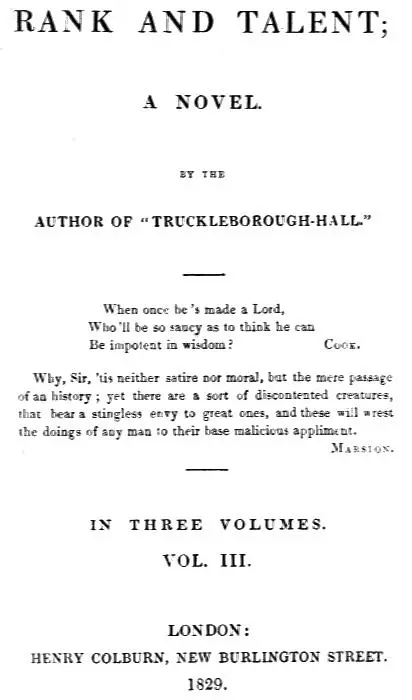
Rank and Talent; A Novel, Vol. 3 (of 3)
William Pitt Scargill
THE CLASSIC COLLECTION · 1829
"Rank and Talent; A Novel" by William Pitt Scargill is a novel written in the early 19th century. The story centers around the characters of Horatio Markham, a young barrister, and the Hon. Philip Martindale, who embodies the tension between social rank and moral character within the legal system and society. The opening chapters set the scene for a courtroom drama where class dynamics and personal grievances play a pivotal role in the unfolding narrative. The beginning of the novel introduces the excitement surrounding a trial taking place in the county-town, where Richard Smith, a poor cottager, is suing the wealthy Philip Martindale for assault and false imprisonment. The courtroom is filled with spectators eager to witness the clash between the oppressed and the powerful. As the proceedings unfold, Markham, though inexperienced, finds himself unexpectedly favored despite the derision of the seasoned defendant's counsel. The narrative also introduces John Martindale, Philip's relative, whose eccentric behavior and disdain for titles reveal a deeper commentary on wealth and status. Meanwhile, the aftermath of the trial and the consequences of Martindale's actions hint at larger themes of justice and morality that will likely permeate the rest of the novel.
Introduction adapted from the source catalogue; source summaries may be automatically generated.
Free to read · English · 57,394 words · No account needed
MAKE TIME FOR A GOOD BOOK
On by default. Untick to stop anonymous reading totals. Each page counts after 10 seconds in view. How this works.
Anonymous counting is on unless you have switched it off.
All these things had their weight; but it does not follow that because a young man considers, that he is therefore considerate. Powerful as consideration may be, feeling is much more powerful; and it has also an efficacy in overruling and influencing the decisions of the understanding, and cheating the judgment by a speciousness of reasoning. Thus it was that Markham, with all his sagacity, allowed himself to be imposed on. He reasoned thus:--Perhaps, if I leave England without announcing it to Clara, it may occur to her that I had some very powerful reason for such neglect of common politeness, and there may arise in her mind a suspicion of that which really exists, and then there may be in her mind a corresponding sentiment, which, if not cherished, may die away and be forgotten; and it would not be right for me to arouse such sentiments at such a time. It will be best then if I personally return the book, and very coolly and politely take my leave; yet, upon second thoughts, why should or need there be any thing of coolness in my manner. It will be most suitable to be perfectly uniform, and to take my leave in a friendly, cordial manner, as I have hitherto behaved towards her.
With this resolution he made his last visit, with a view of taking leave of Colonel and Signora Rivolta and of Clara, and of returning with thanks a book which he had borrowed from the latter. Books are very convenient for lovers; they are a species of Cupid’s go-cart; they are the gentle and gradual introduction of sentiment; they speak without blushing; they are fluent in the utterance, and they can tell many a tender tale by a doubled leaf, or a pencil mark; or a rose-leaf may mark an interesting page. When Markham talked to himself about a cool and quiet leave-taking and a friendly farewell, he did not recollect or deeply think of books interchanged, and of beautiful passages marked for their sentiment and pathos, and most peculiarly applicable to peculiar circumstances: he forgot how many striking passages and elegant extracts he had read aloud, and how much force and energy he gave, or attempted to give, to these expressive and select beauties: he forgot how many associations were connected with books. There was also another circumstance which of course did not occur to him. Clara Rivolta was not situated as any young woman of English family and extensive acquaintance; she had not seen much of society; Markham was the only young gentleman with whom she was at all acquainted; and those few other persons whom she had seen did not make any favourable impression on her mind. By comparison therefore with them, Markham was highly agreeable to her, and positively also was he not unacceptable, inasmuch as Clara herself had no slight tincture of what may be called pedantry. Confined intercourse with human society produces, almost of necessity, some degree of pedantry, which is nothing more than an undue estimate of the importance of some one object of human interest or pursuit. Clara had lived secluded, had been much alone, was of a poetical and almost romantic temperament, had contemplated humanity and its interests through the medium of imagination and poetry; she had lived in a world of her own, and the world of reality was to her thought harsh, rough, and ungracious. When therefore she met with Markham, who had also an imagination somewhat poetical, and a decided taste for the lighter and more graceful productions of genius; and when she saw this young gentleman brought into immediate contrast with an uncourteous and rude coxcomb, as he was at the trial, her opinion of him was flattering; and when, after farther acquaintance, she observed that his mind was well-cultivated, his manners gentle, his deportment essentially and decidedly courteous, and when he had taken great pains to render her well pleased with scenes about her, and to communicate information to her on such topics as she felt interested in, she became more and more pleased with his society, always happy to see him, always happy to hear him, disposed to acquiesce in his judgment, and to be guided by his opinion; and above all, as there was not in her heart any previous attachment, very naturally her affections rested more tenderly on Markham than she was well aware.
Your reading position is saved on this browser. Take it to another device with a library code. Reading pages adapt to text, rather than matching a printed edition.
William Pitt Scargill
William Pitt Scargill
BEHIND THE BOOK
This eBook is for the use of anyone anywhere in the United States and most other parts of the world at no cost and with almost no restrictions whatsoever. You may copy it, give it away or re-use it under the terms of the Project Gutenberg License included with this eBook or online at www.gutenberg.org. If you are not located in the United States, you will have to check the laws of the country where you are located before using this eBook. Read the source licence.
The original source file, including credits and licence, is retained by this library. Request an original-format copy at no charge. Please include the book title and Project Gutenberg identifier #53455.
KEEP YOUR CURIOSITY GOING
Coulson Kernahan

Maurice Baring
Frances Wright
Cécile Tormay

Frederic Jesup Stimson

W. H. P. (William Henry Pope) Jarvis